Very low key end to the year

So here we are on the last day of 2008. I’m writing this suffering all the discomforts of a flu-like infection but it seems from talking to friends, I’m not alone. Everyone seems to have either recently gone down with something similar, or have someone close who has. So I mustn’t be too self-pitying!

But that’s not the only reason why I feel a bit depressed. After the initial euphoria of my decision to acquire MYRO, sadly I forced myself to have a rethink. I decided that as much as I dearly wanted to have MYRO, I could not allow my heart to rule my head. At this time of credit crunch and with a small business to run that everything depends on, I did not think it wise to go ahead with the purchase just now. And especially bearing in mind that I still don’t yet have my microlight licence and a reasonable amount of expenditure will be needed for that.

So there we are. A sad way to leave 2008 but who knows what 2009 will have in store. Maybe it will still be possible in the Spring. I hope and like to think so, anyway.

On that note may I wish everyone a Happy New Year and express the hope that it will be a safe and peaceful one for you and yours.

Very exciting

So here we are, heading towards the fag end of the year and we’re back into that constant dreary weather again when, if it’s stopped raining, it must be just about to start again. The last week or so has been very dull and soggy with very few bright spots – not microlight weather at all.

And while we’ve had downpour after downpour, poor old MYRO, the AX3 that I started on, has been left out in the open. Not totally out in the open mind – its wings have been under cover hanging on the wall of a hangar but its fuselage and tailplane have been standing outside with a tarpaulin over, on a small trailer. Its engine and a few other bits and pieces have been moved over to MZEL, the new aircraft, and it’s now out of check, of course, but just as was MZEL before, MYRO would soon be flyable again with those parts replaced.

I spoke to Rosie a few weeks ago about the possibility of buying MYRO off her but at that time we left things hanging. But I know we’ve both been thinking that MYRO mustn’t be left out in this kind of weather for too much longer, even with a tarp over, as the tail section is still uncovered and water will start to get in and have its effects in vital areas.

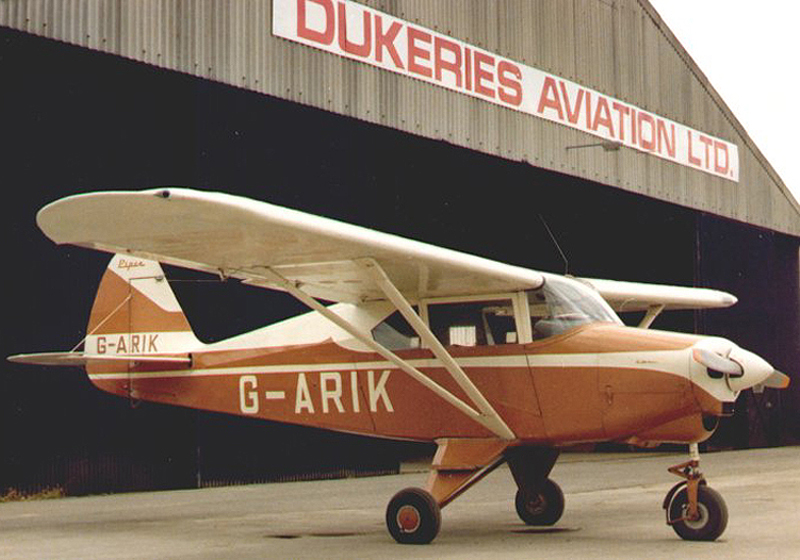
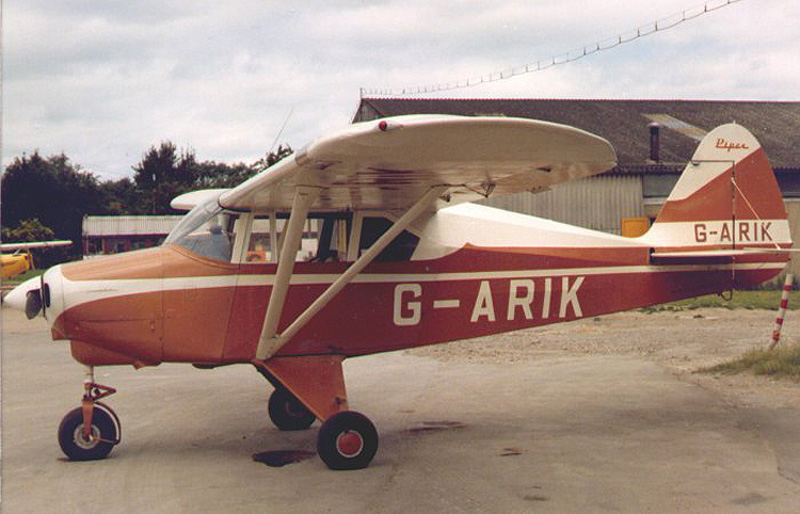
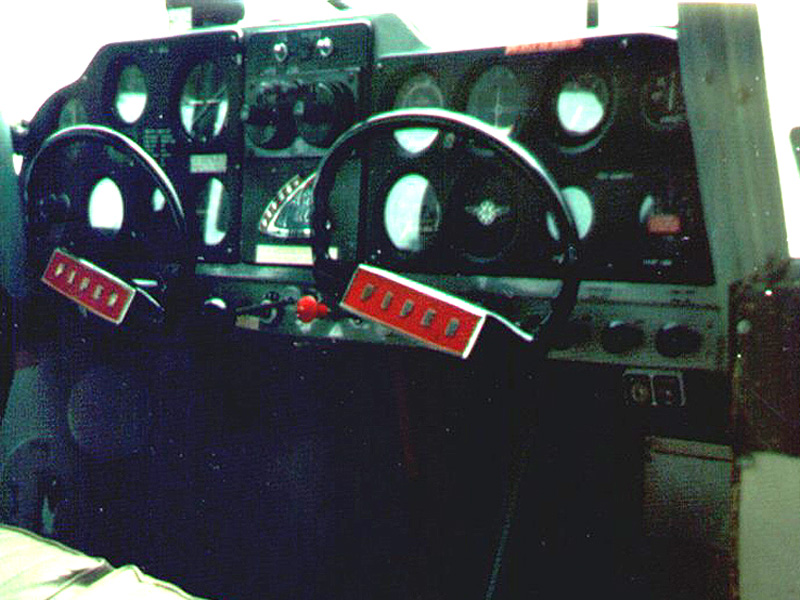
Well, we spoke a bit earlier today and MYRO came up in the conversation. And I’ve now definitely decided to buy it. It’s very exciting and it takes me back 30 years to when I decided to buy G-ARIK, the Tri-Pacer I used to own.

null

null

null

The circumstances are amazingly similar. Now as then I’m stll in the middle of getting my Licence and now as then the aircraft is out of check and was left out in the weather. Getting the Tri-Pacer airworthy was a much bigger job, though, as it had been left out in the open during the winter of 1976/77 which is still one of the worst in living memory with enormous amounts of snow and ice and very low temperatures. And it had to get through the much more stringent Certificate of Airworthiness as compared to the microlight’s Permit to Fly.

I’m very excited. MYRO needs to be moved under cover ASAP really. I hope it will fit into my garage so I’ve got to get that clear of all the junk that’s filling it up at the moment and then it can be brought home. It leaves me with a double problem, of course. I’ve still got to finish off Our Trike that’s in the workshop at Ken’s as well as do what’s needed on MYRO. But so what! Sometimes you just have to decide to do what you know you must 😉

Measles……hmmmmm

You just can’t help making words out of 4-letter UK registrations that automatically become the names of the aircraft. The old AX3 was and always will be referred to as MYRO by anyone who knew and flew in it. Now that’s all very well when the name is friendly, somehow, like MYRO – sounds as though he’ll always be looking out for you up there (strange, but MYRO sounds masculine to me whereas we usually think of aircraft as feminine, like boats). But what if the name er….. isn’t?

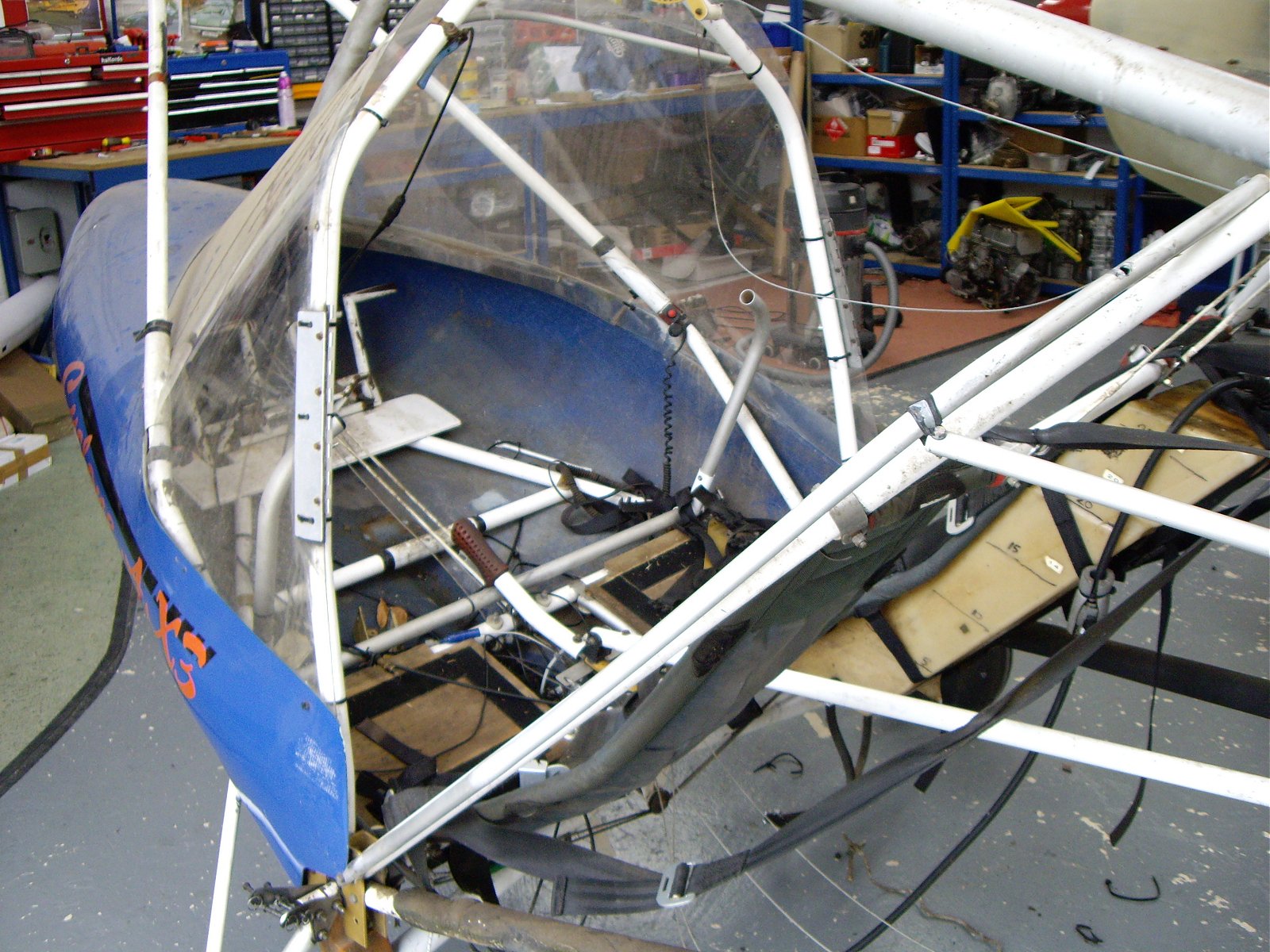
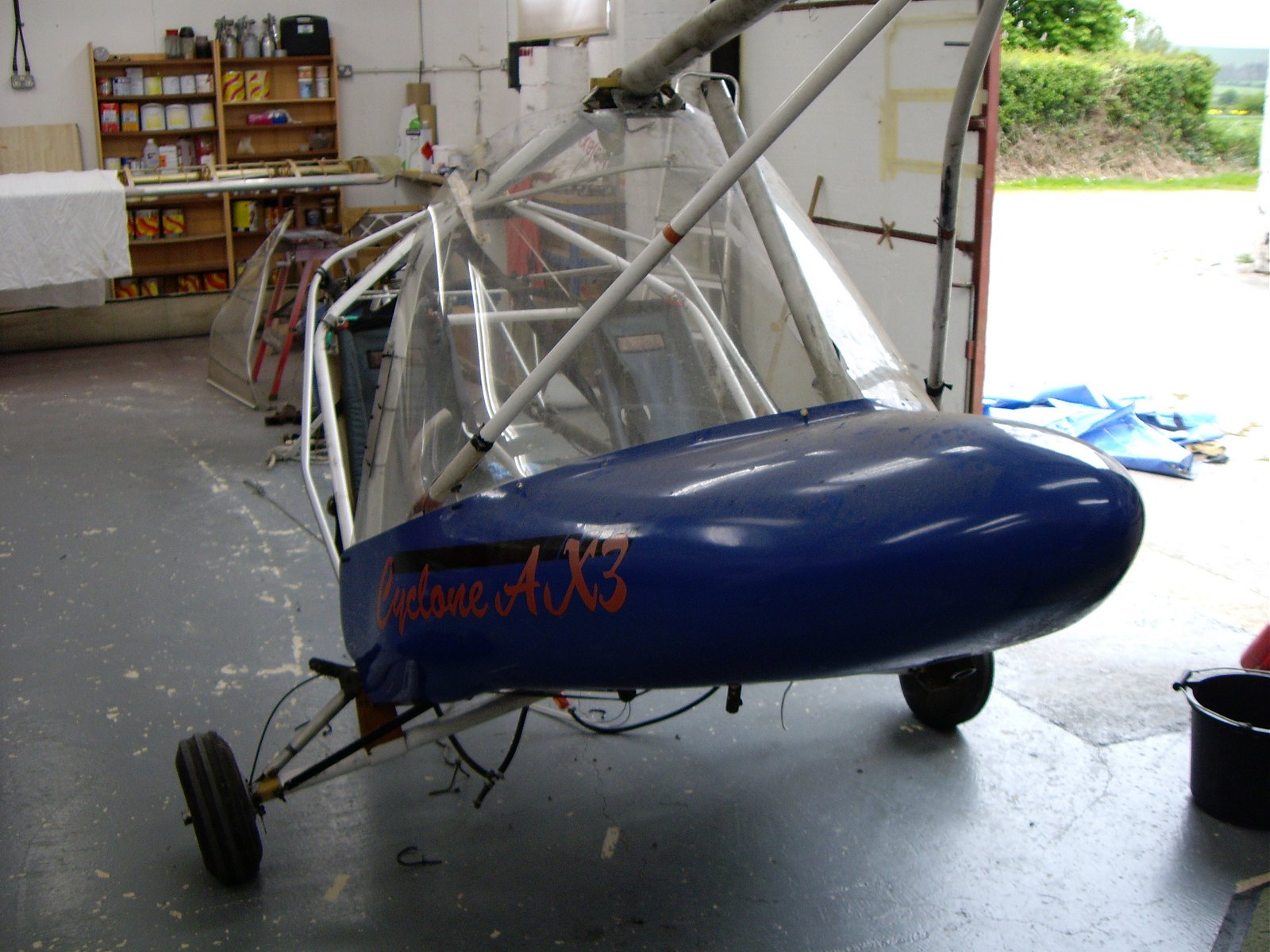
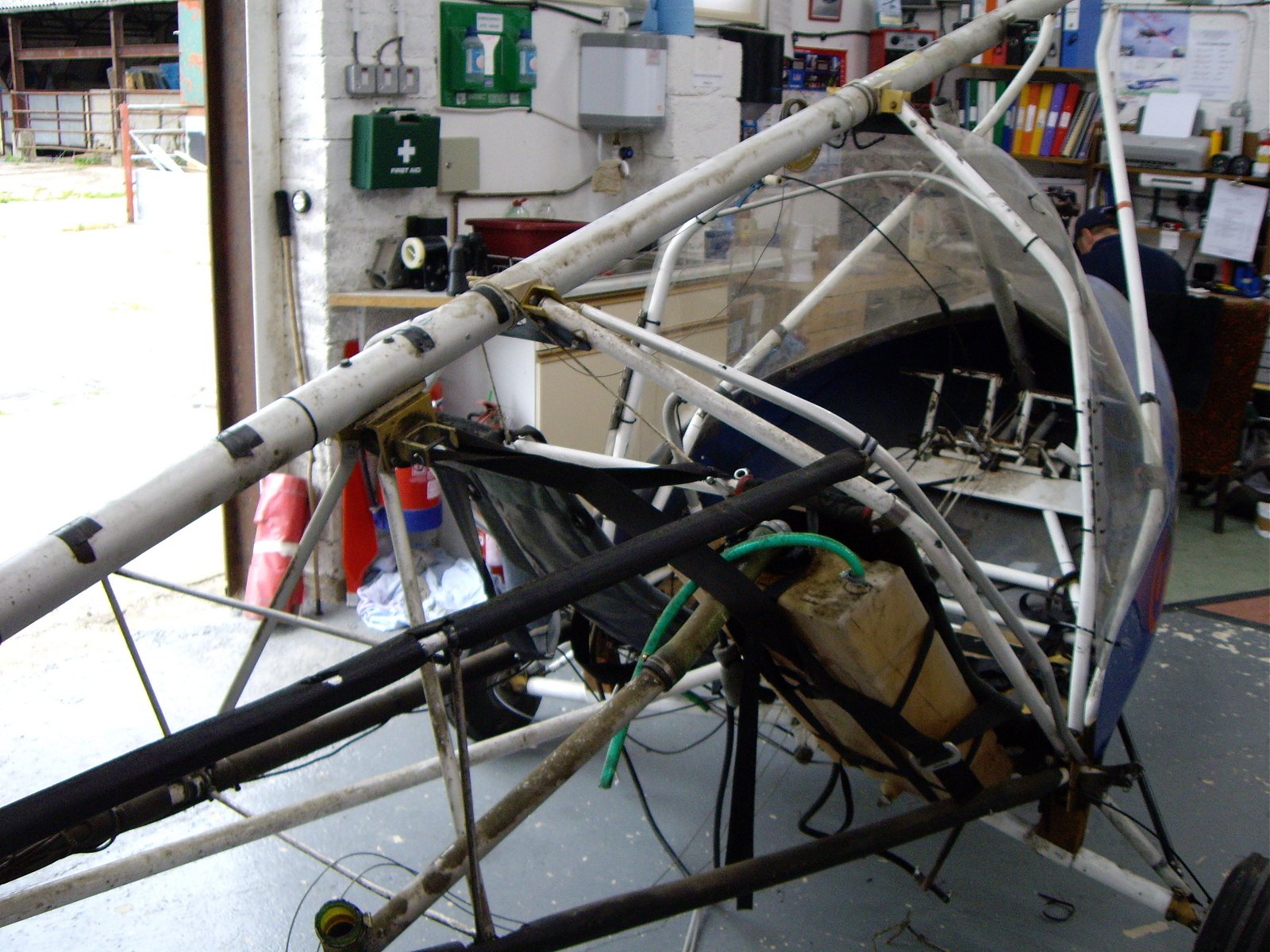
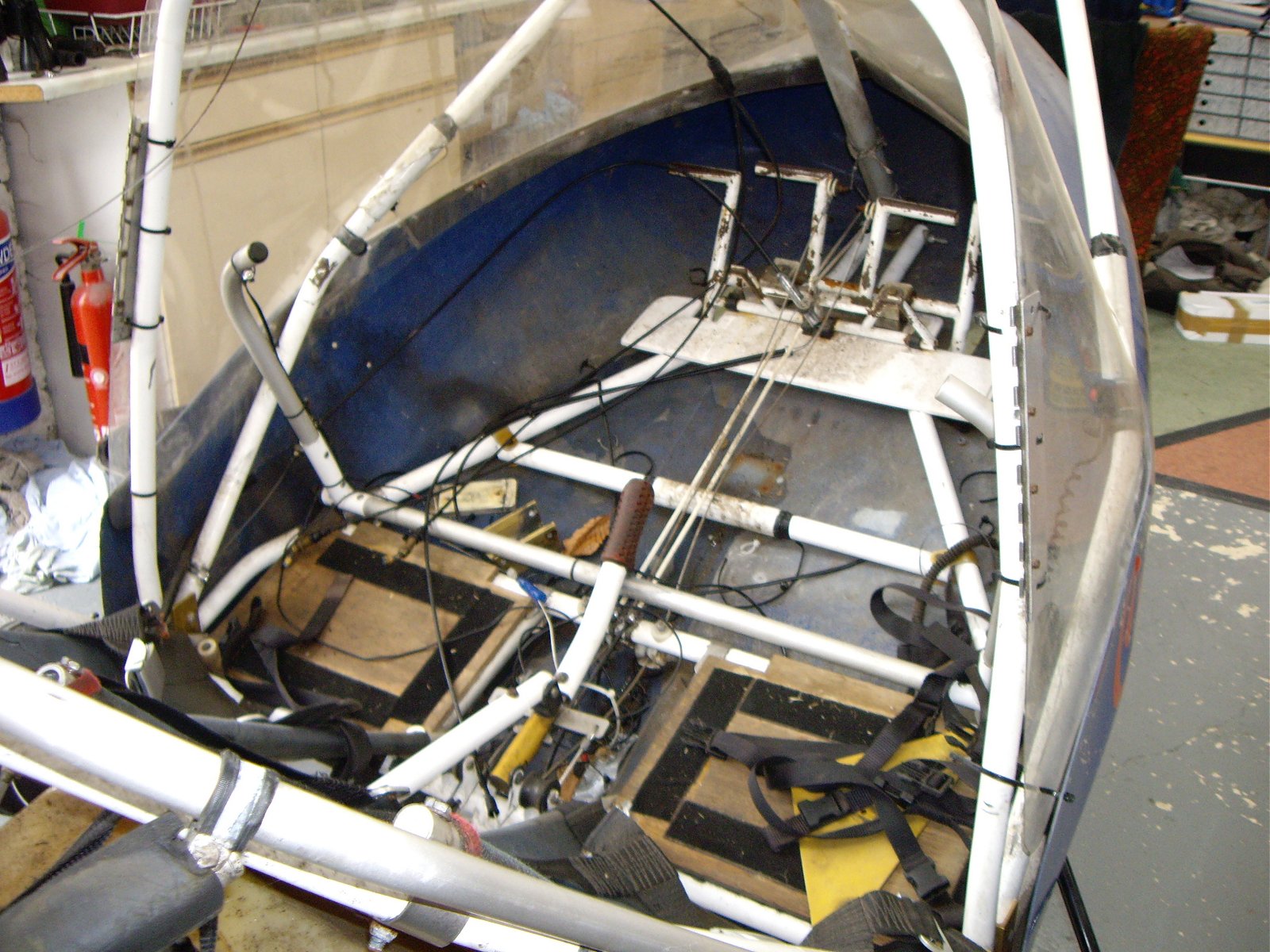
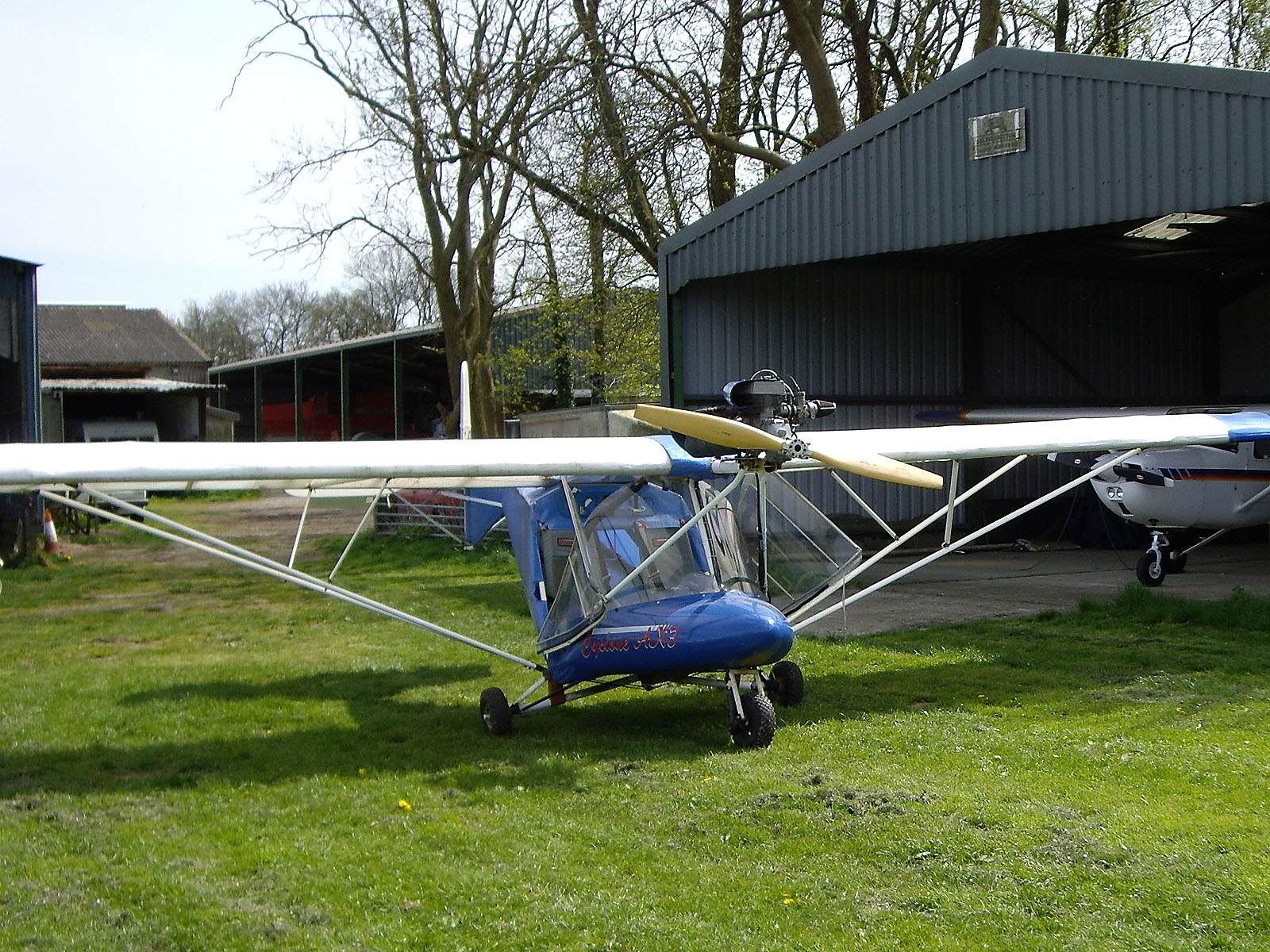
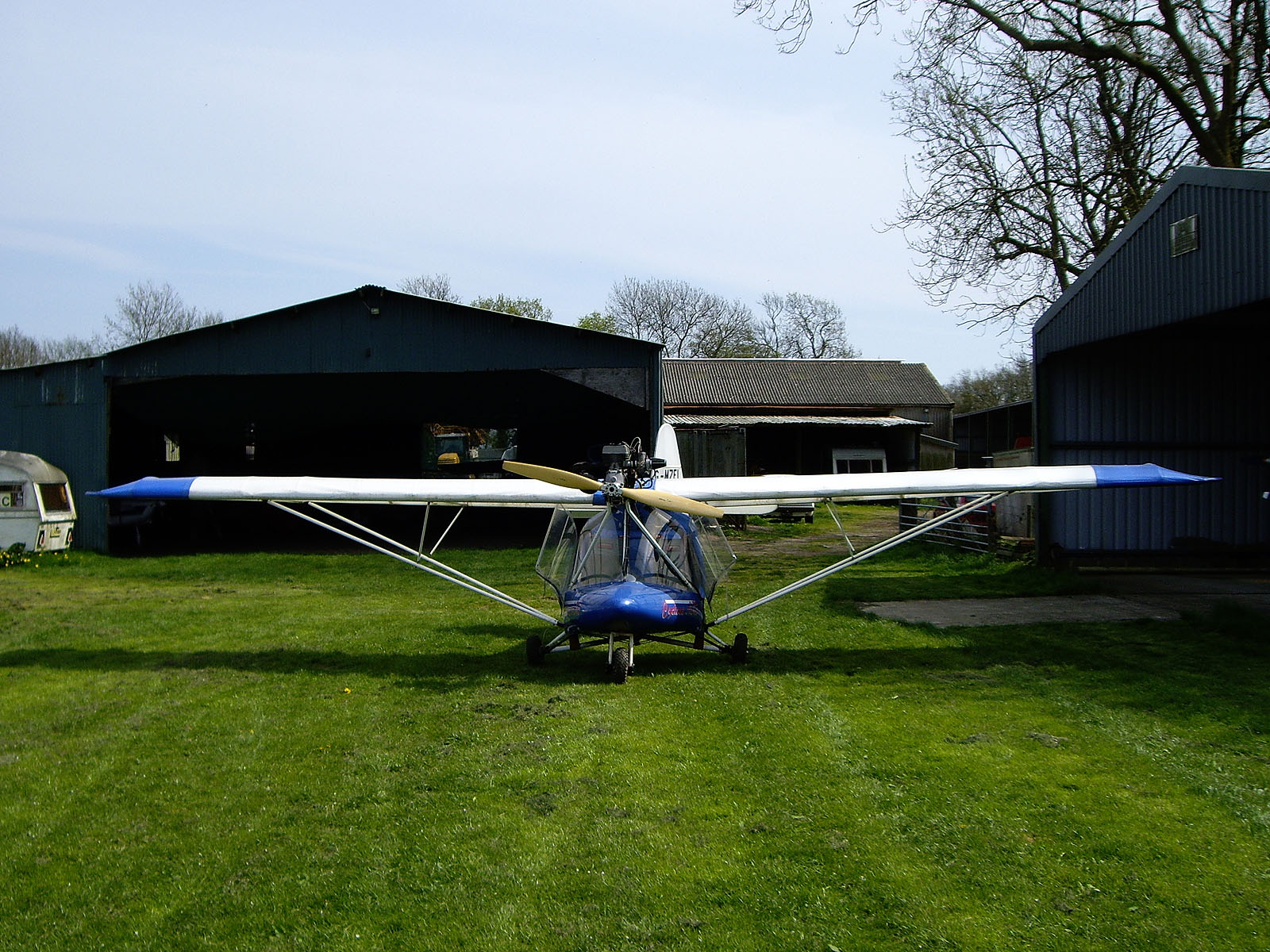
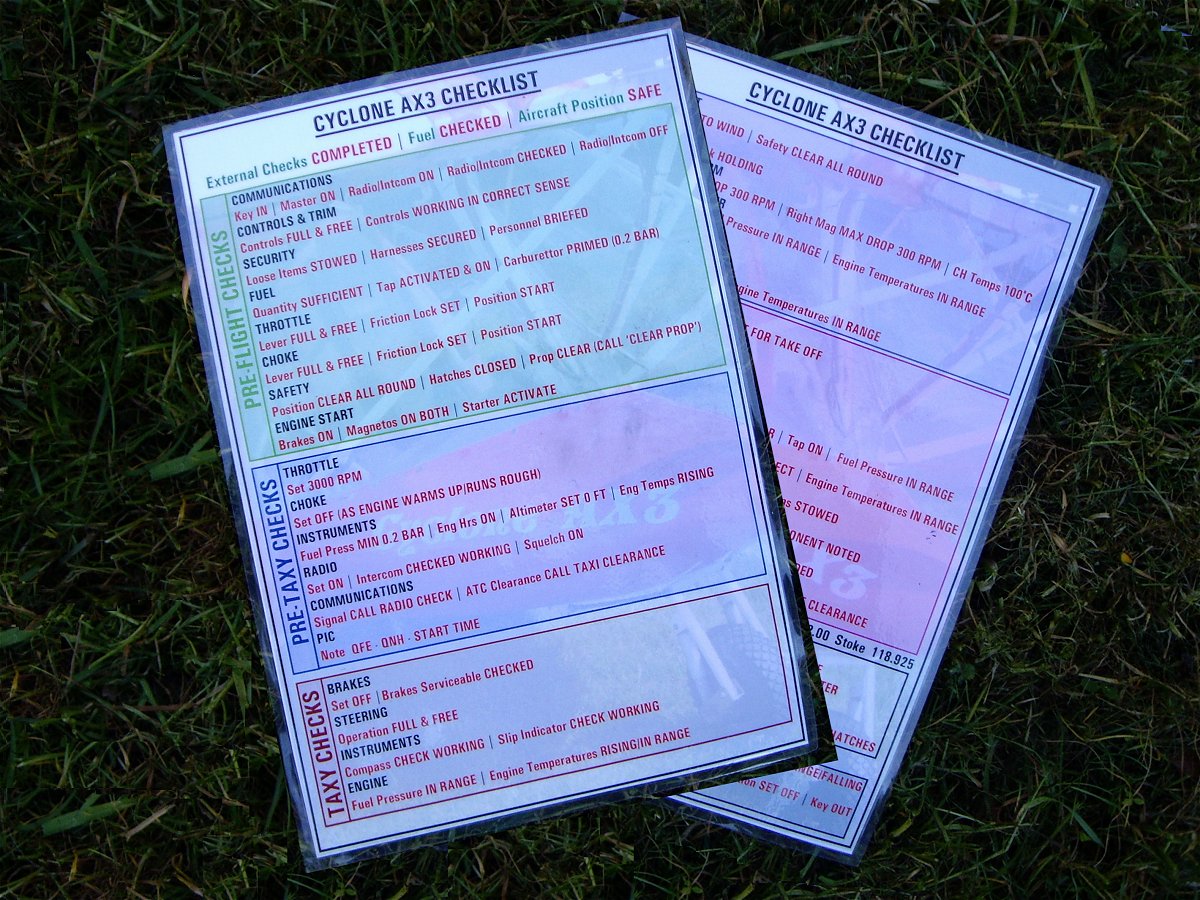
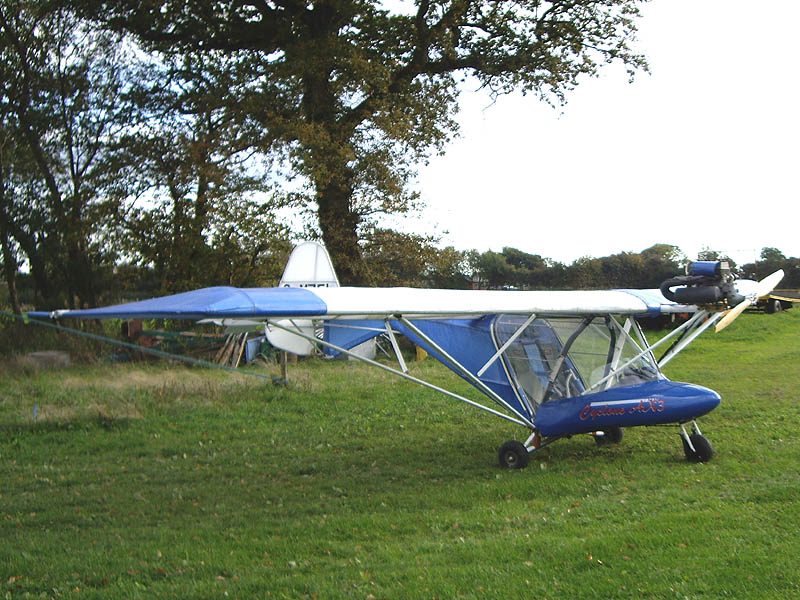
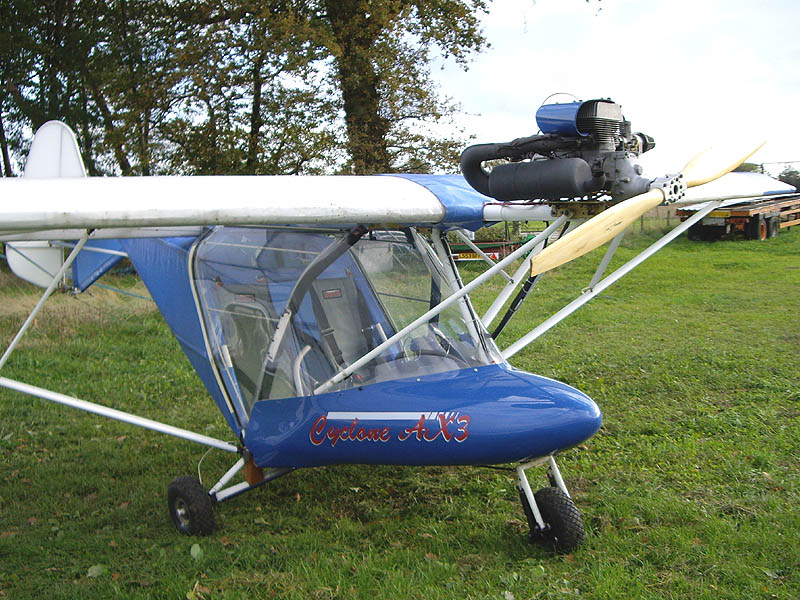
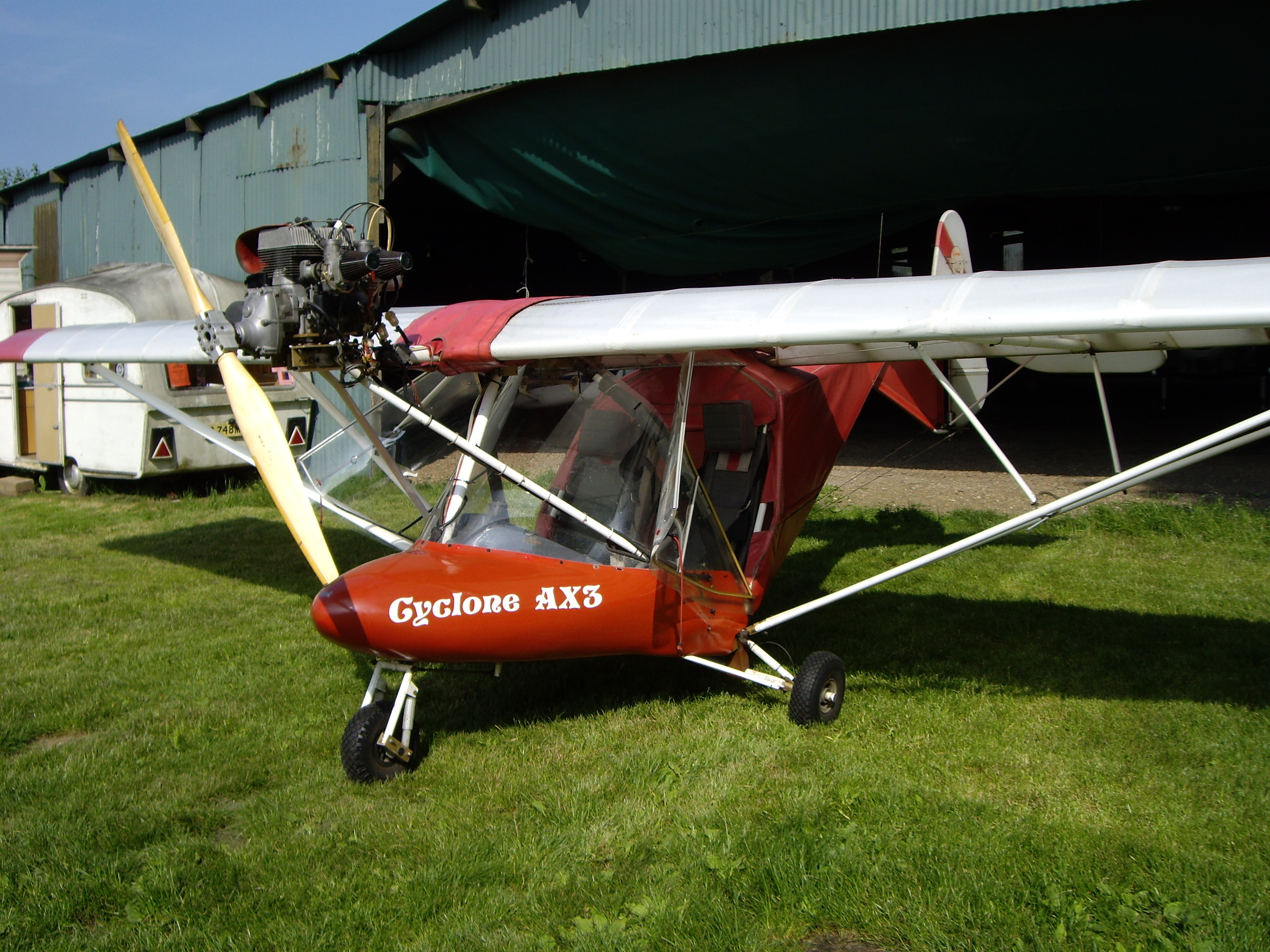
Allow me to introduce you to Measle ….. sorry, G-MZEL, the new AX3. Come on now, stop sniggering. She can’t help her name after all. Sure, we’ll get to love it in time, but it is a bit strange, isn’t it. Anyway, she’s a good little looker (especially for her age, but don’t let her hear you say that), as you can see from the following pics (click on them to see larger versions).

I managed to sneak away yesterday afternoon and got in an hour in MZEL. I was very happy at the end of it because I think I put in my best series of take-offs and landings that I’ve done in the microlight so far. I was always very proud of my landings but 20 odd years is a long time and like it or not you do get rusty. Plus age does take its toll and I have to grudgingly admit that my foot-hand coordination isn’t what it used to be. Sad but true.

But yesterday was a time for a small personal celebration, not for thinking about what used to be. There’s always room for improvement but yesterday I felt that I really could see some progress.

And let me tell you something else, especially all you flyers out there who think that microlights are not real aircraft. Having now flown both microlights and Group A light singles, I have to say that the former are much more tricky, at all times and especially in the landing phase. You can’t just set it up, trim and sit back – you have to fly it with constant control inputs the whole way to the ground. Greasers are far easier IMO in a Group A. And the same applies in level flight. The microlight is constantly at the mercy of the wind and weather. Even in fairly docile conditions like yesterday, due to the lightness of the microlight, it’s easy to find enough lift on downwind to gain 200 feet or more when ideally you want to fly level and you’re thinking about descending! It’s fun flying to be sure 🙂

Back up there

Got 1hr 20mins in last Sunday I’m glad to say, in the new AX3, which is a very tidy little machine. Whereas MYRO has a couple of thousand hours on it, the new one only has a few hundred and it shows. I’ll do a couple of pics when I get the chance.

The trouble with having such a large gap between flights (I last flew on July 26th) is that you have to spend so much time on revision. And you get rusty, even in just 2 or 3 months. While practising slow flying, we just began to enter the stall and my reactions were far from instinctive. Not good at all.

I’m typing this on Friday morning. Looking out of my window the sky’s blue and clear and there’s little or no wind. I’ll ring Rosie soon to see how things stand for flying this weekend. Alternatively, if I get all my jobs done and it’s quiet this afternoon, might even sneak off for a flight later.

I’ll let you know how I get on 😉

Quiet spell

In every sense. We’ve just enjoyed over a week of what must have been the best spell of good weather for the whole of the year so far. Steady high pressure over most of Great Britain has meant clear days, light winds but clear chilly nights. Last night was very cold for the time of year where we are.

But only one problem – when the replacement AX3 had been finished and been given its ‘Ticket’ (Permit to Fly), because the weather was still so poor, Rosie decided to nip off for a holiday. So that has meant no flying for me! I had to watch as the occasional Shadow, Thruster and weight-shift have buzzed by overhead. She’s back tomorrow but true to form, looking out of the window while I type this, it looks as though the calm weather is beginning to break up. 😕

The other worrying thing is this ruddy financial crisis we’re currently all going through. For me, July and August were also quiet months in my business, but then again they usually are, as folks go off for their Summer holidays. There’s been the usual pick-up in September but the jury’s out, and will be until October or even later really, on whether business will get back to anything like normallity. Until then, although I’ll keep my flying with Rosie going, I’ll not risk over-committing myself too much financially especially with the general cost of living (gas, electricity, food 😯 ) being so much on the up.

A somewhat depressing end to a rather below-par Summer really… 🙁

Oh dear, here we go again…

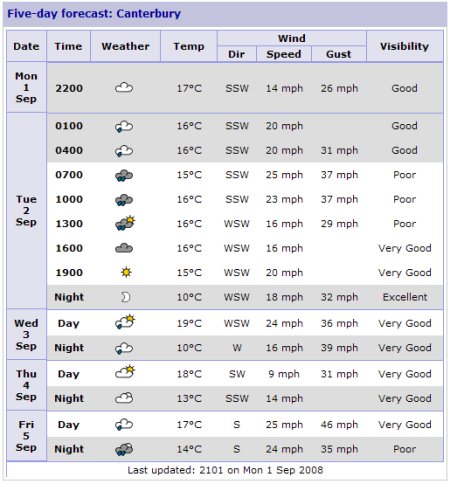
Phoned Rosie yesterday and there’s a good chance that the new AX3 will be serviceable later this week. So we pencilled in Thursday or Friday as possibilities for my next session. So I just looked at the 5-Day Forecast for Canterbury (the nearest large town – city actually) and this is what I found.

Canterbury 5-Day Weather Forecast

Can you believe it. Here come the high winds all over again. Take a look at Thursday – sunny intervals, visibility very good but wind at 9 mph gusting 31 from the south-west!

And if that’s not bad enough what about Friday – occasional light rain but wind from the south at 25 mph gusting 46!!

It’s almost unbelievable that we’ve had such consistently bad weather for so long – and apparently there really is no end to the spell in sight. I guess in a few days we can expect to be hit by the remnants of Hurricane Gustav and goodness knows what that’ll have in store for us 😕

At this rate there’s a danger that flying will become an endangered sport in the UK….

Waiting, just waiting….

So here we are, the last day of August. Yesterday the weather here in the South of England was a scorcher – around 80 degrees Fahrenheit – but today is totally different. Sky is low, dull and completely overcast and we keep getting sprinklings of drizzle. Not much wind though, which is something I suppose. That dropped, at last, several days ago, not that there have been that many good ‘flying’ days since I was last airborne. But flying, in the AX3 at least wasn’t an option anyway.

The reason is that Rosie has had another, better, AX3 stored in her garage for some time. The time for G-MYRO’s annual check came round at the end of August so she decided rather than renew MYRO’s permit, she would swap the engine (and a few other bits and pieces) over from MYRO to the other AX3 and get that flying instead. She thought it would take a couple of weeks or so and that as the weather was not too good anway, to start the work at around mid-August.

Well, we all know what happens with the best-laid plans. The change-overs all went ahead as planned and the time came for the new AX3 to be inspected, weighed and permitted. Without going into detail, a complication has arisen to do with weight-and-balance and the calculated position of the aircraft’s Centre of Gravity. It looks as though one of the ‘standard moments’ used in the calculations is incorrect and until that has been resolved, the aircraft can’t be permitted.

Now we have to wait for the (slow) wheels of bureaucracy to turn and until they do, we just have to keep waiting. Anyway, hopefully I’ll be back flying this month – and as my last flight was on July 26th, it can’t come soon enough.

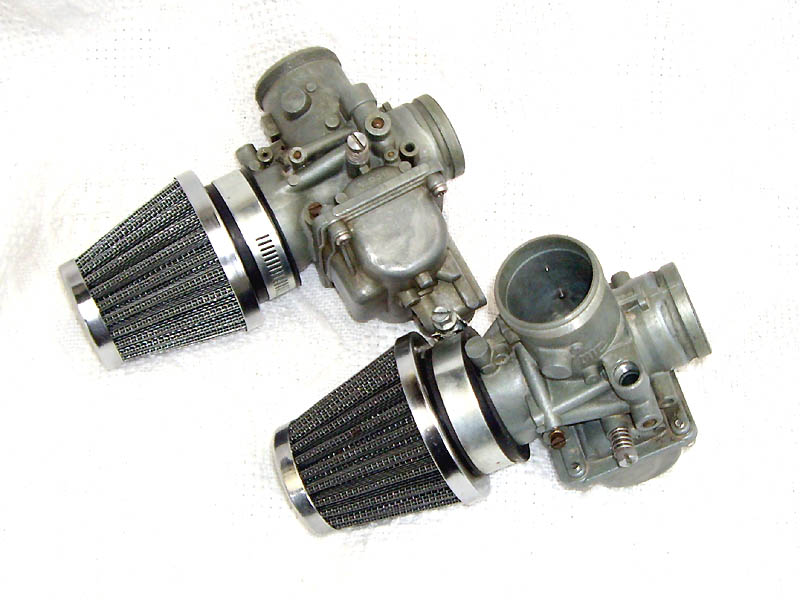
Just realised, after all the somewhat lengthy trials and tribulations involving The Gauge on Our Trike, I forgot to mention that I got the one that Dave kindly sold me working. It was quite a relief let me tell you! Since then, I’ve unfortunately been unable to get any more done. With time passing, I have to get the carburettor tuning sorted out. I found while running the engine to test The Gauge that even when warm, if you close the choke much beyond half-way, the engine stops. In a microlight, that’s not good 😕 If that’s not sorted out it’ll never get its Permit even if everything else is sound. So that is now my next priority and hopefully I’ll see what I can do about it next weekend.

Blow It!

Both Manston and Lydd are looking at 45 knot gusts today – that’s something like 54 mph! The Silver Birches and other trees outside my window are being bent over and hurled around by the wind and the ground beneath them is littered with twigs and small branches that have healthy green leaves on them. We are becoming desperate for some high pressure to get these winds to drop but the forecast for the rest of the week is just as dismal. And the long range forecast for August is predicting more of the same.

I can’t in all my years remember a year like this. We thought last year was bad enough but this is even worse 😯

On the upside (there is one?)….Dave’s gauge arrived this morning. At least I can look forward to fitting that this weekend 😕

Bit Of Luck!

The lows and highs of getting an old microlight flying again…

After the disappointment of  the weekend with The Gauge (see how it has now assumed an identity all of its own 😕 ) I asked over on the BMAA forum whether anyone happened to have a spare one lying around. And Dave did have! So we’ve done the deal, the cheque’s in the post and soon it’ll be winging its way down courtesy of the Royal Mail.

What a bit of luck! Checked with the UK supplier and the news was that this is an old gauge which isn’t very popular any more (people want separate gauges nowadays). Apparently there is a model reference for it but the actual gauge isn’t even in their catalogue now. It could still be ordered though, but would probably have to be specially manufactured in the USA and the lead time would therefore be something like 7 to 8 weeks 😯

But not as much luck with the weather though. The storms and high winds still keep roaring through almost without respite. This is more like Autumn weather – and bad Autumn weather at that. Last night we had a massive downpour in the early hours and although it’s now bright with a fair bit of white cumulus scudding across a blue sky, the winds are blowing a gale (well seems like a gale… 🙄 ).

The strip I’m flying out of is mid-way between Lydd and Manston in East Kent at an elevation of 410 feet, so it’s fairly susceptible to winds anyway and is also close enough to the English Channel to feel the effect of Sea Breezes. Its weather is more like Manston than Lydd and here’s today’s TAF for Manston.

EGMH 120903Z 121018 23022G37KT 9999 SCT018 PROB40 TEMPO 1418 4000 SHRA TSRA BKN014CB

TAF stands for Terminal Airport Forecast and it’s intended to inform pilots flying into or out of an airport what weather conditions they should expect. Here’s what it tells us.

The TAF was issued on 12th August at 9.03am local time. It’s valid between the hours of 10.00am and 6.00pm and the forecast is as follows. Wind from the south-west (230 deg) at 22 knots gusting 37 knots. Unlimited visability with scattered cloud at 1800 ft. For a while (TEMPO) between 2.00pm and 6.00pm (the end of the TAF, so it may go on longer) there’s a 40% probability to expect visibility to drop to 4000 metres in rain showers and heavier rain associated with thunder storms and broken storm cloud at 1400 ft. What a great weather forecast for August in the UK! Unflyable in an AX3 that’s for sure 😐

Sighhhhhhh……. đŸ˜„

Oh Dear…

Sadly, the saga of The Gauge drew to its inevitable conclusion this afternoon. One way or another it had to.

Connected up the new thermocouple sender unit but after starting the engine and letting it warm up for several minutes, there was absolutely no sign of a temperature reading on the gauge. Disappointing but not wholly unexpected, I suppose.

I’ll never know whether the gauge was fully functional or not when I got hold of it and it’s possible I was on a hiding to nothing right from the beginning. But in all honesty, close reading of the manufacturer’s web site did reveal that connecting the gauge incorrectly would probably lead to irreversible damage, which is probably what happened. Thermocouples only generate very small currents so it seems likely that if, during my ‘experimentations’, I inadvertently connected the RPM wires to the CHT gauge, the relatively much higher currents involved could have blown the internal circuitry.

So that’s it then. We’ll have to get hold of another one – I guess probably a new one this time. Another time consuming setback. Very frustrating indeed. 🙁

Hooray!

Well, half of one really. It was important to do something about the problem gauge which has now wasted an awful lot of time and quite considerably delayed our getting Our Trike back into check. Just so people know what I’m talking about, this is what the gauge looks like.

null

Cylinder Head Temperature is shown on the left hand scale and Engine RPM on the right. The gauge is a used replacement as the original had been damaged, and as the connections had also been messed up, I’d not been able to get it working after replacing the wiring as I didn’t know which wire was supposed to be connected where.

I had the idea a few weeks ago of asking for advice on the BMAA Forum and within a very short time was pointed towards the manufacturer’s web site where there is a diagram showing the connections for a similar model. This is what the connections on the back of the gauge look like.

null

The gauge is in effect two gauges combined. The RPM connections I was advised, consist of a link to the magneto (which creates the engine spark) on one side and an earth on the other. The CHT connections go straight to a thermocouple (remember from school, two dissimilar metals that are in contact that create a small current when the junction is heated up). The thermocouple is held against the cylinder head by being screwed down under one of the spark plugs – pretty simple really but quite effective. It was easy to trace the thermocouple connections and according to the gauge manufacturer’s diagram, they should then be connected to the pair of connections on the back of the gauge numbered 3 and 4. Simple.

That just left connections 2 and 5 for the RPM gauge, with the ‘live’ on 2 and the earth on 5, according to the diagram. Marvellous! 🙂

Dave on the BMAA forum had suggested that I checked things out with an electrical multimeter which was a good idea that hadn’t occurred to me even though I have an excellent Robin at home. So that’s what I did. Disaster!. It seemed to me that with the connections as they were, they were all ‘shorting’ out! The only way I could prevent it was by breaking the RPM ‘live’ connection, so back I went to the BMAA forum.

‘Yes’, said Dave, ‘It would appear that way but actually they’re not’. I had asked if anyone knew where I could get an ‘official’ wiring diagram for the Robin engine that showed exactly how the connections should be done and almost straight away, Ginge posted the following one.

null

I’d said that the original connection had been made into a yellow wire which was in a group emerging from the magneto housing, and if you look carefully at the area ringed in red, you’ll see that that’s exactly how it should be. Dang! I’d broken that connection so now I’d have to remake it. 😐

And that’s what I did this afternoon. And guess what – afterwards we had an Engine RPM readout!

But still no CHT reading. And then I remembered. When I bought the gauge, the seller also gave me a Rotax Water Temperature gauge (which Our Trike doesn’t need because it’s air cooled) and a rolled up length of what I’d thought was old wire. When I got it out and unrolled it, sure enough it was a thermocouple. So the question is, is our existing thermocouple not compatible with this gauge and will this ‘new’ one work? I don’t know – I didn’t have a plug spanner with me so I couldn’t swap them over. That will be a job for next weekend.

But at least with Engine RPM I’m half way there. So it’s half a Hooray! anyway 😉

Phewww….

What a relief. For reasons I won’t bother going into, I had to transfer the Our Trike web site over to a new web hosting company. I was really worried because quite a lot of work had gone into setting it up and I didn’t know if it could be transferred and keep all its posts, pictures and comments. 😕

It turned out that although a bit of effort was involved, my fears were groundless. WordPress had already thought about it and provided an export/import system that handled all of the main problems for me. Cleverly, their system wouldn’t let me import my exported file without upgrading to the latest version, which was fairly effortless and painless. Only problem was, for those who know WordPress, the Dashboard had a new layout and a whole bunch of unwanted default pages that I’d originally edited or deleted in the old installation, were reintroduced and I had to poke around all over the place trying to find out how to delete them all over again. 🙄

But I’m glad to say, I did the job in an evening and as far as the outside world is concerned, nothing appears to have changed. What a relief. 😯

I’ve moved over to UKGold Domains and Web Hosting, a new company here in the UK which is just being launched by someone I know. 😉 If you’re interested you can find them at http://ukgold.com. They offer a great range of highly competitive web hosting packages and I think Our Trike is now set up for the future. 🙂

Ruddy Weather!

Day after day – winds something like 12 gusting 25 mph and as if that’s not bad enough, typically something like 60 degrees of directional variability also. In layman’s terms that means that the wind is not only constantly doubling in speed and then abruptly falling back again but it’s also wildly swinging around in direction, from side to side. And this is July – mid-Summer here in the UK for goodness sake, and there seems to be no end to it in sight!

It’s becoming so frustrating. OK, you can fly  an AX3 in these conditions, although it’s not much fun because you’re constantly being buffeted around and you’re needing to work all the time to maintain steady flight. But training in such conditions is pretty hopeless, as I’ve been finding. To learn effectively you need to be able to repeat the same procedure time after time in conditions that are reasonably constant, and that just hasn’t been possible for several weeks now.

To cap it all today, Rosie and I decided that as the day was also forecast to be hot and sunny with almost clear skies that would inevitably lead to severe up-draughts (what is known as thermic activity), we would wait until 6.00pm until things would have calmed down before giving it a go. I have to drive 50 miles each way to the strip which is quite a commitment, really. You’ve guessed it – after getting there today and waiting a while to assess the conditions, we decided that the wind was still up to its tricks and that it would be a waste of time going for a training flight. So we put the AX3 back in the hangar and I left for home again.

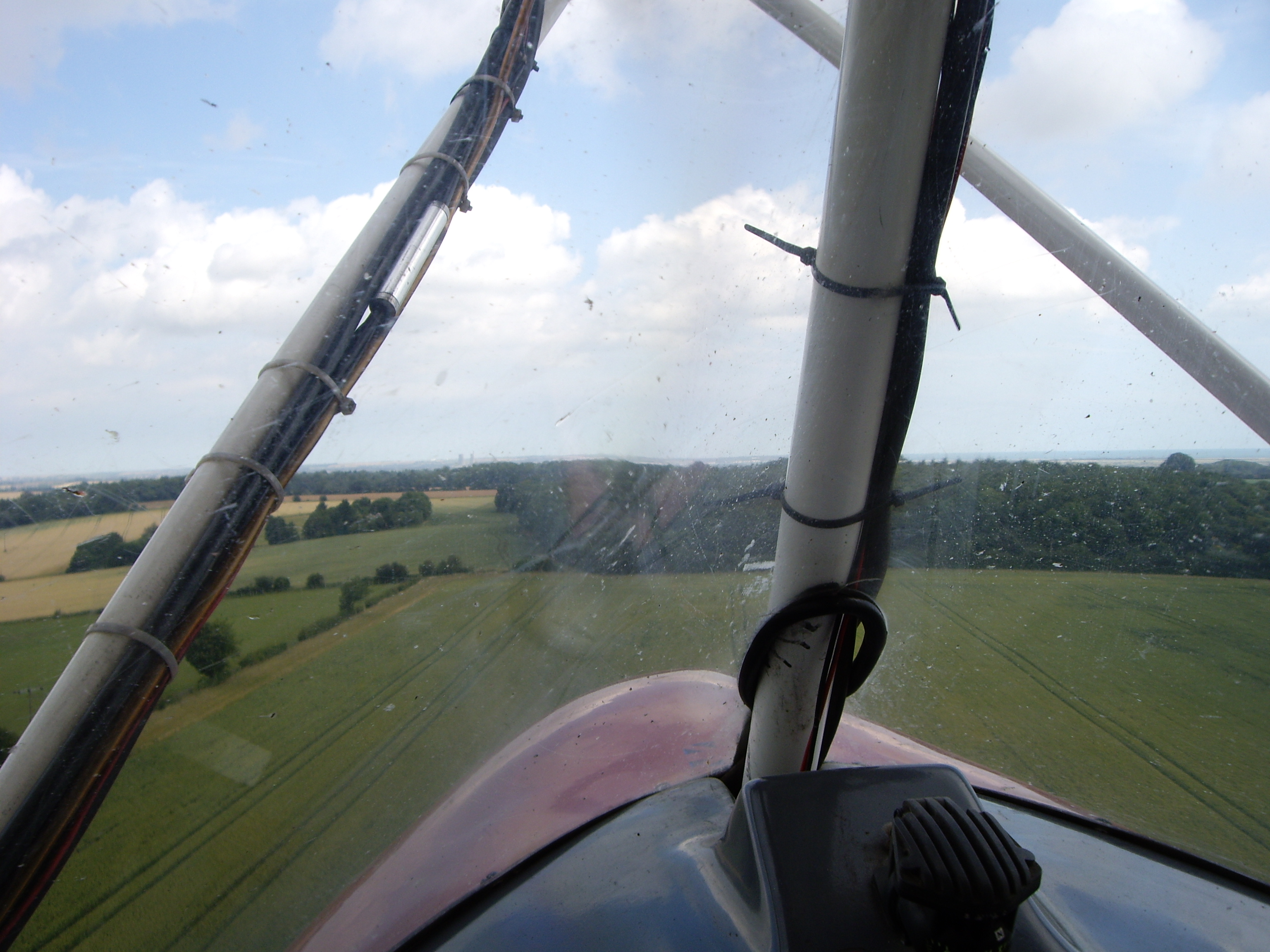
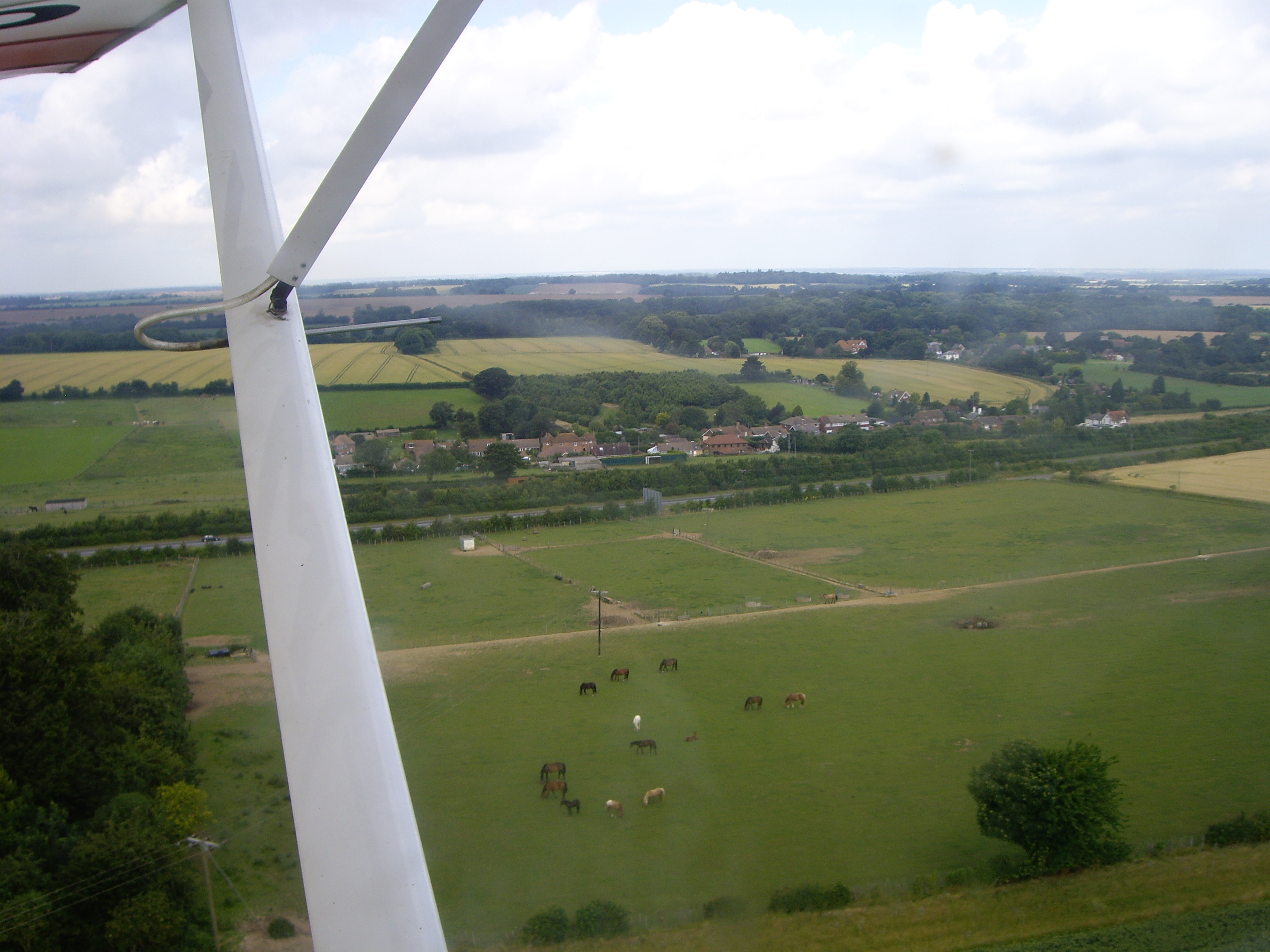
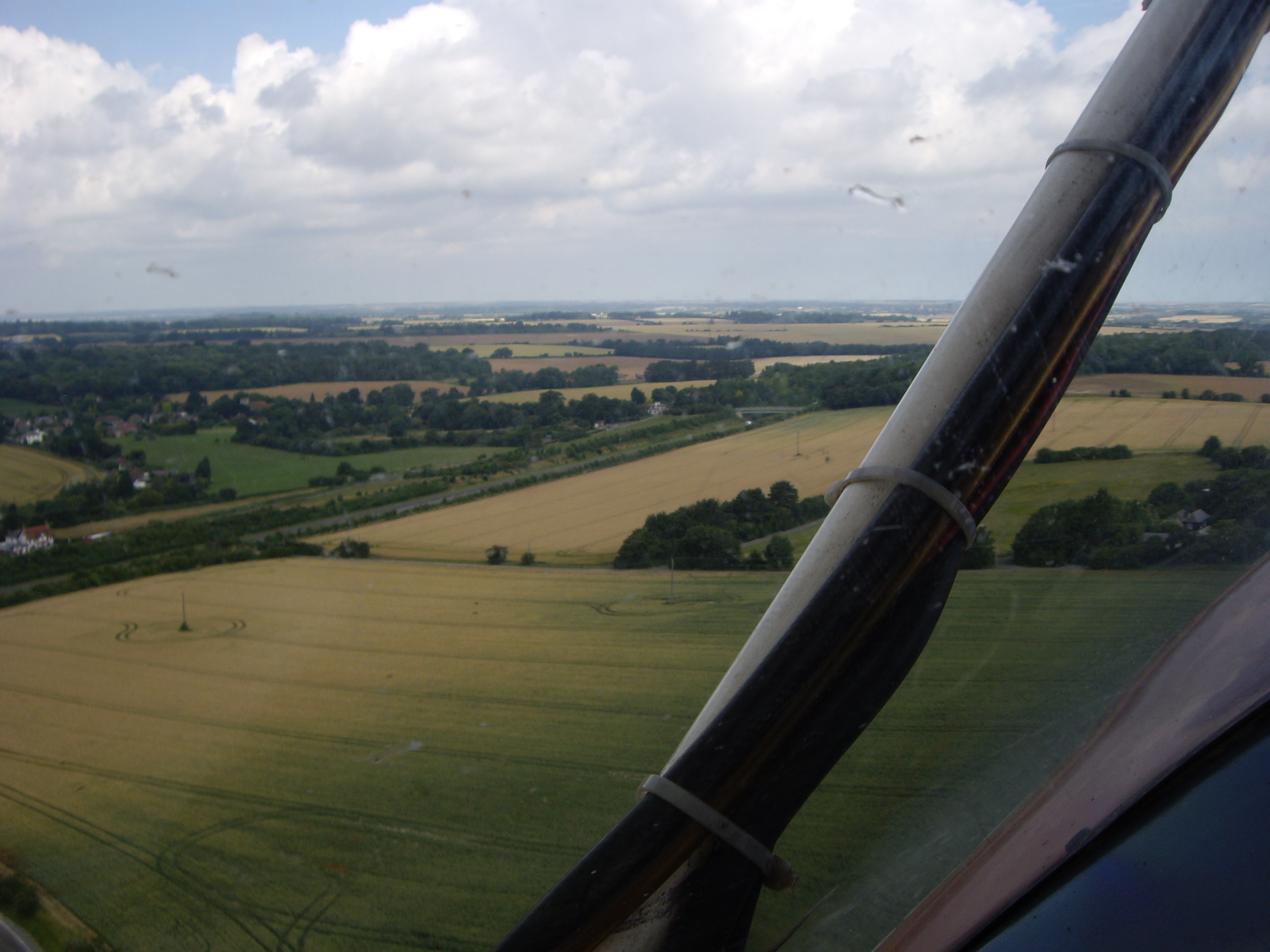
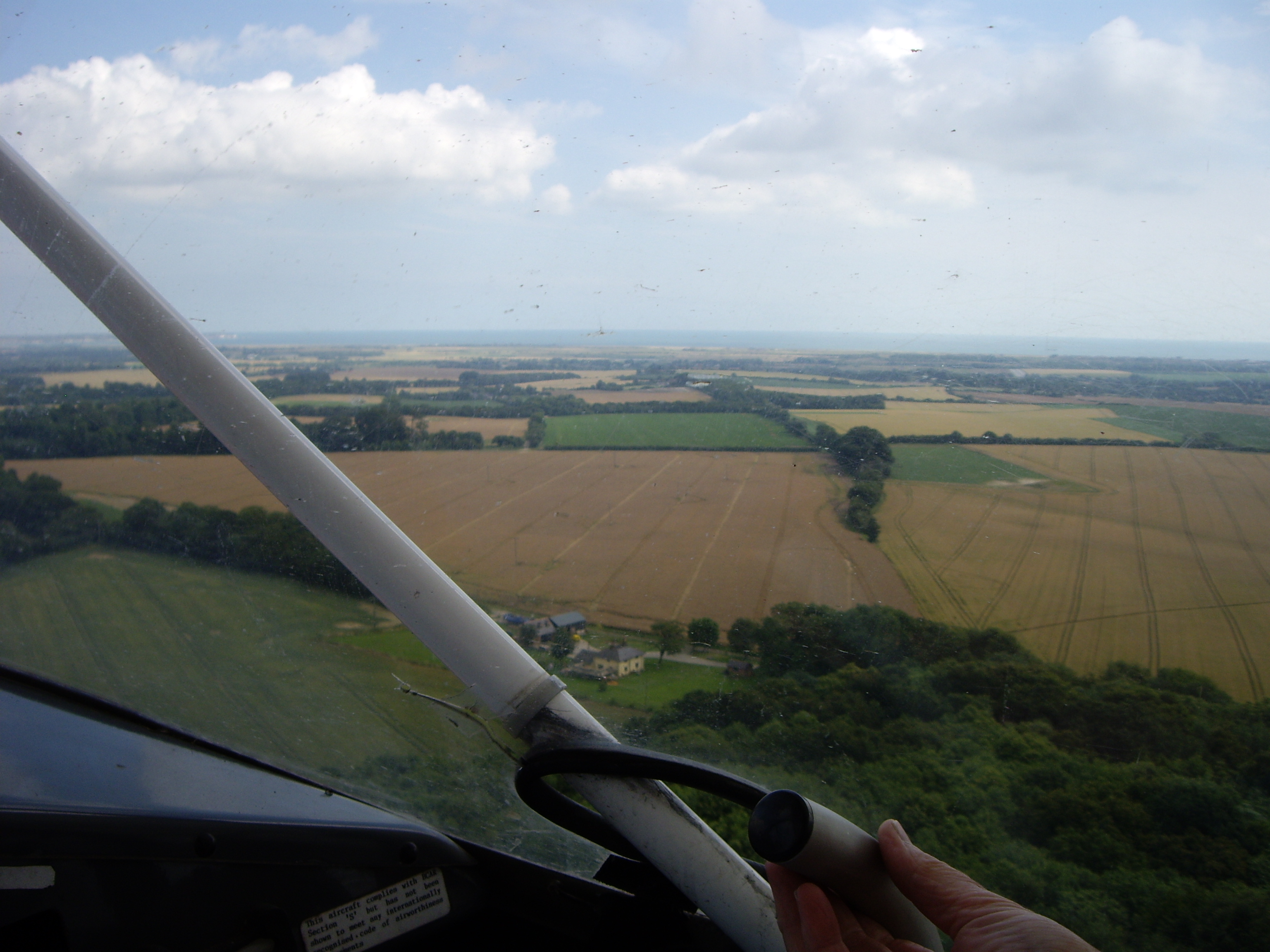
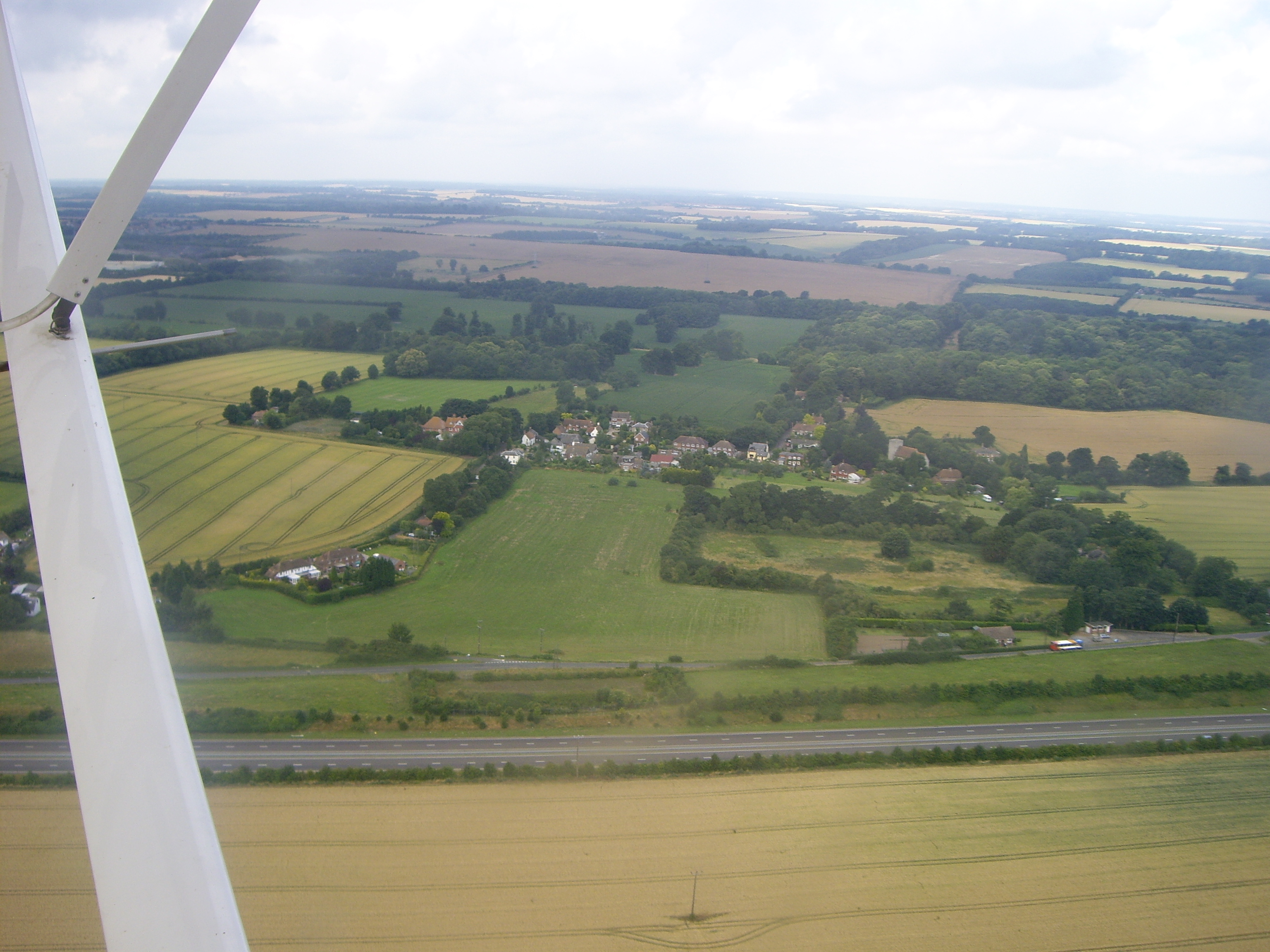
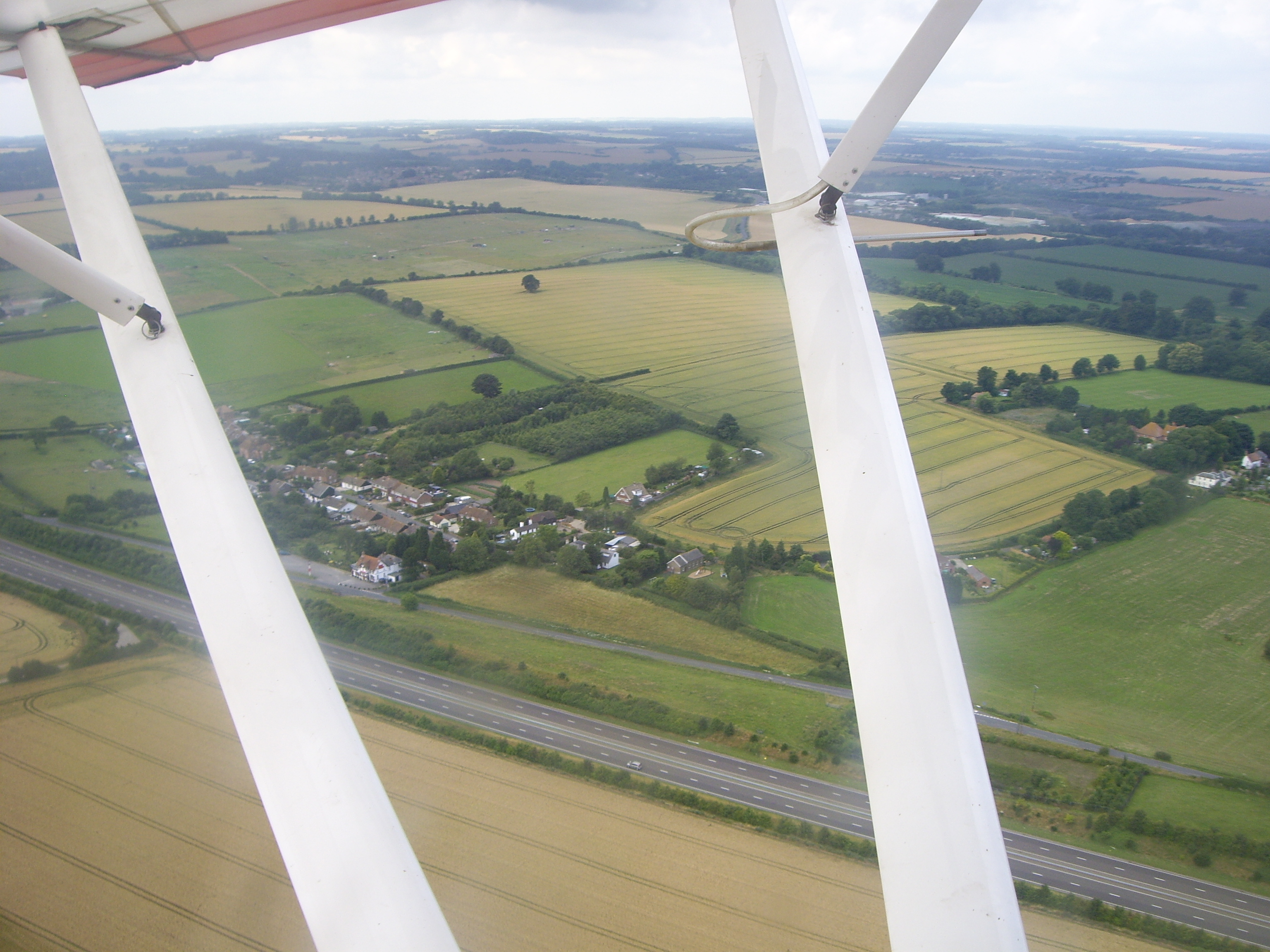
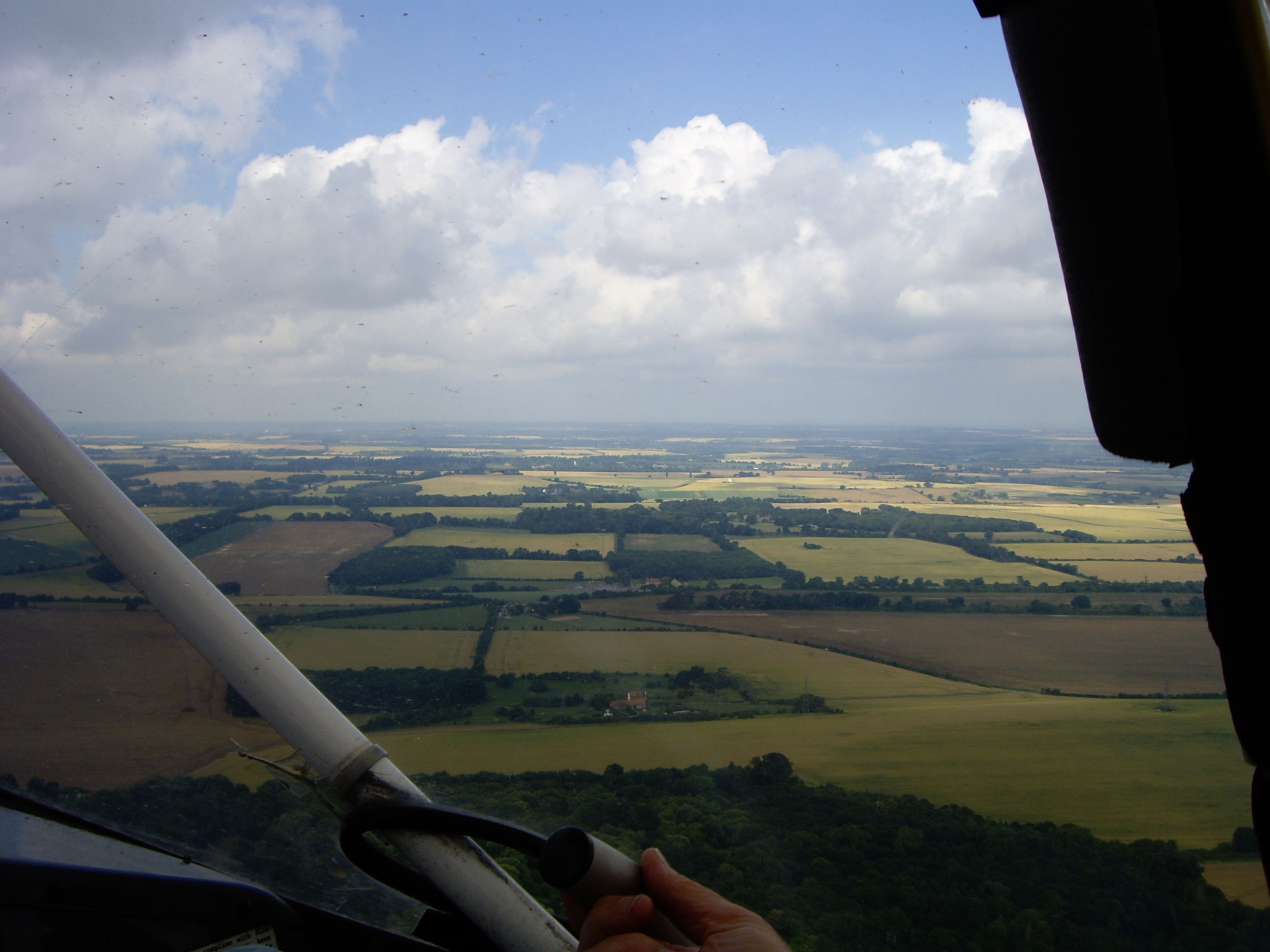
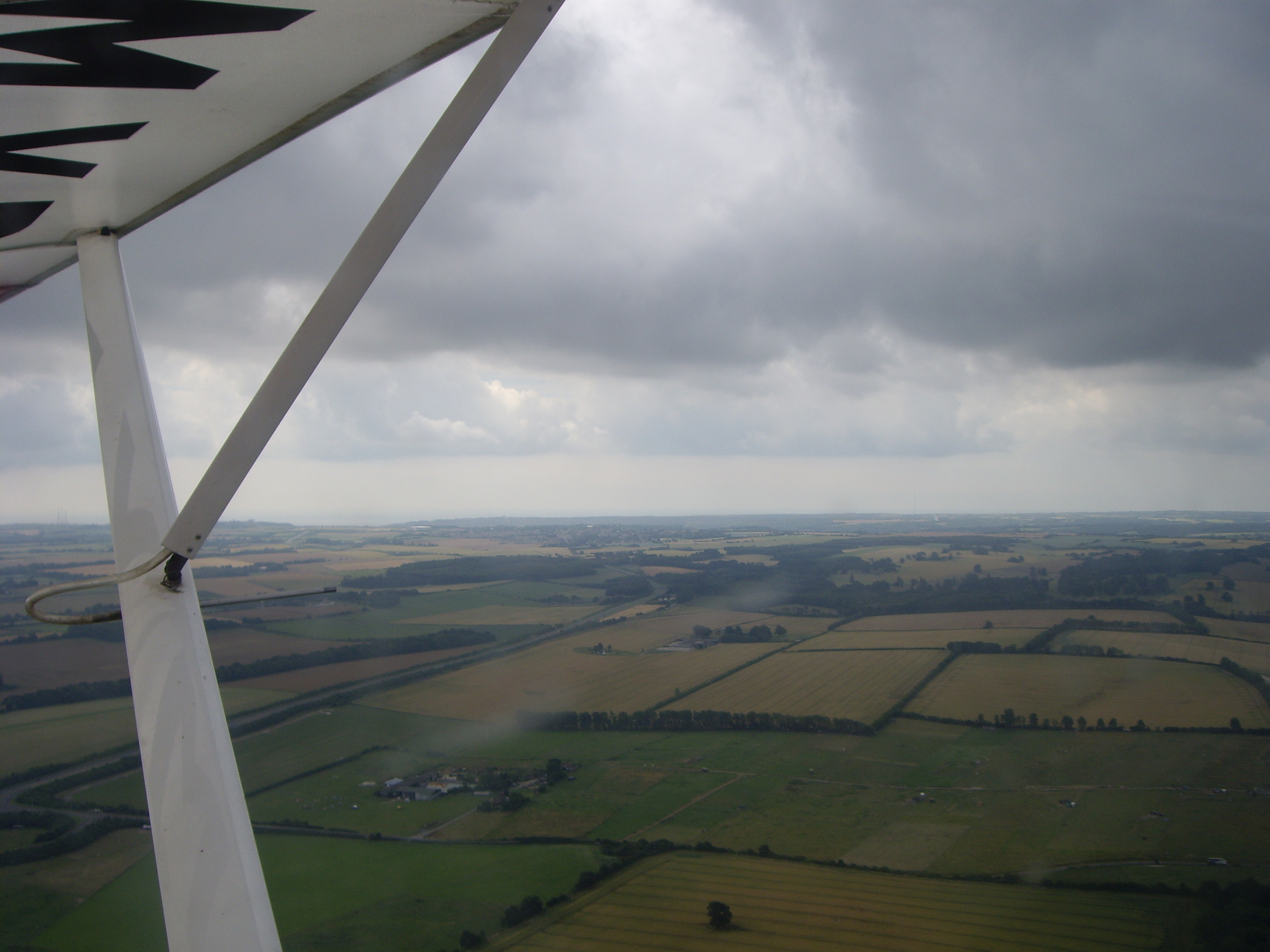
Oh well, we’ll try again tomorrow, but in the meantime I thought I’d share a few ‘pilot’s-eye-view’ pictures to give people an idea of what it’s like to fly a microlight in this part of the world. They were taken late in the afternoon on a day last week which was a bit overcast and I had hoped to have some brighter ones by now. But as you can now see, it hasn’t been possible. The screen had received its fair share of squidged insects and stuff and you’ll also notice the occasional raindrop on it as one or two heavier bits of clag passed over. As before, the pics link to the very large originals for anyone with a fast connection who wants to see the full detail.

I handed over to Rosie just after I’d done a touch-and-go and the first pic was taken at only 150ft or so.

The procedure is – full throttle, as you accelerate, pull back to take the weight off the nose wheel, pull off at 40-45mph, ease the stick forward to get 50mph and hold that up to 200ft, then nose up to get 45mph which you hold for the rest of the climb. Remember the mnemonic – PAT, power-attitude-trim, and even in this little aircraft trimming helps a lot. And don’t forget to keep monitoring your Ts and Ps (engine temperatures and fuel pump pressure) – yes, almost as much work as in a GA aircraft. But much more flying because the considerably lower inertia of a microlight means that you’re hands-on flying it the whole time. Really good fun, leastways I think so 🙂

The next two pics are taken out of the pilot’s side as we continued the climb out.

Check out Google Earth. The next pic is taken across the cockpit in the direction of Sandwich. That’s the throttle lever that Rosie’s fingers are on and the coastline and English Channel in the distance.

The next two pics are looking west from the pilot’s side as we climbed through something like 800ft or so. They show how marvellous the countryside is around here and what the attraction of flying low and slow in a microlight is all about.

If you don’t believe me, take a look at this next one. Just glorious!

And one last one for now, looking from the pilot’s side towards Dover – not that you can see it here!

Well, that’s it for now. I hope I’ve been able to give some sort of idea of what the attractions are of this amazing sport, hobby, pastime – call it what you will. All I know is that I just love it 😉

Shucks!

Today was probably the best flying day we’ve had all year. Blue sky, warm sunshine and hardly any wind. Unbelievable considering how windy it’s been for weeks now (no exaggeration).

Only trouble is, Rosie doesn’t fly Sundays. Shucks!

So I decided to nip down to the Our Trike workshop to check out the replacement CHT/RPM gauge. Grabbed the new jerry can I recently got on Ebay as I knew there wasn’t much fuel left in the tank and picked up 10 litres of unleaded and a litre of 2-stroke oil on the way (it needs a 40-1 petrol/oil mixture).

Pulled Our Trike out into the open, reattached the battery lead, checked everything over, topped up the tank and keyed the ignition. Shucks! It just would not start.

So I removed the plugs, which of course were totally oiled up, and cleaned them – 3 times eventually. I also checked the fuel filter and removed the fuel lines and carburettor plugs to make sure fuel was getting through. It was. Still would not start. What the heck could be the reason?

Aha, I thought. There’s an ignition master switch which I’d switched to ‘on’ – what if that’s making a poor connection? So I switched it off and on 3 or 4 times and then keyed the ignition again. Yippee! It started. Memo – think about replacing that dang switch!

Right – check the gauge……… oh no!! It’s not working!

I tried switching the connections as for a while the CH temperature needle seemed to be responding as the RPM needle should have been when I revved the engine. But no luck – couldn’t get it working. So now I’ve got to check the wiring and try to find out why not. I found what looked like some old wiring diagrams previously but it won’t be at all easy on a 20 year old microlight.

Shucks and shucks again! Not a particularly successful day 🙁

Flying With Rosie

I’ve been trying to get onto this post for a while, especially as I dropped a few hints about it in an earlier one, but as usual time, the old enemy, got in the way. But now the decks have cleared a bit I can take the opportunity to post the latest news.

For several weeks, much of my time was taken up with things to do with the Xair so now with that out of my hair, I decided that the time had come to take the bull by the horns and start seeing about doing some proper flying. After thinking long and hard, I decided that although this whole thing began with the purchase of Our Trike, I now had to agree with something Ken had said. The idea of flying in a totally open cockpit is still fun but there’s much to be said for having a closed cabin. There are obvious things, like having side-by-side seating, which makes the whole experience much more enjoyable if you have a passenger. And as I’ve said before, enjoyment is the main point of this whole exercise. And being able to fly at virtually any time of year without needing to wrap up and wear crash helmets and stuff like that is also another big consideration. But really the deciding factor for me has been the weather.

This year has not been shaping up too well at all in the UK for flying small aircraft. It’s not just that we’ve had a lot of rain, we have, but even when the weather has been clear and bright, we’ve still had quite a bit of wind. Now, wind is a big No-No for Our Trike. More recent flex-wing (or weight-shift) designs, which is what Our Trike is, can handle certain amounts of wind, but Our Trike is an older design and really needs almost calm conditions to be safe. But no flex-wing can be flown safely in anything like the windy conditions that a fixed wing (or 3-axis) design can cope with. So the decision really is a no-brainer. Have to go fixed wing.

The other consideration, of course, is that all of my previous Group A and gliding experience has been in fixed wings so the learning curve is likely to be less steep in a 3-axis model too. So that’s why I got in touch with Rosie.

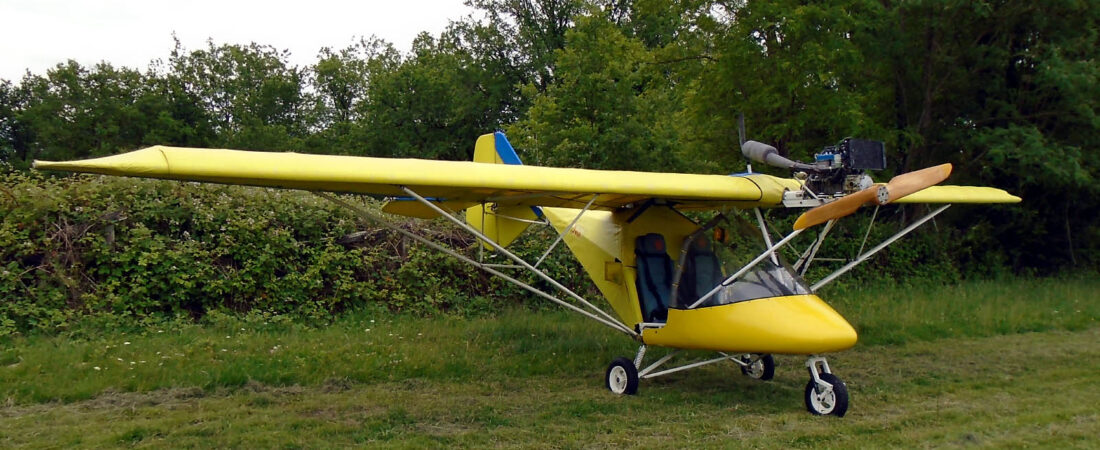
Rosie is a microlight Instructor here in South-East England. She has two aircraft, an Ikarus C42 and an AX3 and you can choose which one you prefer to learn in. The C42 is modern, high-tech and for me, I’m afraid, a bit flashy. On the other hand, the AX3 is old (mid-nineties I think), a little bit tatty and frayed around the edges with a few thousand hours on the clock. Having so much in common with it, obviously I had to go for the AX3! And here it is.

By the way, if you click on any of the images in this posting you will be able to view full-screen versions. You’ll also have the option of viewing the original digital pics which are all much larger than a browser window. But beware – they are all over 1 MB (one of them is 1.7MB) so they may take a while to open if you have a slow connection. But it’s worth it, I think, because some of them have a lot of detail in them, especially the cockpit pics that come later. You can save them into a folder on your own machine to view off-line and if you zoom in you can see an incredible amount of detail. Aren’t they marvellous, these digital cameras 🙂

But before we go any further, let me tell you a little bit more about Rosie. She’s a charming lady of, let’s say, about the same age as us. Flying with Rosie is a most enjoyable experience. She’s amusing and excellent company but like all good Instructors, she keeps control of things, but with a light touch. She knows what she wants you to do and how she wants you to do it but she communicates this in a way that makes the learning process a whole lot of fun.

And so it was that I turned up for my first flight with Rosie on the 10th of June. Actually it wasn’t quite as straightforward as that. Rosie flies from a small farm strip not far from Canterbury and despite her having given me directions how to get there, I’d spent about 45 minutes driving around the beautiful country lanes of Kent lost, looking for it! I’d taken the time away from my business (dang it, why not – it’s my business!!) and bv the time we’d had our briefing it was getting on for 2pm by the time we took off.

It was a beautiful afternoon – bright, sunny, a bit of cloud but a little bit windy. Rosie handed the controls over to me quite soon after take off and I thoroughly enjoyed getting the feel of them. We headed for an area in the direction of Dover and could clearly see the Cross Channel Ferries entering and leaving the harbour. This was the kind of flying that I had been looking forward to.

We ran through the Microlight Syllabus. Straight and level and turns to the right and the left. Climbing and descending, straight ahead and in the turn. Stalling, slow flying, I didn’t realise until afterwards just how much of the basic syllabus we covered. Rosie was very complimentary. She said my flying was ‘delightful’ which I thought was not only a charming compliment for which I was most grateful, but which also made me feel just as I had as a young student pilot over thirty years ago when my old Instructor had complimented me when I’d done something well. Strange, isn’t it, how some things just don’t change with time. The wide grin was plastered all over my face like glue 🙂

Rosie directed me to a little landing strip in a nearby field – just a mowed strip on a not-that-level field next to a road where we could do some touch and goes. Boy, if I’d had any thoughts of being a bit cocky about my flying skills up to then, now was the time to forget them.

The approach was over the road and just as you thought you’d managed to get everything nicely set up, you were hit by the same bit of lift every time, rising off the tarmac. There were trees to our right and as the wind was a bit from right-to-left and not straight down the strip, there was a bit of roll-over off them. And then to cap it all, we were flying into the low point of the field with the strip rising gently up ahead of us and there was a ditch with a few bushes just before the threshold causing the weirdest little bit of turbulence I’ve ever come across. All in all, quite challenging! But fun was not the word.

It soon became clear that there is some way to go before I get back the somewhat delicate skills that you need to do consistent good, safe landings. And in any case, there’s a learning curve because the whole approach and landing sequence is so different between a typical Group A light aircraft and a 3-axis microlight. Because the inertia of the microlight is so much lower and the forward resistance relatively so much higher, the approach is considerably steeper, so even without flaps (the AX3 and most microlights don’t have any) you feel as though you are doing a Group A full-flap approach. Then, you leave the flare later and much lower (ahem… bum height as a certain lady Instructor who will remain nameless suggested) and hold off aiming to land on the main wheels with the nose up to keep the weight off the nose wheel. I found that I was keeping too much trailing throttle on as I tended to do in the past to get a ‘greaser’ of a landing but this meant two things tended to happen. First, by the time I’d touched down, I’d used up too much of the runway and secondly, the long flare gave the wind the chance to blow the aircraft around. And so it did! Things to remember and lessons to learn straight away.

But all good things come to an end and eventually we headed off back to the home strip. That first session came to 1hr 30mins – and I wouldn’t have missed it for the world 🙂

I next flew on 24th June. Boy, if I’d thought the last session was challenging, it was nothing compared to this. The wind was gusty and also pretty variable meaning that setting up to land was not at all easy. We returned to the same field as before for some more touch and goes. The whole session lasted for 1hr 25mins and I have to say, it was pretty gruelling. I thanked Rosie afterwards for persevering because it must have been pretty tiring for her as well, especially as some of my efforts were not at all pretty. It was excellent practise, not that you expect to be flying and landing in such conditions all the time. But experience suggests that some day it will happen, so what better way to learn how than with an experienced Instructor sitting by your side.

To date, just another 1hr 10mins on 1st July and this time conditions were not ideal, but were a lot better. Hooray! Take offs and landings totally under my own hand at last. A satisfying and essential advance and development. After all, you can’t solo if you can’t take off and land… 😉

To finish this post off, what about a few more AX3 pics for those who are interested. Here’s another external shot taken from the other side.

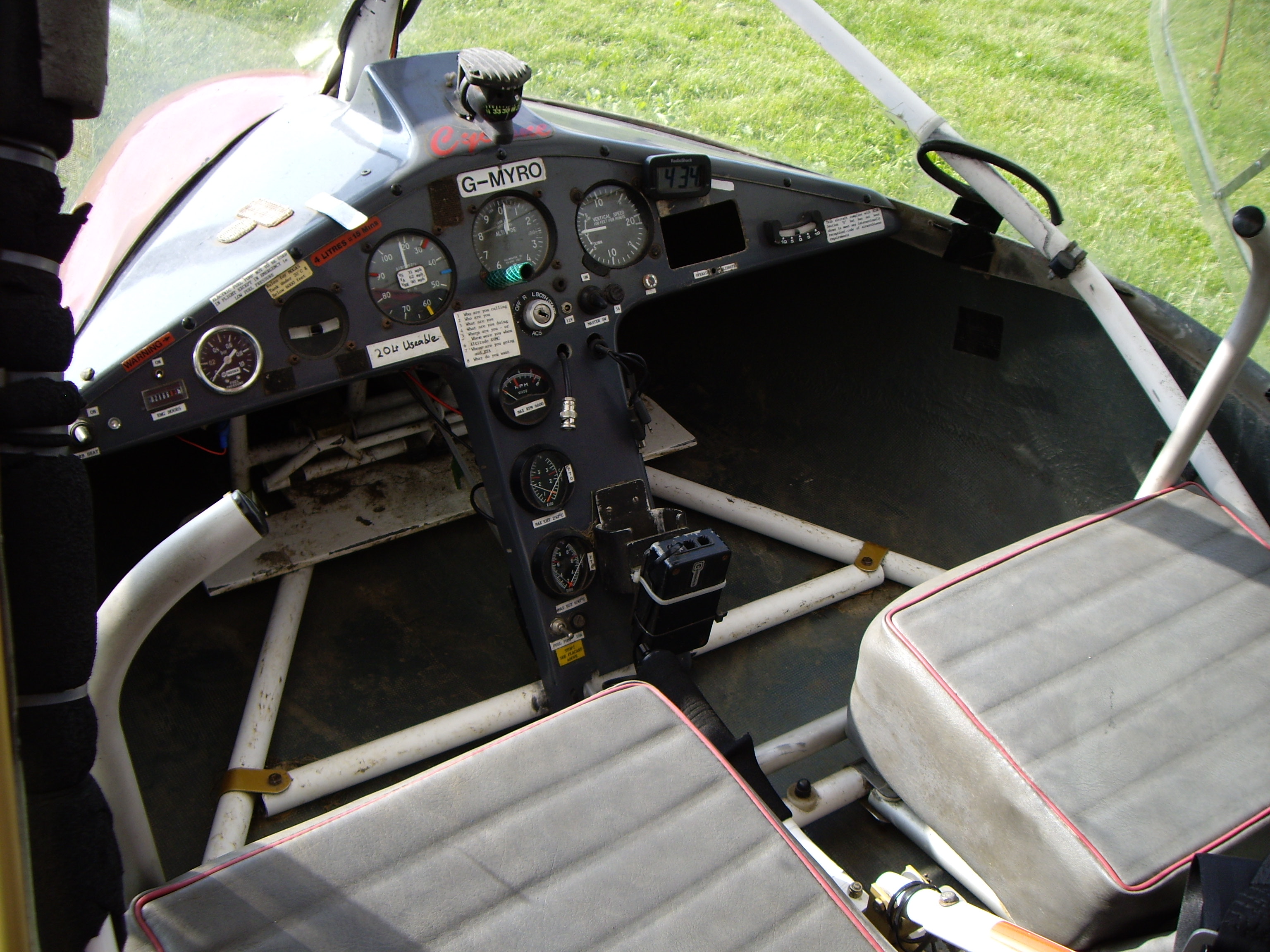
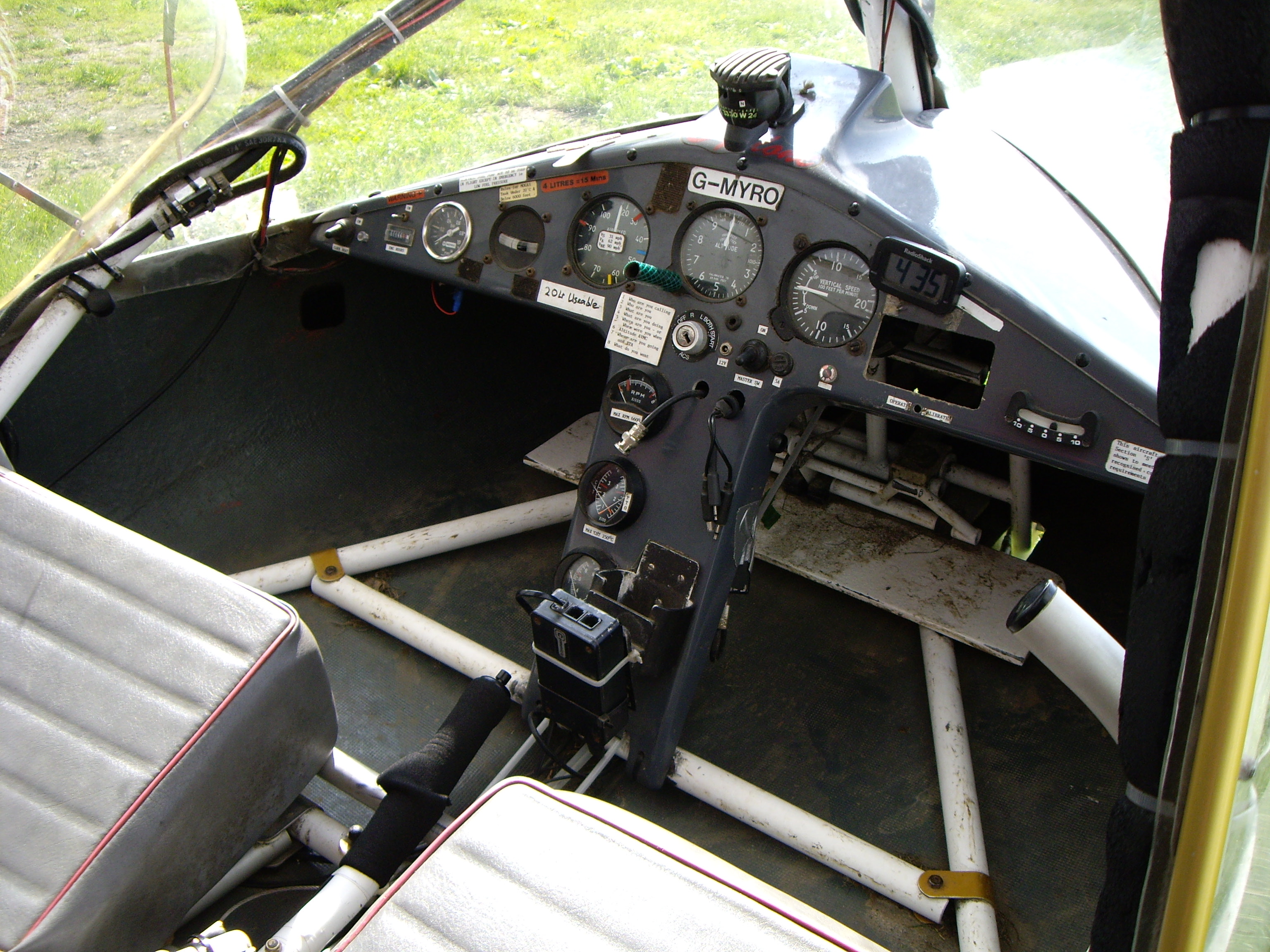
And now a couple of cockpit shots to give a feel of what it’s like to fly one of these little aircraft. Rosie had removed the little Icom radio when they were taken which explains why there appear to be some loose cables hanging out.

Note that the AX3 has a single central stick. Here are some of the controls and indicators that can be seen if you zoom in a bit – see if you can spot them. Master switch, fuel cock, mags/starter switch, engine choke, fuel pump switch, fuel pressure gauge, carb heater switch, engine hours switch, RPM gauge, airspeed gauge, compass, engine temp/pressure gauges plus, of course airspeed, altimeter and vertical speed gauges. Even in this type of aircraft, pretty much a ‘standard fit’ of instruments, but no DI note. And more and more owners are fitting GPSs as well, these days.

One last one to finish off.

Not the fastest, most modern(!) or the most comfortable 3-axis microlight around but what the AX3 does have in abundance is character. That and flyability, and I look forward very much to progressing my microlighting experience in it.

Back In The Our Trike Workshop

WOW! 2 postings in 2 days. Something of a record for Our Trike!!

The past weekend was glorious here in South-East England – first Biggin Hill Airshow for many a year that hasn’t been ruined by low cloud and rain. Anyway,  I felt that I was owed a  bit  of ‘me-time’, so after completing the inevitable chores that always seem to come first, I got myself back to the Our Trike Workshop for a few hours.

First job was to fit the replacement RPM/CHT gauge. All went pretty well – very neat job actually even though I say it myself 😉 – but just one problem.

I had made a note of the  order of connections on the old gauge so I would know how to connect up the replacement. But – and it’s a long story involving Toddie, my Springer who goes bonkers wth the sound of rain on our conservatory roof, the paper pad with the notes on and a paper ripping spree brought on by a heavy overnight rainstorm – these had been lost. So I had to make the connections as best as I could remember and when the engine is run again, we’ll have to see what happens. Hopefully, even if they are wrong no damage will be done and it’ll just be a matter of switching things around. But we’ll see.

I also decided  to refit the wheel spats. Blimey what a job. I hadn’t managed to find any suitable aluminium to make replacement brackets from (all the lovely little hardware shops that used to sell such things 20 or 30 years ago are long gone, put out of business by the global multiples who have no interest whatsoever in supplying such items) so I had just tidied up the existing ones and refitted them. Getting the holes to line up was a nightmare made even worse by the incredibly limited access to the inside-rear of the spats themselves.

However, I persevered and eventually got all 3 bolts on both sides in – but on weird-looking angles. Couldn’t tighten them up because although I’d dashed around picking up all the tools I thought I’d need before leaving home, I’d managed to leave both of my socket sets behind.

Hopefully when the bolts are tightened, they’ll pull into place but  care will be needed as the spats are only fibreglass and it’ll be easy to split them.

But that’s for next time…

It’s All Up In The Air…..

Well, not quite …… but see the next post.

After our thoughts of a few months ago about the merits of an enclosed cabin compared to an open one, we decided to look around the market to see what was on offer. Well, whether it’s because of the Credit Crunch or some other reason, compared to a few months ago (let alone last year when we bought the Trike), second-hand prices for many microlights have plummeted. In particular, we found that there were several Xairs around with various engine options and at various quite attractive price levels.

We started by considering two that were on offer from the same seller ( a group who were moving onto bigger and better things), one with a Simmonini two-stroke engine and the other with a Verner four-stroke. Only trouble was, both had had engine blow-ups in flight and had dumped their owners in fields from a great height! After taking a bit of impartial technical advice, we decided to give both a miss.

After considering a very attractively priced Xair with a BMW R100 motorbike engine (not a bad choice if the installation is done well, but quite a few aren’t we learnt), we decided that the best thing would be to go for an example with a Rotax 582 two-stroke engine. Now this is not a ‘touring’ engine for getting from A to B quickly – it’s more for pootling around the sky in your local area admiring the view and having fun. But really that’s what we want to do – to just get in some cheap flying hours.

We then homed in on a lovely little red and grey Xair being sold by a group in Lancashire. My research revealed that it will need an engine overhaul and new crank in about 50 hours or so, but after negotiating a price that took that into account, the deal was done. And here she is.

It really is a delightful little machine. Ken and I both had a chance to take the controls from the right-hand seat and it really was great fun. Here’s a pic of the cockpit – two sticks unlike some models which is a nice touch.

This is the so-called wide door model but as you can see from the next shot, that’s pretty relative really and getting in and out is something of an acquired art.

Just one last shot to finish off from the left-hand side.

So as things stand, we have had to find temporary hangarage down here in Kent (not an easy thing as there’s not much around at the moment) as the hangar at Ken’s hasn’t even been started yet. Insurance cover has been transferred over from the original owners and now all that remains is to get her flown down from Lancashire (remember, we don’t have our licences yet). But there’s just one fly in the ointment

So now we come to the whole purpose of the title. Ken and I have had a bit of a falling out. At the time of writing, after finding her, researching her and negotiating a selling price for her, sadly my involvement with the Xair has now ceased. I’m going to press on again now with Our Trike and get that to Permit stage and I’ve set a personal target of end of July for that. I’m also going to go ahead with my training for my NPPL (microlight licence) and then see what the future holds at the end of it.

So you see, things are all a little bit up in the air……

Doesn’t Time Fly

Hmmmm…. bad pun not intended, because while time has been flying, we certainly haven’t. As expected, Ken was indeed out of the country for most of the Autumn, up to the end of October. And I was also busy, as expected, with my business. An exciting time for me, but a dead loss as far as Our Trike was concerned.

During the whole of this time it has remained untouched, in the workshop at Ken’s place. I have one of the original wheel spat brackets that was made, somewhat badly, from rather lightweight aluminium. I was going to get two more fabricated from something a bit stronger, but still haven’t done so. I did manage to get hold of a CHT/RPM gauge to replace the original that didn’t work when we connected it up and tested it when we last ran the engine, but it is still un-fitted.

Obviously with Christmas now coming up we need to reformulate our plans in a big way. Nothing will happen now until after the New Year – except we must make sure that the battery, which was fitted new by the previous owner just before we bought the trike, is checked and charged up. But I’ll let you into a little secret. Ken has been making noises about really wanting something that has an enclosed cabin with side-by-side seating and has even suggested disposing of the trike and getting hold of something like the Thruster, shown below.

The one shown above is the T600N, with a nose wheel. I prefer the version with a tail wheel, theT600T, like the next pic, except with a fully enclosed cabin.

Have to say that I quite like the idea. Having held a ‘normal’ Group A (as it then was) light aircraft licence, flying this type of aircraft certainly appeals. However, they’re a bit more expensive to buy than a trike and although there are quite a few open models, there doesn’t seem to be too many tail-draggers around with enclosed cabins. And there still remains the question of what to do with Our Trike. Common sense says we get it airworthy first if we are going to sell it, so the work we’ve started will have to be completed by the Spring.

Ahhh…… problems, problems, so many problems ….. 🙂

Oh Dear

..

Over a month has come and gone since the last post, so what’s been going on? The answer is, “Very little!” in the Trike department. Ken has long since recuperated from his little op so that hasn’t been the problem. No, we have to look elsewhere for what’s been holding us back.

The first thing has undoubtedly been the weather. By now the whole World probably knows about the deluge of biblical proportions that struck the UK during what was supposed to have been the early part of our Summer. Miles and miles of the North and West of the country under water, homes, farms and businesses flooded and Lord knows what else. Thankfully we were not affected half so badly in the South-East but we still had day after day of unremitting rain. So that’s the main reason.

But there’s something else. For the last couple of years I’ve been developing and running a small family-owned business for a client who in that time has also become a good friend. At the end of June the family decided that they wanted to pull out of the business and divest the company. So I acquired it off them.

This was a totally unforeseen possibility when I first had the idea of getting the Trike and, of course, it has totally thrown my plans into confusion. Obviously the business had to become my first priority and that’s what has happened. For now anyway.

The Summer months are the ‘quiet’ time for this particular business but (I’m glad to say!) that has not been quite the case this year. So as well as having to make the necessary changes to financially integrate the company into my existing business and get it ready for the Autumn, I’ve also been quite busy just running it.
I guess with the weather being so poor, I didn’t mind this too much because even when the sun has emerged it has been far too windy for microlighting. However, as I type this we have blazing sun and a clear blue sky and potentially the hottest day of the year to look forward to. Still a bit breezy though as the sun warms everything up.

So does this mean we’ll be able to get back on track again? Hmmmm…… maybe, maybe not. Ken now has one or two business trips coming up. Did I say a few? In fact from Tuesday week he’ll be in and out of the UK more or less non-stop until the end of October. And me, I’ll still be concentrating on the business of course. We had a chat the other day and the conclusion we came to is that as a result of all this, this year may end up being a wash-out in both senses of the word.
Anyway, we’ll have to wait and see. If my business settles down as I hope it will, I’d still like to get some microlighting under my belt this year if I can. In the last few years we’ve had some glorious long Autumns in here in the UK and perhaps that will happen again this year. If it doesn’t, then probably no chance.

And pity all the poor devils who run microlighting and flying schools!

Friends Drop In

So last Sunday we managed to get almost all of the airframe inspection work completed. We finished off the re-cabling but the problem was that when we eventually reconnected the battery and fired up the engine, the RPM/Engine Temp gauge didn’t work properly. We don’t have a wiring diagram and just had to rely on the fact that the original connections were correct. That might be a dodgy assumption. In any case, on closer inspection the gauge is U/S anyway, so until we obtain and fit a replacement, we’ll not know for sure. It would be nice to have a proper wiring diagram, though, so we know that what we’re doing is correct, so we’ll have to get in touch with Medway Microlights, who now officially support our trike model, to see if they have such a thing. My guess is they do 😉

Final job today was removing the wheels and checking and regreasing the roller bearings. Bit messy but we didn’t find any problems and it’s good to know that they are now packed with nice fresh grease.

As the weather was fine, I wanted to take some pictures of the field. Now I have a confession to make. After just taking delivery of my lovely new Pentax digital camera a few days earlier, I have to admit that I forgot to take it with me. Luckily, Ken’s son Marc came to the rescue and loaned me his, so I was able to take the following pics which give a good impression of the lie of the land.

As you can see, the field can hardly be called level, but we think there’s a strip angled slightly right to left from the foreground into the distance that will be long enough and flat enough for us to use. There are some tallish trees along the boundary of the field behind where the pics were taken from, but again these should not cause too much of a problem as the field is pretty long, as you can see, and microlight approaches are also steeper than fixed wing.

Then there was a bit of a din and Ken’s brother, Peter, decided to drop in with a friend for a cup of tea. Din, you say. Motorbike? Sports car? Not likely. Jet Ranger helicopter!

Toddie, my Springer, is an ex-Gun Dog so he was not too perturbed by the noise. The afternoon was warmer than it looks in the pics so after Peter had switched off he decided to take advantage of the helo’s shade. Bit cheeky eh 🙂

Anyway, at the end of the day. we’d made a bit more progress. More or less got everything back together and have run the engine again. Pity about that flippin’ gauge, but C’est La Microlighting Vie, I guess 😉

Wot… No Pix?

Should hopefully from now on be a thing of the past!

First thing was, took my good ole Minolta digital camera down to Ken’s at the week-end and took a few shots of the field from which we’ll hopefully be flying at some time. Weather was sunny and bright, field was being mown by the local farmer’s tractor. Conditions – more or less ideal. Took shots. Result – rubbish! Exposure a total disaster, and I’ve found this quite a lot with this camera just lately.

ACTION – order a lovely new Pentax 7M pixel Optio S7  😉

Have now got it – it’s tiny and really nice. So now there’s no excuse – expect to see a few more pics in future postings 🙂

Couldn’t resist slipping this pic in here. What a nice piece of kit it’s turned out to be! 3x optical zoom plus 4x digital, 23MB internal storage (and an extra 1GB fast memory card that will hold about 1000 pics cost only an extra ÂŁ10!!), 2.5″ LCD screen, captures sound and movie clips and all only 85.5×53.5x19mm. How do they do it.

Pentax Optio S7 Ultracompact Digital Camera

Moving on…… we nipped down to Medway Microlights as well on Sunday to get the info we need, on membership, training, hangarage (if we decide we’d like to have any part of our training on our trike), stuff like that. Was rather quiet for a week-end but we had a very pleasant couple of hours drinking tea and chatting with staff and a couple of members.

Ken’s now thinking of training on a 3-axis aircraft rather than a weight-shift (which ours is) because at the end when he’s got his licence, he’s thinking about splashing-the-cash and going for a 3-axis with an enclosed cockpit. An Instructor we spoke with thinks that he should make a choice because the skills required are different and not immediately transferrable. For example, with a weight-shift, you push the bar forward to ascend whereas with a 3-axis you pull the stick backwards. This can obviously be quite critical at certain times – eg when you’re flaring to land  😕 – and it’s at times like that when stress can be relatively high for a student that accidents can happen, if they keep switching from the one type to the other.

He doesn’t have to make that decision quite yet as after a small recent op he can’t fly yet anyway, but he probably will go 3-axis I think.

I’ve taken the decision to start dual training as soon as possible. Unfortunately I’ve not had the time this week (I wanted maybe to do a couple of hours on Wednesday but I was too busy with work commitments) so whether I’ll be able to do any this week-end or have to wait till next week, I don’t know.

I’ll let you know as soon as I do 😉

Oh – by the way – we have managed to get a bit more work done on our trike. The week-end before last I replaced the dodgy cabling. Well, almost. There’s a panel-mounted single fuse in the circuit and that turned out to be naff, so I couldn’t finish the job. Have looked for a replacement but not found one yet. But we will, we will….

Nothing Doing …… (Almost)

Well, something like 10 days have slipped by and we’ve been able to get very little accomplished in that time. But not quite nothing!

Managed to make contact with our local BMAA Inspector who will have the job of giving our trike a thorough look-over and deciding whether she’ll get her Permit To Fly or not. Anyway, that’s still a few weeks down the line. His name’s Jim and he sounds like a very nice chap indeed. Obviously safety must always remain the top-most priority but already the differences between microlights and Group A light aircraft, that we’ve been used to in the past, are becoming apparent. With the former, you’re discouraged from touching anything on your aircraft whereas the opposite seems to apply with microlights.

The policy seems to be to positively encourage you to do things yourself (on the assumption you do have some idea what you’re doing, of course) and I think this is a very good thing. The more you get to know about your aircraft, how it’s made, what the various parts do, how it goes together and, more importantly, the condition it’s in, surely the safer it will be for both you and your passengers. Not even a complete fool would risk flying something they know to be unsafe, and how can they know that unless they’ve been all over it with their own eyes and hands, touching, feeling, removing and replacing bits, tightening nuts, checking cables, fabric, components and so on. Luckily I’m pretty experienced in those things, but for other less experienced owners who have yet to learn, that surely is why at the end of it all you have an experienced inspector go over it with a fine tooth comb just to make sure you haven’t done anything silly. Anyway, in my book, it’s a good system.

What else have we done? Well, not much unfortunately. I got hold of some excellent 4-core multi-strand cable at the weekend but the FA Cup Final saw to it that the old cabling didn’t get replaced. After watching the match I almost wish I’d spent the time working on the trike instead!

A grudging ‘Well Done’ to Chelsea 😐

Getting Our Hands Dirty

Well, the Bank Holiday weekend came and went. The weather forecast for Sunday wasn’t good (in fact the weather turned out not too bad as it goes..) so Ken suggested going down to Popham on Saturday. I’d already told my son that I’d fit new brake pads on his car – how come sons nowadays don’t seem to be able to do half the things we had to at their age….. or are they just cleverer than we were and can always get their Dads to do things for them instead? So I couldn’t go and Ken went down by himself – said it was a terrific show and that he’s never seen so many microlights of all types and sizes, together in one place. Oh well, too bad that I had to miss it.

But come Monday I decided that come what may, we’d get our hands dirty. The day started alternately bright then overcast, but always breezy. We thought we’d nip down to Rochester Microlights to see if we could get any first hand advice on what we needed to do by way of stripping and inspection for the Permit to Fly.

On the way down it stayed breezy and there were a few spots of rain on the windscreen. It was great to get back to Rochester Airport. It’s where we kept the group Cherokee before we sold it back in the 80s and I don’t think I’ve been back since. I’d forgotten what it felt like to be driving onto an airfield – funny thing is although we’ve only got a microlight and it isn’t even flying yet, I’m already beginning to feel ‘part’ of it again.

Anyway, you’ve guessed it, because of the weather there was no flying going on at all, let alone of microlights, so the office was empty and locked up. So we nipped into the airfield restaurant. I just love how restaurants on small airfields all seem to have the same atmosphere – two cheery ladies behind the counter and bacon butties on the go the whole time. We had a mug of tea each and the largest sausage rolls you could ever see, with 3 big fat sausages inside.

On the way back the sky darkened and the heavens literally opened into the most intense deluge I’ve seen for a very long time. Even with the wipers on full speed, we could hardly see the road ahead and traffic had to slow right down. I’d hoped to start work on the Trike in the open air but that was impossible. Luckily the garage it’s in has pretty good lighting so we were able to get started anyway.

By the way, while we were getting going inside, Toddie, my Springer was outside in the rain. Like all Spaniels, he loves water and getting soaking wet and filthy dirty are doggie heaven for him. There are plenty of opportunities for him to do both at Ken’s so I suppose you could say that despite the weather, everyone was happy 🙂

Unlike most trikes, ours has got electric start which uses a small battery in a holder below the main tube just in front of the engine. So the first job was to disconnect it. We then started off by removing the mainwheel spats (quite easy) and then I thought it might be a good idea to remove the nose pod so we could get a good look at the nose gear. Bad idea – very bad. After removing all the mounting fixings and a lot more besides including a length of wire locking (that will now have to be replaced) between the pod and the main frame, we couldn’t see any way barring magic or a hacksaw to separate the pod from the frame. I think we’ll just have to hope that the engineer who does the inspection will be able to see enough with the pod in place, so when we’ve done all we can in the nose area, we’ll just refit everything and hope for the best, I think.

Ken had to finish early but I pressed on and had a really productive few hours. I checked the plugs (nice and new, no wear) and found them to be very oily. Not surprising I guess being as it’s a two-stroke engine with inverted cylinders (still no new pics yet, I’m afraid – just too dark today). Compression seemed OK so enough oil must be able to drain down the cylinder walls and foul the plugs if it stands for a while. Must remember that for the future – might have to remove and clean the plugs as a pre-flight check before starting the engine if it’s been standing for several days, as it inevitably will do.

Here’s a pic taken by the previous owner showing the engine.

Our Trike's Fuji 2-Stroke Engine

I was then able to check every tube, nut, bolt, joint, mounting, cable, locking pin and locking ring from the rear of the Trike (including the engine) down to the cockpit. I was really happy with the progress made and glad to find, as far as I could see, no major problems. I did find a bit of abrasion damage that somehow looks to have been caused by a cable when the frame has been folded down, on the right hand main undercarriage strut. The integrity and strength of the strut do not look to have been impaired and hopefully this will not be regarded by the engineer as a serious problem.

So at the end of the day, we were able to make a good start on the pre-inspection work we need to do before the Inspector gets his hands on the machine. We now need to get hold of 2-3 metres of good quality 4-core cable to replace the telephone cable that’s been used to connect the instruments (incredible isn’t it!!), do the checks we need to on and around the front section of the Trike and that’ll just leave the wing. I reckon just another weekend should do it for the main frame, controls, engine and body. But the wing, ahhhh… that’s a whole new bag of worms. I doubt failure of a trike frame is ever responsible for an accident but wings can and do break if they are not in perfect condition.

We will need to get it assembled and thoroughly check the tubes, battens, joints, cables and fabric and as we don’t even know yet how to assemble it as mentioned in the previous post, we have a small mountain to climb in that direction. But we’ll press on undaunted and think about that in a week or so, when the time comes 😉

First Visual Check

Sorry, no pics for this posting.

We had our first fairly close look at things over the weekend. No major problems found. The engine gauge actually shows RPM and engine temperature and doesn’t seem to be working properly. Hardly surprising as someone looks to have used single strand household telephone cable, which is very fragile at the best of times, to connect it (!!) and the connections look very dodgy. The in-line fuse may have gone as well, but none of this matters as we will be renewing all electrical wiring (there’s not much) in any case.

More importantly, there’s no sign of any airframe damage or corrosion and all the cables look good as well. The airspeed indicator wasn’t connected (plastic tube from gauge was not connected to nose venturi) and when it was reconnected it tested fine. Left rear tyre was almost flat so it’ll probably need a new tube or maybe just a valve core. Add it to the list!

Laid the wing out for the first time. Have to confess that without having the manual with us, we couldn’t fully assemble it! Lots of tubes and battens have to be carefully inserted and secured in the right places and exactly how wasn’t immediately obvious. It has to be done right, of course. Bit of a learning curve there I think. One thing we did find was a tiny bit of abrasion damage – a small hole near the right wing tip caused by a metal stub on the wing leading edge tube being left unprotected and rubbing against the wing fabric during transit. Looks to have happened some time ago, but what a silly thing for someone to have allowed to happen. Otherwise the wing looks to be excellent, but it’ll have to have what’s called a Betts Test. The Permit to Fly Inspection Notes state that ‘major’ fabric damage has to be repaired. This probably wouldn’t be classed as that but we’ll still see what’s needed to get it fixed as we’d like to start with a ‘clean sheet’ so to speak.

I’ve been collecting info and advice on what we need to do next. I’ve been told that forms and other info are on the UK CAA and BMAA web sites so I’ll be checking those out soon. First thing will be to get the trike re-registered with the CAA and then we’ll need to make contact with a local BMAA Inspector. But we’ve decided that we’ll strip all the ancillaries, like the pod, side fabric and spats off first so we can get a good look at what’s underneath, as we’re sure he’ll want to do that.

We have May Day weekend coming up and a holiday on Monday 7th so we hope to get the stripping well underway. We’re probably going off to a Microlight show at Popham on the Sunday (good opportunity to see how the wing goes together eh 😉 ) so hope to return with bags of new-found knowledge.

That’s all for now.

Some More Pics

Nothing much happening trike-wise right now. We’re both very busy with other things so the trike has stayed locked away in its garage.

So in the meantime, here are a few more pics taken by its former owner. Sorry about the rather low quality 😉


They give some idea of the excellent condition the wing is in. As it’s been stored away in its bag, even for several years, deterioration should be minimal. The danger for any wing comes from exposure to UV, and that just hasn’t happened with this one.

As you can see, instrumentation is pretty basic – just an airspeed indicator, altimeter, compass and clock, plus cylinder head and exhaust gas temps. It has both pull and electric start – reassuring to know, I’d have thought, if the engine should happen to stop mid-flight. Nice to know that if it should happen, on top of everything else, you wouldn’t have to be frantically yanking on the rope to get the fires alight again!

Let The Blog Begin!

Look, we’re two old friends and we’ve just bought a microlight together. Nothing wrong with that. I saw it on eBay and on 19th April 2007, we trailered it home and locked it up in a barn at Ken’s place. I’m Roger by the way.

OK, so we’re both in our 60s but we still want to have some fun!

One or two of our friends seemed quite surprised when we told them. Yes, we both have zero hours on microlights and will have to get our microlight pilot’s licences. But we both have some previous flying experience so that shouldn’t be too difficult. And yes, the microlight hasn’t been flown for over 10 years, so it’ll have to be made airworthy and be thoroughly checked before being given a Permit to Fly. But we reckon we can do that.

Turned out that quite a few of the people we told about our plans said how interested they were to see how we got on. So then I had a thought. How about starting a blog – then we can take everyone along with us and share all of our experiences and adventures, maybe, along the way. ‘Great idea!’ they said.

So here it is! Welcome to Our Trike.

Our trike’s a Southdown Sailwings Puma Sprint – one of the best and most popular trikes of its time. Built in the UK in 1985, sold to its first owner in 1986 but not flown since 1995. Only 308 airframe hours in total and only 38 hours on its immaculate wing and Robin engine, which were replaced in 1990 and 1991 respectively with only a 30 minute check flight on the new wing in the eight months in between!

It’ll be a lot of fun getting it (and ourselves!) flying and neither of us can wait! If the Summer carries on like the Spring has been here in the South of England – long, clear, warm, calm days, this will be a year to remember.

Oh, by the way, just a little footnote to finish this posting off. Apologies to any of our US cousins who may be reading this. To you they’re ultralights, to us they’re microlights. We’ll be using the British term all the time, but anyone can feel free to use whatever description they prefer in any comments or replies, which we hope to see plenty of.

That’s it for now.