Flash in the pan?

I’m very interested in making videos to do with my flying adventures and find it a lot of fun. My video editing package (Corel VideoStudio Pro) comes with an automatic music package but I have found that something like 80% of it isn’t to my taste.

As I can’t keep using the same pieces over and over again I find myself downloading royalty free material more and more from various internet sites and then editing it to delete the bits that I don’t like and then add the nice bits that I do like in at extra places in the tunes until I get final edits that are exactly what I want and of the right length. And I enjoy doing that as well.

I’ve always had a bit of a musical ear and one of my regrets is that I didn’t follow it up when I was younger and learn to play an instrument properly. Like many youngsters, I tinkered with keyboards and guitars but never put enough effort in sadly to make anything of them.

While playing around with music for my videos I’ve realised that huge volumes of really great stuff are being created on the ever more capable keyboard synthesizers that are available nowadays at quite affordable prices – Yamahas, Casios etc etc and that triggered me to do a bit of research on the internet in general and on Youtube. And I’ve become mesmerised to the extent that I want to be able to do what the people posting the videos do and I just know that I could if I tried.

So now I’ve decided that although I’ve left it a bit late in life, it’s now or never and that I’d like to get my hands on a keyboard to see what I can actually do. OK I’ll never in the time that I have available at my age be able to master the musical theory that the guys (and gals) who’ve been playing piano and keyboards since they were young have, but I don’t think that that will stop me still being able to have fun and create some reasonable music that will give me a lot of pleasure.

So what have I done? Well, a sequence of events came to fruition yesterday evening as though they were meant to be. Last week I spotted a used Yamaha keyboard some way away from where I live and contacted the seller who didn’t seem to be that fussed about selling it to be honest.

But then while I was waiting for them to come back to me to arrange a viewing, I rescanned the ads over the weekend and a much newer one (like only about 10 years newer!) showed up for just a little bit more money, but with a stand unlike the original one. And to top that, it was only about 30 minutes fom my house!

So to cut a long story short, I’m now the proud (and excited) owner of a terrific Yamaha PSR-E313 keyboard for not a lot of money which I can’t wait to get stuck into learning how to work and then how to play. Here’s a shot of it with my ‘learner’ chord and note stickers on it.

null

So far I’ve only been bashing out a few one-fingered melodies that sound gorgeous and learning to play Twinkle Twinkle Little Star with two hands (but only one finger left hand chords) but I’m really looking forward to getting stuck into it more seriously. There are some great tutorials on Youtube not to mention, of course, paid-for internet courses as well as instructional manuals. And in the final event, who knows, even a human teacher if I get that serious.

My thinking is that it’ll be a much better way to pass the dull, rainy days instead of just wasting time surfing the net and messing around on my computer until the day has been wasted and is gone. This, of course, will guarantee that we’ll have perfect weather over the coming summer months that will keep me well away from the keyboard 🙂

Will it only be a flash in the pan? Most learners lose interest in keyboards after a few months and put them back onto the small ad sites. Only time will tell if that will be the fate of my Yamaha…

Slightly disappointing

Another ‘double disappointment’ day, but nothing too serious and the disappointments were also offset by a couple of positive developments, I’m glad to say.

Firstly, my home-made fuel rig. The fuel resistant grease arrived from the USA the other day and today I was able to pack the leaky fuel pump with it to see if it could seal the leaks. Not unsurprisingly it didn’t work and I thought it prudent to switch the power off when fuel started to leak from around the top of the pump where the electric motor’s brushes and commutator are located.

So the pump is now proven to be not only absolutely useless but also dangerous and with my determination fortified by this new information, I got in telephone contact with Ebay customer service later in the morning.

I had already been offered a partial refund for the pump which even now I haven’t received in full, so today I wasn’t prepared to brook any nonsense. As far as I am concerned, I am entitled to a full refund of all monies paid including carriage and customs dues under the terms of both the Ebay Money Back Guarantee and PayPal Protection and when the young lady agent tried to fob me off, saying that the claim had already been closed, I refused to play ball.

To cut a long story short, a 30 minute phone call between France and the UK to be exact, that’s what they eventually also agreed to, so I’m now looking forward to the monies arriving back in my bank account in the next few days. So at least I won’t be out of pocket as far as this awful pump is concerned.

I’ve already ordered a replacement direct from China (a knock-off Bosch type) which doesn’t have as high a rating as the faulty one, but now it’s just a matter of waiting for it to arrive and seeing how it turns out.

In the meantime, I fitted the old Facet pump that was originally in MYRO. As expected, it worked fine and demonstrated that the principle of my rig’s design is fine but it’s far, far too slow to continue using permanently.

After I’d sorted out Ebay, it turned out to be a pleasant afternoon so I decided that I’d nip over to Malbec and top up 77ASY’s tanks with fuel that I already had in readiness. Having done that, I then clipped a ferrite bead onto its radio power lead and with Philippe’s help, who was bleading his Citius’s brakes assisted by Victor, I checked to see how good or bad its transmissions were with 77ASY’s engine running by listening in at a distance on my Vertex handheld.

I had been told by a chap at Sarlat a few weeks ago that the interference was quite bad but today I found that although there is still a bit of background engine-type noise, the transmissions were quite intelligible. So that’s a problem that I’m not going to worry about any more, for now at least anway.

So what was the second disappointment? Well, tomorrow and Saturday we expect to have two glorious flying days with a high of 20 degrees Celsius and clear, almost windless, skies on both days. So what’s disappointing about that?

Unfortunately the runway at Malbec is so waterlogged after the recent stormy weather and heavy rains that it’ll be unusable for at least a week. And with more rain expected on Sunday and during the coming week, it could be even longer before we’re able to get back into the air 🙁

Fuel rig news

Having stripped and reassembled the electric pump that I’ve used in my fuel rig, I now understand what the problems are. I’ll mention what I shall be doing to try and resolve them but I thought that having put it back together again, I’d give the system another go this morning.

null

Having connected the system up to my car battery and carefully primed it, I activated the pump to see what would happen. For reasons that I do not understand, it appeared to be returning fuel to the jerrican so I took the step of reversing the connections on my car battery and trying again. Success! This time fuel began to flow out of the delivery tube into the small container that I was using to collect it, and at not that bad a rate either.

Well, partial success anyway, because although this time there seemed to be little if any fuel leaking from the pump’s bottom plate, after a short while a leak did start from where the casing enclosing the pump’s electric motor joins with the pump’s rotor body. And this wasn’t really surprising, because when I disassembled it, I found that both the design and manufacture of the pump are very poor.

Here’s a sketch that I’ve done to show how the pump is put together. It’s just hand-drawn so apologies for the quality.

null

The pump consists of three sections – a top cap, a central section and a rotor chamber at the bottom.

The top cap contains the electrical connections and the brushes for the electric motor, a solid bearing in which the top of the motor shaft runs and holes to accept two long screws that pass down through the central section into threaded holes in the rotor chamber, which when tightened hold the whole thing together.

The central section comprises just a tube in which the motor magnets are mounted and in which are the motor windings. Otherwise the central section is just an empty void.

The rotor chamber on the bottom is a bit more complex than I’ve shown it to be but that isn’t important. What matters is that it contains a rotor to pump the fuel from its inlet connection out through its outlet, which is driven by the lower end of the motor shaft.

When the pump is disassembled, the central section separates from the rotor chamber taking the motor shaft with it as the windings are strongly attracted to the magnets which are fixed in the central section. You then find that the motor shaft passes through another simple bearing in the top of the rotor chamber and connects to the rotor by way of a slot.

Now for the problem areas, which are fairly obvious. When running, the rotor is said to generate a pressure in the chamber of 14 psi and clearly as the bearing in the top of the chamber through which the shaft passes has no kind of gland packing on either side, fuel in the chamber is forced up through it and into the void of the central section. Then no matter how tightly the retaining screws are screwed down, because there isn’t any kind of sealing gasket at either the top or the bottom of the central section, as soon as the level of the fuel inside it reaches the lower joint it begins to leak out.

And more seriously, the fuel is then in direct contact with the windings of the motor and can potentially rise higher and higher in the central void until it comes into contact with the motor’s commutator and brushes. In fact, when I first tried the pump out, I primed the system very energetically using the primer bulb that I’d incorporated and fuel not only began to leak out of the lower joint between the motor body central section and the rotor chamber but also out of the top joint where it joins the top cap. And afterwards when I stripped the pump I did indeed find that the commutator and brushes were wet.

Quite honestly, the design and manufacture of the pump are shoddy and if I’d known then what I know now I’d never have bought it in the first place. The lower shaft bearing in the top of the rotor chamber and its potential for allowing fuel to pass through it into the main body of the pump’s electric motor is the principal issue.

Now, I’m not a design engineer and therefore have no idea how you design your way around that problem and evidently the designer of the pump didn’t either but for what they’re worth, here are my thoughts.

The lower shaft bearing really needs some kind of gland packing that allows the motor shaft to rotate within it but prevents fuel passing up through it and given how the design is, I can’t see how that can be done properly as a design afterthought. I know for sure, because I tried it today, that if you just pack the bearing with standard grease, the fuel just washes it away with impunity and continues its journey north.

The idea I’ve had is to see what can be done if fuel-resistant grease is used instead – and yes, before the uninitiated and great unwashed say that there’s no such thing, there is. It’s called EZ Turn, it’s for lubricating and packing seals in aircraft fuel systems principally, and is available in cans and, luckily for me, in 5 oz tubes. Take a look at the following link.

EZ Turn

I’ve only found it on the internet being sold by US suppliers like Skygeek, who I think are the most competitive for both the product itself and delivery, and from the German Aircraft Spruce franchise at much higher cost, presumably because they just ship it in from Aircraft Spruce in the US and then just send it out.

I’m going to experiment with packing the lower bearing with it and seeing if I can work out some kind of containment mechanism. The reason for that is that as well as there being pressure generated inside the pump itself, I want to pump the fuel upwards to the level of the Savannah’s wing tanks. This will give plenty of potential because of the ‘U’ tube effect for fuel to fill up the whole of the void of the pump’s central section so it comes into contact with the motor’s commutator and brushes while the motor is running, which would be undesirable to say the least.

I don’t hold out too much hope of succeeding but as I’ve already received a partial refund for the amount that I paid out for the pump and am asking for more, it’s a shot to nothing almost and it’ll be interesting trying. In the meantime I still won’t have a working fuel rig though, which is a bit of a bummer 🙁

Nice flight on Saturday

My good friend Victor is still unable to fly solo and is likely to remain so for some months to come following his accident last year, so I’m hoping that he’ll be able to join me on as many of the flights I have planned this coming year in the Savannah. Last Saturday turned out to be a pretty good flying day so we decided to do a little local tour to get things underway. Here’s the route that we settled on.

null

Victor’s quite a stout chap so I thought that I’d start off with a landing on a nice long runway to gauge the feel of the aircraft with the extra weight onboard, so the first port of call was Condat with it’s massive hard, upward sloping runway. The next stop was LF2438 Valeuil, the airfield operated by our old friend André up near Brantôme and this was going to be good fun because Wim was going to fly up there ahead of us in his Weedhopper so we could introduce Victor to André together.

Wim then planned just to fly back to Plazac but our idea was to continue on to Ribérac, which I’ve already visited but Victor hasn’t, and then to continue on to Ste Foy-la-Grande, an airfield that I’d never been to before. We then had two choices as shown on the image – either to return direct to Malbec from Ste Foy or to drop into Castillonnès before heading back.

In the event, because as usual we ended up meeting and talking with new people on our journey, we did the former as time became a bit tight and we all planned to head off to les Eyzies for a meal together in the evening. But it was still a good afternoon’s flying despite being slightly curtailed.

When landing at Condat, our first stop, we had to go around for what was my second time there. The reason was that just as I was about to flare, the Savannah’s flaps unlocked and snapped closed again, so rather than risk continuing even with the length of runway ahead of us, I decided to put power back on and climb away for another approach.

The next time I made sure that the flaps were securely locked and the landing went off pretty smoothly, but I noticed that with the extra weight onboard, the Savannah’s rate of descent at around my usual approach speed was noticeably higher and therefore something to be wary of.

After adding the Savannah’s details to the movements book, we took off to head for Valeuil, which is not the easiest airfield to find as it’s quite small with trees on three sides. However, I spotted it in good time and set up for a landing. Valeuil is a tricky little airfield to land at. Just beyond its eastern boundary there are power lines, so coming in from that direction is not really advised. But landing from the west there are some tall trees on the approach and you have to drop in over those then push the nose down without gaining too much speed to give yourself as much runway to land on as you can.

The prevailing wind on Saturday meant that we had the approach over the trees and I was wary of starting too low because of the weight onboard. But I got it wrong, was too high and couldn’t get enough height off even by slipping the aircraft, so being mindful of the power lines that were in front of us, I took the decision to pile power back on yet again for the second time that afternoon and go around for another try.

This time things worked out OK and soon we were taxying up to park with André and Wim walking down from André’s house to meet us. We then enjoyed a good half hour or more’s conversation with André and the owner of a pendulaire based at Valeuil who was fettling his aircraft ready for the new flying season while his wife sat out in the bright sunshine. That was a good result in my book.

We taxied out behind Wim, who turned after taking off to head back to Plazac while we continued on as planned to Ribérac. And when we landed on what was a super afternoon for flying there was nobody there and everything was all shut up. Not quite, actually, as a lone figure emerged from the open hangar to greet us and expressed as much disappointment on his part that he was all alone and that nobody was flying on such a lovely day.

We then said our goodbyes with time marching on to head off for Ste Foy-la-Grande, a small, mainly ‘avion’ (as distinct from ‘ULM’) oriented airfield due west of Bergerac. And as we arrived everything became a little bit unreal.

The runways at Ste Foy are 10/28 with 10 being the preferred direction. With the prevailing wind at the time, I set up to land by joining downwind for 10 but while I was doing so and before I became too committed, I noticed a Jodel flying at about a circuit’s distance out in the opposite direction. Then I looked again and spotted a motor glider taxying out towards the end of runway 28, apparently with a view to taking off from there.

Using the radio was useless. In France the shared frequency, much like SafetyCom in the UK, is 123.50 but listening in on that frequency was hopeless because of all the aspiring airbus drivers, at Montpazat further south in the Lot mainly, but elsewhere also, who were calling out their positions at all times without ever mentioning which airfield they were at, making their calls practically meaningless. It even included one who hogged the airwaves to say that he’d cleared the runway after landing, wherever he was. Utter madness.

So I thought that it was a good idea to get out of there and reconsider the situation, and lucky that I did, because then I clearly saw the Jodel that I’d spotted earlier landing on 28 – uphill and with a tailwind. How crazy was that? But that wasn’t all. After I’d followed him in and landed on runway 28, which had become pretty active by that time, Victor and I could hardly believe our eyes when we saw a ‘pendulaire’ (flexwing) take off on runway 28, fly around a little bit and land back on 10! I’ll make no further comment 😐

As I’d never visited Ste Foy before, I decided to take a few photgraphs and here they are, below.

null

null

null

null

As can be seen, it’s a nice little airfield but as is often the way here in France, although there were quite a few people doing this and that with quite a large group gathered around a glider, nobody paid any attention to us at all. The airfield card says that you can obtain refreshments on site and as Victor and I both fancied a cup of coffee, we asked someone where we could get some. He said that the source was actually the large house right next to the apron, but as the proprietors were busy in their garden preparing for the new season, there wouldn’t be any on offer that day.

So we then decided to make tracks for home. It was already too late to head on down to Castillonnès, so we took the alternative route to the north of Bergerac CAS directly back to Malbec. The return leg went well and then I had my only disappointment of the afternoon. All of my landings up to then had been pretty good, especially with the extra weight onboard that had been a new and unfamiliar factor, but that wasn’t quite the case at Malbec.

As we were on final, Jean-Michel, the new addition to the airfield, was waiting with his engine running at the top of the runway for us to land and I think I paid him a bit too much attention. The result was that I ended up a tad too high and we landed with a bit of a bump. There was no harm done of course, except to my pride, but it’s always annoying when the last landing of the day is a poor one. So drat and double drat – and lucky that the afternoon had been such an enjoyable one as otherwise I’d have had a really good reason at the end of it to be cheesed off 😕

It’s official!

It doesn’t matter that there’s a very cold snap forecast for the UK or that there’s still a bit of rain and some brisk winds here in the Dordogne. Winter is officially over.

How do I know that? Because today I had flight after flight of cranes (‘grues’ in French) flying over my house heading north to their summer homes in northern Europe. And those canny birds know when to make the trip, they just do.

So don’t break out the bikinis and sun cream just yet, but maybe think about digging out the shorts and getting ready to put away the thick jumpers. It may not quite look like spring out there but it’s just around the corner, for sure.

Trust the ‘grues’. They’re never wrong – they can’t afford to be with all the effort that’s involved in flying as far as they do. Looking back on My Trike, it appears that they are about a week earlier than last year, which possibly bodes well for the coming spring and summer.

Let’s hope so anyway – it would be nice to have another long hot one – with plenty of flying, even if it does have to be first thing in the morning or late in the afternoon 😉

Double disappointment

The replacement Camloc fastener for the one that I lost from 77ASY’s engine cowling arrived in the post on Saturday so although it was an excellent afternoon for flying, I went to Malbec to fit it and then returned home to continue working on my new fuel rig. My plan was to finish the job off, leaving Sunday free for me to go flying.

I did indeed manage to complete the job before it began to get dark but then I had a major disappointment. I connected the rig up to a 12V car battery and the pump burst into life when I pressed the start button so so far, so good. Then I placed a jerrican containing fuel in position with the delivery tube feeding into an empty one and squeezed the primer bulb a few times.

Fuel did indeed rise from the jerrican into the filter but more to the point, I was extremely alarmed to see that at the same time it was leaking from the pump’s base plate. I checked the retaining bolts and they were a bit loose, so having tightened them this time I just pressed the power button.

The pump whirred but failed to deliver any fuel and instead just continued to leak like a sieve. I checked the retaining bolts again and also the top screws that I think retain the motor, from which area it also appeared to be leaking, but the problems continued. At that point I decided that it was time to give up as light was running out.

At least I had a flight to look forward to on Sunday, I thought, but yet again I was to be disappointed. Although the day had been forecast to be as good as, if not better than, Saturday, in fact we were subjected to mist that persisted for the whole of the day. Bergerac airport was reporting IMC for practically the whole day and as I’d planned a flight around the periphery of its CAS, I thought it sensible to give it a miss and 77ASY stayed in its hangar.

Earlier today I took the opportunity to get the fuel rig out again to have another look. I’ve contacted the pump supplier in the US and as I purchased it from Ebay and paid by Paypal, I’ve demanded a refund. I’ve also said that I don’t intend to incur the (substantial) cost of returning it since it’s only good for scrap, and I’m now awaiting their reply.

What I found a short while ago was that now that the leaked fuel has evaporated, what’s left behind is what appears to be a clean oily residue. This suggests to me that the pump had been tested using oil so I ask myself what’s going on? If it was tested after manufacture, how come they didn’t also find that it was leaking like a sieve?

For now I’ll wait for the supplier’s reply to my Ebay dispute but I’m thinking that what I’ll do, probably tomorrow, is strip the unit to see if there’s any potential for making up and fitting replacements gaskets made from, say 1.5mm nitrile rubber, that may stop the leaks in their tracks.

In the meantime, here are a few shots of the completed rig. First, a couple of shots fom the front showing the basic arrangement with the fuel delivery tube and start/stop button on the left and the long (too long, but can easily be shortened) 12V power leads with crocodile clips to connect remotely to my car battery, on the right.

null

null

Now two shots of the rear showing the connection arrangement.

null

null

All items excluding the pump, so that’s the fuel filter, the electrical junction box, the main connection cable, the start/stop button cable and the pump connection cable are secured to the backboard just by cable ties, the ultralight pilot’s saviour. I’m just hoping that I can do something to solve the leaky pump problem and that it’s not just been sold as a con trick because if I can get it working to the spec that’s been published for it, the rig will be exactly what I need. Here’s hoping, therefore.

LATE-BREAKING NEWS

I have just received a message from the American supplier of the pump via Ebay. They have acknowledged that it should be returned at their cost but also seem to be recognising that this may not be financially justifiable. They have therefore asked me to obtain a quote for shipping it back to them but to not return it at this stage. Encouraging signs 🙂

Home-made refuelling rig

After I had my refuelling accident with the Savannah last summer which led to my having to replace its windscreen, I vowed that I’d find a way to top-up the wing tanks without having the risk that such a disaster might ever happen again.

The problem is due to the need to raise the fuel up to wing height which can be no mean feat if you want to do it in one go, as then the jerrican that you’re lifting can weigh as much as 20 kgs. And even when you’ve got it up there, you then have to find somewhere on the wing surface to stand it without causing damage to the wing skin. And even then you have to find a way of getting the fuel out of the jerrican and into the tanks without spilling any.

That was when my problem arose as I was using a hand-held, battery powered pump to do the job, which it did successfully until its outlet tube came off, flooding the wing with fuel before I had a chance to switch it off.

For me, any meaningful solution involves electric pumping. I know that there are some good manual fuel pumps available but they still leave you with the problem of somehow tracking the fuel level in the tank that you’re filling if you’re working at ground level, or taking the fuel container up onto the wing with you, with the attendant risk of accident once again.

I wanted to come up with a solution that didn’t involve raising the heavy container and still allowed me to check the level of fuel in the tank while I was pumping and to do that I needed to have remote access to the pump stop/start and also a pump that delivered fuel at a reasonable rate.

The latter requirement was satisfied by an American pump designed for high powered road and racing cars that delivers fuel at the rate of 10 litres per minute at a cost of only around $60. That seems to me to be both realistic and economic as it would allow an average top-up to be done in something like 2 minutes per tank. It was then a matter of working out some sort of set-up incorporating it.

I mulled over the basic design for a while and as I need something to hold a jerrican weighing about 20 kg with its contents, it couldn’t be anything too lightweight and flimsy. Plus as far as possible I wanted to use materials that I already had to hand and that could be worked using standard tools.

My design incorporates a backboard that supports the jerrican and is tilted backwards so the fuel runs towards a low point. The jerrican also needs to be held on an angle by a fairly robust frame so the low point is a corner below the filler outlet making it possible to almost empty it with the pump using an inlet tube that reaches down into the corner.

I have made the backboard from a piece of old contiboard type material left over from an Ikea kitchen fit that I did for a friend and I’ve used copper tubing for the jerrican support frame and legs – 12 mm for the jerrican support frame and 14 mm for the rig’s legs.

Here’s where the job is as of today. First, the front view of the basic backboard.

null

The rear view of the backboard

null

The front view with a jerrican in place.

null

Another view with the jerrican in place.

null

Top of the backboard with the pump and other items in place showing the general scheme of things.

null

The idea is that the in-line filter (top left), which is incorporated to ensure that only clean fuel reaches the aircraft tanks, will be securely mounted probably on the rear of the backboard. It will have 2-3 metres of tubing attached to it to reach up to wing level and there will be a plastic clothes peg arrangement on the end of the tube so the end can enter the wing tank filler mouth and be clipped securely to the lip that projects upwards leaving hands free.

The primer bulb will be used to prime the pump so it never has to run dry as it is spec’d at a high output and after being primed initially would always run wet in a vehicle. It will be attached to a length of stainless steel tubing that enters into the mouth of the jerrican and reaches down to its lower rear corner.

There will be an electrical junction box mounted on the rear of the backboard in which there will be connections for the pump, a push/release start/stop button on a flying lead about 2-3 metres long and flying leads about 10-15m in length that will connect via crocodile clips to my car battery with an in-line safety fuse.

The idea will be to climb up to the wing tank filler on steps and place the end of the fuel filler tube into position, taking the stop/start button with you. The rig will be connected to my car battery standing several metres away which will be a good safety feature.

In theory the rig could be connected to the aircraft’s battery either directly or via the cigarette lighter socket. However, I don’t want to do that (a) because there seems little point in discharging the aircraft’s battery when the car battery will be close to hand and (b) it will require having the aircraft master switch turned on which, in the case of the Savannah (bad design), starts to clock up engine time on the hour meter.

The pump is rated at 10 litres per minute so if it performs to spec, I’ll have a rig capable of doing an average top-up in about 2 minutes per side as I wanted. And even if this stretches to 3 minutes or so, I won’t mind too much.

The whole project should be finished and working ready for testing tomorrow and I’m rather looking forward to it.

Aaaarrrrgggghhhh!

We had a beautiful day today – calm wind, a clear blue sky (to start off with at least), a high of 17 degrees Celsius and… the first butterflies of the year. Spring is here! Well, for this week anyway as it looks as though things will remain much the same, albeit maybe a couple of degrees or so lower, going into next week.

And both Friday and Saturday look as though they’ll be perfect for flying, so today was a good day to get the Savannah ship-shape and all ready to go. And as I needed to be at Malbec to move the X-Air to make space for an incoming ‘pendulaire’ who is joining us there, I had the perfect opportunity to combine the two activities.

Things went well and I soon removed the end terminals of the new plugs and got them fitted. And today I also had the tool to remove the magnetic plug below the gearbox which I forgot to take with me when I did the oil change the other day. I’d expected oil to come out when I removed it but none did and I was pleasantly surprised that far fom having an overcoat made out of metal filings, all the plug had clinging to it was a light black sludgy material.

It only took a jiffy to clean that off and replace the plug and it was time to give the engine a run-up, which I did after pulling the Savannah’s nose out of the front of the hangar. In doing so I unfortuantely forgot that I’d left the four Camloc fasteners that secure the lower part of the engine cowl on the top of the fuselage just in front of the screen and, of course, during the process they fell off into the muddy grass below. As is always the way, I could only find just three of them.

Now if I was in the UK and had ordered some replacements from a UK supplier, I could be pretty much assured of the fact that I’d receive them by Friday at the latest. But this is France. I’ve ordered three more so I have two spares from ULM Technologie and I’ll be very surprised if I see them before Monday. If so, despite all my efforts, that’ll be my week-end’s flying up the spout 🙁

A day for staying indoors

The south-easterly winds began to pick up yesterday afternoon and by nightfall we were experiencing gusts of over 50 mph, which continued overnight and for much of today. Because of the direction from which they were coming, the winds weren’t cold but were quite damaging and when I went out later this afternoon, quite a few trees, especially old, weak ones, had been brought down. I’d also endured a rather restless night because of the howling and banging that the wind caused.

Fortunately I did the engine oil change on my Savannah that I’d been waiting to do for some time, yesterday afternoon before the winds increased in strength. I was disappointed to find when I came to remove the old oil filter that the new tool that I had acquired to do the job with was too large to get through the gap between the oil filter and the exhaust pipe of the front left-hand cylinder. In the end there was nothing else for it other than to remove the springs securing the pipe at the silencer end and slacken off the bolts attaching the pipe to the exhaust outlet on the cylinder.

This did the job but I still couldn’t use the tool to unscrew the oil filter because there was insufficient friction between the oil filter’s surface and the tool band that’s supposed to grip it. I found that very disappointing – the tool looks good but quite honestly isn’t very effective – and I ended up using the time-honoured process of bashing a sharp screwdriver through the body of the oil filter and using it as a lever to loosen the filter.

No problems getting the new one on and tight though, as it only needs a ¾ turn once the rubber sealing gasket touches the metal surface of the cylinder block and it didn’t take that long to complete the oil change. The exhaust pipe went back on nicely as well.

My only regret was that I hadn’t taken a tool with me with which to unscrew the magnetic plug on the side of the engine below the gearbox. So sadly that’ll have to be left either until next time or until I can remove the plug while having a means with me to stop the inevitable oil flow that will arise from the hole it will leave while it’s out.

The manual says that the engine needs 3 litres of oil and that volume brought the oil level to exactly the top mark on the dipstick. In comparison, the old black oil was half-way down, mid-way between the upper and lower marks.

I also forgot to take my small diameter spark plug tool with me yesterday so couldn’t swap out the old plugs for the new ones that I’d puchased. When I came to do so today, I found that whereas the new ones appear to have solid terminal ends, the old ones have had theirs removed and the plug caps fit straight onto the terminal end threads. I also found when I tried to swap out the first plug that the existing plug caps are of too small a diameter to fit over the terminal ends of the new plugs, which are the Rotax recommended model.

I now face something of a quandary. I do not like using plugs with their terminal ends removed as I believe that it creates a potential source of sparking between plug and cap and therefore radio interference. This is important because as I was told by a helpful chap at Sarlat the other day, my radio transmissions are being broken up by what sounds like engine interference. I’d therefore prefer to retain the terminal ends on my new plugs and either modify my plug caps or replace them, but before making any changes I need to find out what is the Rotax recommended arrangement.

Nothing’s ever straightforward, is it, even something as apparently simple as an oil change 😐

A bit of good news from today is that I have now received or already have, all of the components I need to make myself a refuelling rig. I vowed never to allow the possibilty to arise again in the future for a fuel leak during refuelling that could again damage the Savannah’s windscreen. I’ve therefore got a design in mind, which I’ll provide more details about in my next post, for a system with a 12V electric pump that will raise the fuel from ground level up to the height of the Savannah’s wing tanks and allow controlled filling of the tanks.

However, the wind smashed my post box into smithereens today and before I can go ahead and start work on the refuelling rig, I need to make a new one. I preferred my old, wooden rustic version to a nasty new metal one, which is all that you can buy in the stores around here. In such a way are priorities unwillingly forced upon us 🙁

And today was my birthday – yes, yet another one – so many thanks for all the messages and kind wishes that I’ve received from family and friends. Even if one did describe me as a dinosaur… 😉

Another lovely day

The weather forecast was for a cloudy day with occasional sunny breaks and a high of about 12 degrees Celsius. However, we had sunshine all day and a high of around 16 degrees and with very little wind, it would have been a good day to go flying.

But I couldn’t do that because the Weedhopper’s new ASI arrived today, as the seller said it might and I wanted to go over and fit it into 28AAD’s panel so I could finally call the aircraft finished. Here’s a shot of the ASI just after I’d unpacked it.

null

When I packed up the car to go across to Malbec I also put all of the materials that I’ve had ready by the door for some time so I could also do the Savannah’s oil and plug change if I had enough time. That didn’t happen however, because once I’d fitted 28AAD’s new ASI I thought that it would be a good idea to run its and the X-Air’s engines to warm them up and give their batteries a bit of a charge.

Here are a couple of shots of two of my ‘fleet’ after I’d got 77ASY and 28AAD out of the hangar where they’re both being stored

null

null

And here’s a shot of the Weedhopper’s now completed panel. I think that it’s turned out very well.

null

As well as giving 28AAD’s engine a run I also gave it a taxi to the end of the runway and back again. It (and the X-Air also, I’m glad to say) started very easily with no messing around and there was plenty of power on tap when I opened its throttle a couple of times coming back up the slope to the top of the runway.

My plan is to do 77ASY’s oil and plug change tomorrow as it looks as though it could be another fine day. If so, I might also be able to get a short flight in in the Savannah during the afternoon. It’ll be nice to get the Weedhopper’s wings on so I can have a flight in that soon as well.

A bit more Weedhopper stuff

My friends are all away on breaks and vacations until next week so I’m trying to make the best use of my time while they’re gone. The seller of the airspeed indicator that I’ve bought for 28AAD, my French Weedhopper, has told me that it’s in the post and likely to be delivered tomorrow, and as I want to put the Weedhopper to bed so I can turn to the work I have to do on the X-Air, there was one more job that I needed to do and wasn’t looking forward to, quite honestly.

That was to modify the Weedhopper’s inter-wing covers, or the upper one to be exact. Because the aircraft was previously fitted with a 582 engine that requires a different exhaust mounting to the 503 which it now has, there’s an extra hole in the upper cover and because it also had a ballistic parachute attached, there’s an even larger one more or less right in the cover’s centre. Both holes can be seen in the following image.

null

MYRO’s old cover didn’t need and didn’t have these holes but although it’s red, it isn’t suitable to be used on 28AAD. The reasons are that (a) it’s in rather poor shape compared to the Weedhopper’s one and (b) it’s all red whereas the front of the Weedhopper’s cover is yellow to match the leading edges of its wings.

So what to do? I decided that rather than try to patch the holes, which I didn’t think would look quite right, instead I’d make some covers for them which could be applied using Velcro. I thought that, although it’s unlikely, doing so would also give a new owner the chance to fit a ballistic parachute of their own and even re-upgrade the engine to a 582 if they wanted to.

Although MYRO’s old cover is a slightly different shade of red, I didn’t think that this would matter and cut the pieces I needed for the job from its old lower inter-wing cover so I still have its old upper one should I need it. It’s taken me a couple of days with my trusty old Singer sewing machine but eventually here’s a shot with the two new covers lying next to the holes that they have been made to fill.

null

And here’s the final shot with the two covers Velcroed in place.

null

They seem to be pretty well attached so hopefully they will remain in position in flight. I’ll only know for sure when I get to finally assemble the Weedhopper’s wings and get it up into the air, which I can’t do soon enough for my liking 🙂

Funny old day

To start off with, we’ve had no telephone or internet service for the whole day again today, which is now becoming somewhat intolerable to say the very least. I think that I’m going to have to contact my service provider as although I think it’s to do with the hoped-for upgrade to ‘fast’ internet, I’d now really like to know what’s going on.

Then I had a message fom John in the UK that My Trike had been hacked. It appears that someone somewhere had exploited a weakness in the version of WordPress that I was using up until earlier today to hack in and post some anti-ISIS propaganda. It wasn’t serious and didn’t take long to resolve so hopefully with the updates and changes that I and my hosting company have since made, that’ll be the end of it.

And a big ‘THANK YOU’ to John for alerting me to the problem on a day of all days when I’ve been without a proper connection and have had to log on yet again using the data connection on my mobile phone.

It’s been wet and windy all day today, not as bad as in the UK but enough to make you want to stay indoors in the warm and dry. I watched the opening day of the Six Nations rugby yesterday and was pleased to see both England and Scotland win their initial games but wasn’t overly impressed by the English performance. And with today’s weather, I stayed in again and watched Wales beat Italy after a rather slow start, so not a bad week-end for TV, which I don’t tend to watch very much.

My friends are all on holiday for the next week or so, so in my more idle moments I found time to take stock of the tasks that I have before me in the immediate future. These mainly concern my aircraft because for the time being, with Sterling still at a very low level after the Brexit referendum, I’ve sadly had to put the work I have planned on my house on hold. The pound’s collapse has in effect increased the cost of my plans by something like 10-15% and that isn’t acceptable for me.

But I don’t think that all is lost. I am of the opinion that there is an impending Euro crisis just around the corner, which if it occurs will change the complexion of many things. Greece will inevitably be unable to make even a token part of its bail-out repayment that’s due in September, which I think will have repercussions. Also, the banking crisis in Italy still hasn’t been effectively resolved and will not go away, as won’t the problems at Deutschebank.

And when you then toss the upcoming elections in the Netherlands (March), France (April) and Germany (September) into the pot, you have a recipe for a great deal of Euro uncertainty over and above that resulting from the Brexit negotiations, so my policy will be to sit tight, bide my time and see what happens. I doubt that Sterling will regain its previous lofty levels over 1.30€ but I think that there is major scope for it to rise considerably over its current level of 1.15-1.16€.

So what about my aircraft? First my Savannah, 77ASY. I mentioned in a previous post that its now in pretty good shape and the most pressing job will be to carry out an oil and plug change and general check-over ‘under the hood’. Hopefully I’ll be able to do that this coming week, but it’s not that urgent and the aircraft will still be flyable in the meantime.

Other jobs on the list include touching in all of the bare rivets left after fitting the new screen, cutting in the new carpet that I have to go on the cabin floor and taking another look at the rubber edging for the new panel top covering.

Now 28AAD, my little French Weedhopper. I say ‘little’ but it’s really only ‘little’ in terms of cabin width. In France it’s a 450 kg aircraft (UK, 390 kg) and it has the same wingspan (10 metres) as the X-Air. With the usual UK ‘logic’ (more like ‘illogic’), there the X-Air is a 450 kg aircraft whether it has a 582 or a 503 engine whereas the Weedhopper/AX3 is only available ‘factory-built’ with a 503 engine and a 390 kg max weight limit.

However, if home-built from a kit with a 582 engine, when it comes under the auspices of the LAA rather than the BMAA, then it becomes a 450 kg aircraft. Logical? I make no further comment.

Here in France, my Weedhopper, which originally had a 582 engine, will still be classed as a 450 kg ULM even fitted with MYRO’s old 503. Why the difference between France and the UK? Don’t ask – because that’s the way it is and if you DO ask, you’re told to shut up. I know, believe me.

But back to the jobs that I have in-hand on 28AAD. Fundamentally, it’s all ready to assemble and fly and I can’t wait for the opportunity to do that. I’ve got one more little job in the pipeline, though. Following the repair and renovation work that I did on it, I’d had to leave MYRO’s old airspeed indicator in its panel, which is unfortunately scaled in MPH. But good news! A few days ago I came across a used, good condition 80 mm diameter unit on Le Bon Coin (yes, again…) reading in KmH, just as I did for the VSI that I had needed and similar to before, agreed a price for it of 130€ including delivery.

My cheque has already gone off, so once it’s cleared I look forward to receiving and fitting the gauge and then 28AAD really will be finished and ready to go. I look forward very much to getting back into a Weedhopper and flying it for a short while but ultimately I hope that I’ll then be able to find a buyer for it ‘at the right price’ as the new flying season gets underway.

That just leaves 56NE, my X-Air and I’m in a little bit of a quandary here. I want to sell it ASAP really but to do so, I need to drop the panel and repair the connections to the twin EGT gauge that appear to have broken. It’s a tedious job, but not that difficult and I just need to motivate myself to do it. But that’s not the source of my problem.

The indications are that the ignition stator of the X-Air’s 582 engine has developed a fault. The rev drops are wildly different when a mag check is carried out and the rev counter readout is way off. Will this deter a potential buyer? I think that it will, bearing in mind that few French pilots seem to be as adept with a spanner as I am.

Having replaced the Weedhopper’s stator, it isn’t that tricky or long a job to do, and with a stator only costing 200€ from my favourite supplier, I think it might be a good investment that will lead to a quicker sale.

So that’s it for now. Now all I need is for the ruddy weather to start to pick up a bit as even though all three aircraft are under cover, it’s much nicer to be working on them when it’s a bit warmer and with the sun shining in a clear blue sky. Mind you, when it’s like that, you want to be flying… 😉

Is it Spring yet?

Well, no, but today was very spring-like with a high of 17 degrees Celsius. And my car temperature gauge at one time showed 22 degrees while it was standing in a sheltered spot in direct sunlight, but I believe that that really was a bit too optimistic! But I had a couple of things to do over at Malbec so I took the opportunity to get over there this afternoon while the weather was so pleasant.

The first job was to stick the labels onto the Savannah’s new switch panel. The label sheet arrived from LAS in the UK a few days ago and I’ve been wanting to get the job done so I can cross it off the list. Here’s how it looked afterwards.

null

Drat and double drat – even though I stuck a line of masking tape onto the face of the panel to line the labels up on, they’re still not all quite in line. But too bad, they’ll have to stay as they are, at least for now, because there are spares remaining on the sheet. I also think that I’ll have to apply ‘On’ stickers above the switches as I don’t think they look quite right without them.

The other thing I wanted to do was bring back MYRO’s old inter-wing covers that I’d taken to Malbec in case I needed to use them for 28AAD, my French Weedhopper. I didn’t and now I need to cut one of them up so I can make little patches to velcro to the Weedhopper’s top cover where there are holes for the exhaust strut from when it had a 582 engine and its old ballistic parachute.

I tossed them in the back of my car and as 77ASY was standing outside in the sun, I couldn’t resist taking a couple of shots of it.

ICP Savannah MXP 740

ICP Savannah MXP 740

Apart from starting on the general external tidying-up work that’s needed, cutting the carpet that I have to go on its cabin floor and revisiting the panel edge trim, it’s in pretty good shape and more or less ready for the coming season. After I’ve done its oil change and changed its plugs, that is. I’ve already got some great flights in mind with more ideas in the pipeline, so I can hardly wait. I’ll post more details when the time comes 😉

Condat go-around

On Saturday 21st January I repeated the flight that I did on 17th December but this time in the other direction. I’ve got the video thing cracked now and recorded footage of the whole flight, but as nothing much new happened, I won’t be putting together and posting a video of all six take offs and landings. However, I had to do a go-around at Condat, my first port of call, and as that was quite interesting, I have put together a short video showing what happened.

As Condat is an ‘altiport’ airfield, meaning that you have to land uphill and take off down, there was a pretty brisk tailwind on final. My first attempt wasn’t helped by 77ASY’s flaps that I’d set at 15 degrees for landing, unlocking and snapping themselves closed on downwind. It took me a few moments to reset them and as a result I ended up too high and too fast for a controlled landing. So I decided on a go-around and just as I climbed out a helicopter crossed my path at circuit height, joining to land.

The video can be viewed by clicking on the image link below.

Flight on 17 December 2016

My last flight of 2016 was in lovely weather and took in six local airfields. I set up my little video camera under the right wing and recorded the whole flight from beginning to end. I have since edited the recording into a video of nearly 20 minutes duration which can be viewed by clicking on the image below.

The six airfields are just a handful of the many that there are within a very small area and reflect the variety of types that we are fortunate to be able enjoy. Three of the six, Malbec, Condat and Galinat, are type ‘altiport’, meaning that landings have to be uphill and take offs down, while the others are conventional.

All six are accessible without formalities or landing fees except that in view of the heightened security level that currently prevails in France, DGAC permission is required to land at Belvès and that of the proprietor, at the demand of the local Préfecture, to land at Condat.

Too good to miss

Today wasn’t an ideal flying day by any means, but with fair to good visibility, a forecast high of around 10 degrees Celsius and fairly light east to south-easterly winds it was too good to miss. And all the more so as I’d not flown since just before my visitors arrived dead on five weeks ago.

I added 25 litres of fuel to 77ASY’s tanks yesterday and was rather concerned that when I poked my fingers in I couldn’t feel the fuel level in either tank. My initial assumption was that I’d made an error in my fuel calculations when I last flew and had landed back at Malbec with much less on board than I’d thought. So I bought another 50 litres on the way home yesterday evening and today began to add it to what was in my tanks.

I’ve not used my 12V fuel pump since I had the fuel spill accident that damaged 77ASY’s windscreen and although I’ve now put a jubilee clip on the outlet hose, it’s leaking for some reason or other. So instead I’m transferring fuel into a 5 litre container and using that to pour fuel into the tanks. I was merrily pouring the first 5 litres into the left hand tank when just as it was finishing, horror of horrors, the tank overflowed onto the wing.

Luckily the overflow couldn’t go anywhere near the new windscreen but I had to move very quickly and mop it off the paintwork a bit smartish. Later on, I also had to turn the aircraft on the slope at the top of the runway as fuel again began to flow over the wing out of the swan-neck vent tube in the tank filler cap as it was so full, so it was a lesson learned – the hard way, as usual.

I was more careful filling the right hand tank and again just under 5 litres went in, so at least I was able to calculate back and confirm that when I landed after my last flight I must have had 35 litres, or half tanks, remaining as I’d thought.

But back to today’s flight. While the days are still so short making long-distance flights more or less impossible, I’m trying to make the best use of my flying time by getting in as many take offs and landings as I can. In my last flight, I did a circular tour of five local airfields that gave me six take offs and landings in a relatively short period of time, so today I decided to repeat the exercise but in the opposite direction.

That meant that I’d take off from Malbec and then head off for Condat to the north-east with its long hard ‘altiport’ (land uphill, take off down) runway. From there I’d make the short hop back to Galinat with its ‘altiport’ grass runway and then continue on to Sarlat-Domme. Then I’d make the hop to Belvès before continuing on to Castillonnès from where I’d commence the return flight back to Malbec.

I suspected that time would be of the essence with the afternoon being relatively short and the likelihood that I’d meet people to chat to along the way, and I was to be proven right. I set up my video under the right hand wing and managed to capture the whole flight again.

I also took my little Nikon camera with me but didn’t take many shots as I didn’t have much time on the ground and in any case, the view of the ground through 77ASY’s left window left a lot to be desired with the sun being so low in the sky. Here are the few that I did take.

First, a shot of Plazac off to my left as I flew by on my way to Condat.

null

On the ground at Condat. There was more of a tailwind on landing than I’d expected and I had to go around the first time. The helicopter in the shot was just crossing the upwind end of the runway to join downwind and land as I was climbing out but we saw each other with plenty of time to ensure that there was no risk or danger to either of us.

null

Now a shot of Sarlat-la-Canéda as I flew by on my way into Sarlat-Domme.

null

I had a useful conversation with a guy at Sarlat-Domme about my radio. He said that he could hear my transmissions but that there was what sounds like engine interference that is breaking up the signal. My new plugs and oil have arrived for the engine service that I propose to do and it may well be that the sound will disappear when I change the plugs. However, I’m thinking now that I may also replace the plug leads and caps so I know that I’ve done as much as I can to deal with the problem at this stage.

From then on time was becoming more pressing so I only stopped long enough on the ground to make a note of my flight times before continuing. That meant no shots at either Belvès or Castillonnès but I took a couple over Lalinde as I headed for home. They’re not very good because of the light and first here’s a shot of Lalinde itself.

null

Now a shot from overhead Lalinde looking east.

null

By the time I arrived back at Malbec, the sun was already touching the horizon and light was beginning to fade. There were more guys there than when I left and the first thing that I noticed was an ‘autogire’ up on a trailer. It seems that he’d dropped in earlier and had taken off to head south to Sarlat when he had an engine failure just after taking off. Luckily there’s a large field that’s ideal for an ‘autogire’ to land in in the valley and that’s what he did without harm to either himself or the aircraft. The pilot thinks that it’s not a serious problem, just fuel starvation, so he hopes to sort it out quite quickly.

Before they left, they offered to give me a hand to push 77ASY back into the hangar, but I declined and off they all went leaving me to sort myself out. By the time I’d finished doing so, dusk was heavily falling and here’s a shot of the sunset that I took from the top of Malbec’s runway.

null

A great end to another brilliant flying day I thought 🙂

My new landing light

The forecast high for today was 3 degrees Celsius but according to my car temperature gauge it was 8 degrees in this afternoon’s bright sunshine. And with little or no wind it was a good day to go flying, but although I was at Malbec I had other things to do, in the shape of fitting my new landing light.

I’ve ordered the items that I need to give 77ASY an oil change and new plugs but as they won’t arrive for a few more days I thought that I’d refit the engine cowlings that I removed a few days ago to install the new landing light in the lower one. The reason is that Saturday looks as though it should be another good flying day, and just in case I’d like to be ready to take advantage.

But as this was the first time that I’d removed 77ASY’s engine cowlings, I took a few photographs before replacing them.

null

null

Considering that the Savannah is now almost 16 years old, I don’t think that things ‘under the hood’ look in too bad shape, although I’ll be giving all the tubes, hoses etc and the engine frame a good check over when I do the oil change. Then it was time to refit the cowlings and connect up the new landing light and here’s how it looked when I’d finished.

null

By this time the sun was low and shining directly onto the nose of the aircraft so although I switched the light on to try it out, it wasn’t really a fair test.

null

Having completed the landing light job, it was time to turn my attention to the floor of the hangar in which 77ASY is temporarily residing. It slopes downhill and when I came to refuel the aircraft a few days ago ready for my next flight, I found that almost all the fuel on board had flowed into the lower wing tank. I also noticed that the lower filler cap was below the higher tank and if therefore I’d added more fuel there was a real risk of it leaking out of the lower filler cap vent over 77ASY’s wing.

That’s all I need after having had the recent fuel leak that damaged 77ASY’s windscreen, so I thought it best to leave refuelling until I’d been able to level the hangar floor up a bit. And that’s what I decided to also tackle today. I didn’t want to make a big job out of it because when the hangar has been cleared out a bit (my French Weedhopper is also in there for the time being) we’ve decided to lay a level concrete platform for the aircraft to stand on, so today I just dug out a channel for the higher wheel to stand in.

And it worked very well as the following pictures show.

null

null

So that was it for today. Tomorrow I’ll go back and top the tanks up ready for my next flight which with a bit of luck should be this week-end. I hope so as I haven’t flown since mid-December before my guests arrived for Christmas and New Year, so I’ll be keeping my fingers crossed 😉

A good day for doing ‘stuff’

A belated ‘Happy New Year’ to everyone who’s still with me and following My Trike at this stage of my meanderings through my life in France. I really do appreciate all the messages and comments that I receive so a big Thank You to everyone concerned.

Well, Christmas has come and gone and here we are already over two weeks into the new year. My sister and brother-in-law who joined me for a month over the holiday period left on Saturday so now it’s time to get back into the stride of things.

There were a few fine days while they were here but not that many to speak of, so I didn’t miss out on much flying. And although it was bright today, it was rather cold with a bit of a northerly breeze, so not one to be thinking about getting up into the air. And I didn’t want to anyway as I had other plans.

I removed 77ASY’s engine cowling yesterday and as I don’t know when it last had a service, I’ll give it an oil change and new plugs during the coming couple of days. The other thing that I wanted to do was fit the new LED landing light that I’ve had in the boot of my car for several weeks so when I returned home, I brought the lower section of the cowling with me.

I’ve been thinking about how I might secure the new light in place and eventually came to the conclusion that as the old one was merely held in situ by silicone sealant and it hadn’t budged the whole time, I’d just do the same with the new one. All I needed to do was enlarge the existing hole to take it and ‘Bob’s your uncle’.

Well, not quite, because although I wanted it to be a nice snug fit, I didn’t want it to be forced in in such a way that it was trying to pop out again. Plus I also had to adjust the shape of the hole to take account of the curvature of the cowling, so that was today’s conundrum.

I did the work in my kitchen where it was nice and warm. The body of the lamp is 65mm in diameter and its rim 70mm and luckily I had a 64mm hole cutter handy. So the first job was just to use it to enlarge the size of the existing hole and then it was a matter of carefully enlarging it further and changing its shape, checking all the time as I went, until the light went in.

It went pretty well as the following pictures show.

null

null

null

The silicone sealing job is not my best ever as it was difficult both holding the cowling firmly and applying the sealant at the same time. However, one thing I have learnt about using silicone sealant is knowing when to stop and I decided that enough was enough before I spread it all over the cowling and the light itself.

I think it’ll do the job and enhance the appearance of the Savannah. Now I can’t wait to get it connected up and see how it looks 😉

Stunning flying day

Afternoon actually. We had a high today as forecast of around 15 degrees Celsius, clear blue sky with bright sunshine and little or no wind, but a dirty little low level immersion as a result. But no matter. As yesterday I finished all of the work on the Savannah to do with fitting the replacement screen, changes to the electrics and installing new strobes (just the new landing light now left to do), as I haven’t flown it since August when the damage to the screen occurred and as Malbec, our home strip, is an ‘altiport’ (land up-hill, take off down) of only 160 metres, I thought that it’d be a good idea to get some landing practise in.

We are very lucky as we have a whole bunch of airfields of all types and dimensions within just a few minutes flying time but for the exercise today I chose the following:

Take off Malbec
Landing 1 – Belvès LFIB (conventional, 800m grass runway 11/29)
Landing 2 – Castillonnès LF4722 (conventional, 450m grass runway 15/33)
Landing 3 – Sarlat Domme LFDS (conventional, 747m tarmac runway 10/28)
Landing 4 – Galinat LF2461 (altiport, 450m grass runway 16/34)
Landing 5 – Condat sur Vézère LF2423 (altiport, 600m tarmac runway 17/35)
Landing 6 – Malbec LF2467 (altiport, 160m grass runway 02/20)

Here’s a shot of the route.

null

The total flying time was only 1 hour 52 minutes, the shortest leg was just 11 minutes and the longest only 32 but the enjoyment and satisfaction was out of all proportion to the time involved. And to top it all, I at last got my little camcorder working on a power pack and without vibration in its mount, so I got it all on video. Editing that should keep me occupied during the long winter evenings.

There were one or two interesting incidents along the way. For the first time since Wim and I have been landing there, there were other aircraft parked on the apron at Condat and the pilots of two of them were standing chatting together. I passed the time of day with them for a few minutes before they left, one in a Zenair 701 clone and the other in a rather odd looking little biplane.

While they were leaving, I noticed a gyro on the dead side, which you are not supposed to fly over because of houses, and before I taxied to take off myself, I failed to notice that he’d turned in tight and was going to land. I didn’t even see him on final and as I was about to enter the runway, the gyro shot past above and in front of the Savannah. So that was a lesson learned. I’m used to just looking out for other fixed wings, but gyros are much smaller and less noticeable, so from now on, I’ll take even more care looking up the final approach path.

It then became a bit like Piccadilly Circus with busy traffic. As I took off and climbed out, I kept a special look-out for the gyro just in case. I didn’t see it, but as I glanced to the right straight into the sun I caught a glimpse of another fixed-wing in the glare of the sun just beginning to turn onto base leg. That was enough for me. The Savannah climbs like a lift when asked, so I pulled up the nose and climbed out of there before any other unexpected traffic appeared. And of course, nobody was talking on 123.5 as they could have been…

But that wasn’t all. As I was heading west straight into the sun at about 1700 feet, suddenly I noticed another aircraft below me and to the right. It was a retractable flying on about the same heading and overtaking me at about 300 feet below. The sun being so low made it difficult to see very much and I was worried in case he was flying with a partner aircraft, but all I could do was pull right to place him on my left where I could see him better.

As I turned left towards Malbec overhead Wim’s field I watched as he slowly disappeared into the distance. I didn’t see any other aircraft, though, and shortly after I was very pleased to do a perfect landing at Malbec without further incident.

I now have family visitors arriving tomorrow for the next month, so this could be my last flight of 2016. If so, it was a really good one 😉

Awesome!

My son departed for home on Tuesday so I was straight back to work on the Savannah yesterday. The first thing I did was connect up the new strobes to make sure that they worked properly and the title of this post is my reaction when they burst into life! It’s a much over-used word these days, but I was extremely impressed when I wired them up on my kitchen table and ended up with blobs in front of my eyes for several minutes!

null

null

I connected them into the Savannah yesterday but apart from testing them, I couldn’t finish the job as the fixing screws that I needed were smaller than those that I had available. I couldn’t wait to finish the job off today and here are the shots of the new strobes mounted at last on the Savannah’s wingtips.

null

null

null

So with that job done, it was time to move on to completing the work on the panel. First a shot of the new high level switch panel, finished at last and mounted in position.

ICP Savannah switch panel

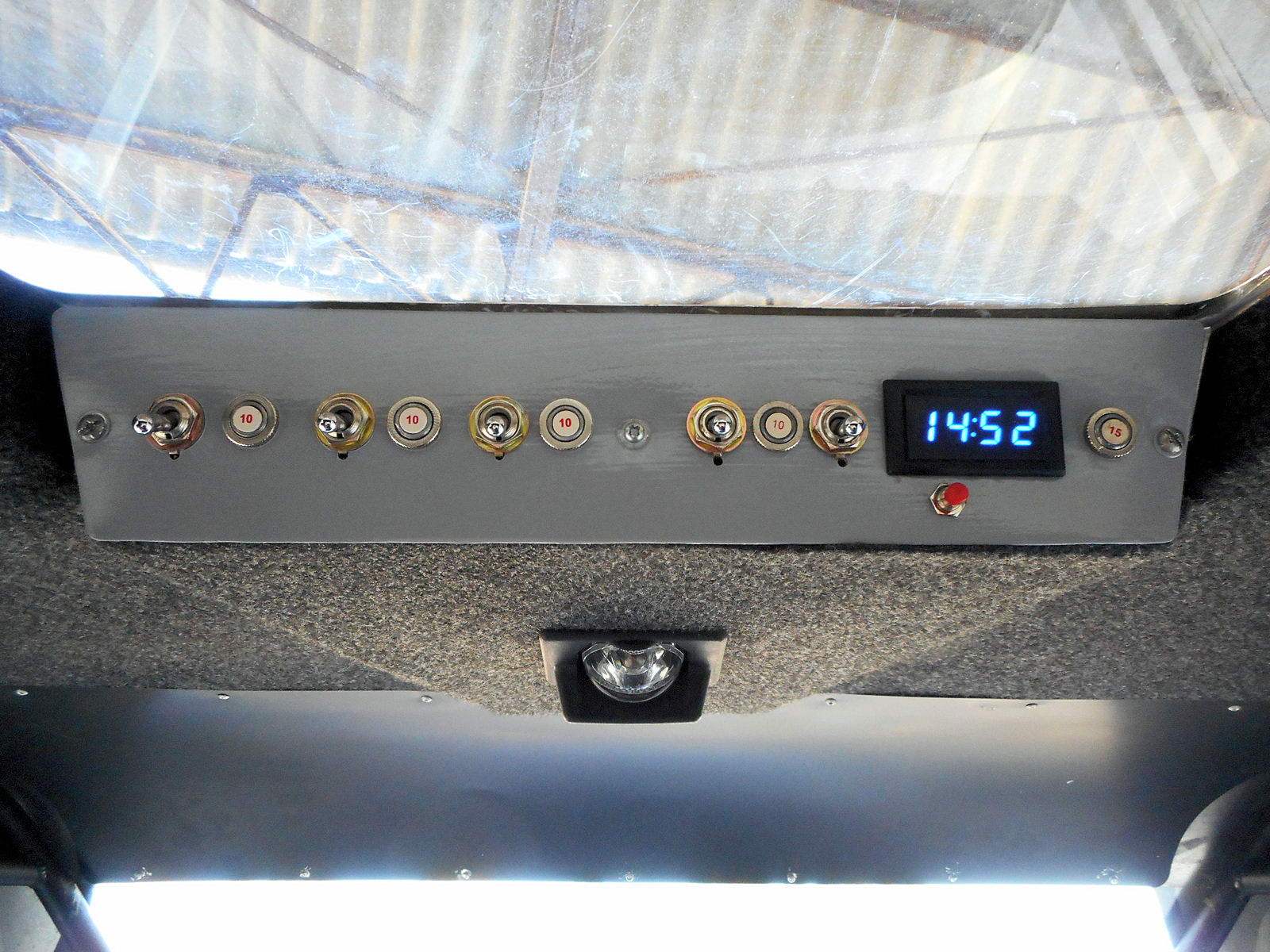
I love the little electric clock that I decided to fit and think that it was a very good decision. It only illuminates when the master switch is turned on and has an internal battery so as to retain its settings when the power is switched off. Here’s a close-up view of it.

null

The little red button is one that I’ve had in my box of electrical bits for over five years, since I was adapting the radio push-to-talk in my pal Ken’s X-Air back in the UK. It’s one that I rejected then as being too small for that application but has turned out to be perfect for this job.

It’s used to select the clock’s various functions: Time Hours/Minutes -> Time Seconds -> Date Year/Month -> Timer. It works like a charm and will save my having to use my watch for navigating by. And I also think that it’s great in blue 😉

And finally for today, the big one – sticking on the new screen top covering. I decided to use slow-curing (about 1½ hours) PVA glue in preference to contact adhesive because I wanted a glue that would allow me to move the covering around so I could get it correctly positioned and would also be easy to clean off any excess, smears etc when I was finished.

PVA satisfied both of those requirements and it seemed to work fine, although I’ll know better tomorrow when it’s had time to fully cure. I also attached one of the rubber trims that I had delivered a few days ago as an edging and also fitted the compass. Here’s how it turned out.

null

It has been hard work and a bit of a long haul, but I’m very pleased and think that all of the work has been worth it. The rubber edging isn’t quite right, but I can deal with that at any time in the future.

So all that’s left is to fit the new landing light. Apart from that, 77ASY is at last airworthy once again and who knows, with a bit of luck I might be able to get it back up in the air this week-end as on Saturday we’re expecting 15 degrees, a clear sky and light south-to-south-easterly winds. Should be more or less perfect 🙂

LED landing light

The Savannah’s landing light worked when I first acquired the aircraft but now it doesn’t. I’ve checked that there is current present, so the bulb has failed. It’s a pathetic little halogen (I think) lamp of the type used as downlights in kitchen and lounge ceilings. It’s only been fixed in using silicone sealant so changing it should be easy and I’ve been looking around for a suitable replacement.

High power LEDs are the thing nowadays and after looking around for something of about the right dimensions and brightness, I came across the following Chinese (naturally) item.

null

So for around 12€ including shipping to France I got myself in effect a pair of landing lights. They are 70mm in diameter with a depth of 45mm and should be quite easy to mount in the Savannah’s nose after slightly enlarging the existing hole. And with 9 LEDs and 27W power, they should be well up to the job, plus they don’t look too bad either.

So do they work? Take a look at the following and decide for yourself.

null

They are excellent. And with a projected life of over 5000 hours, this should be the last time that I have to replace one. But on the other hand, I do have a spare, don’t I 😉

I couldn’t resist it

It was such another lovely morning that I just had to get over to Malbec and sort out the Savannah’s new panel top covering. While I was at it, I also gave its cabin a good clean out to remove all the dust and mess that had fallen into it due to the work over the many weeks previous.

I knew that I wouldn’t have the time to complete the whole job but I just wanted to get the covering cut to shape and into position on the panel top, ready for sticking down. And that’s what I managed to do before calling it a day and dashing home for a quick bite to eat before starting on the work to get my house ready for my son’s arrival in a couple of days time.

Here are some shots of the results.

null

null

null

I’m very happy with the final outcome and think it’s a big improvement on what was there before. It won’t take much to stick it down, mount the compass and find some proper edging (what’s shown is the rubber moulding that was left over from what I put along the bottom of the new screen).

A few minutes ago, the postie beeped her horn and delivered the little clock/timer that I ordered from China to go into the cutout in the new switch panel, so that’s handy. And not only that, I’ve just received an email to say that my recently ordered new strobes that were on back-order have been despatched and are on their way. So life is looking up 😉

Yes, OK, I know…

I said that I’d have to stop work on the Savannah to start making preparations for my son’s visit in a few days time. However, with a high of 16 degrees Celsius forecast and the next stage involving a bit of painting and the use of silicone to seal the new screen, both benefiting from being done with a higher temperature, I couldn’t resist going back to Malbec today.

The first thing I did was clean up the area just forward of the new screen rubber and apply some bare metal paint. And while that was drying, I turned my attention to fitting the new high level switch panel. Here’s a shot of it – rather poor I’m afraid, because yet again I forgot my camera and had to use my phone.

null

I had to leave the strobes unconnected because the old ones are still installed and I don’t know what would happen if they were connected direct to power rather than through a control box as was originally intended. The wires emerging through the cut out will be used for the new digital clock/timer that I’m still waiting to arrive from China.

Then it was back onto the new screen and applying a bead of white sealant between the rubber and the fuselage. Despite the bit of a mess that I’d been left with by whoever had last fitted the screen, it didn’t come out too badly.

null

null

Now all that’s left to do is to fit the new panel top covering. That shouldn’t take very long but I’ll have to think very carefully before dashing to Malbec to do it tomorrow in case that won’t leave me with enough time to get ready for my son’s arrival. But it’s very tempting I have to admit… 🙂

Topless no more

I was furious last night because of what had happened earlier and because of a combination of that and a large pot of coffee that I consumed during the evening while watching the UK Championship snooker, when I went to bed at shortly after 1.00 am, I just couldn’t sleep. As a result, I was up at around 4.00 am cutting out the new roof plastic for the Savannah 😕

I managed to get to sleep when I went back to bed but still awoke at about 8.15 am, so not a very restful night. I finished off drilling the new roof plastic that I’d cut out earlier and left for Malbec after a delayed breakfast.

I went resolved to completely remove the roof panel that I’d all-but completely fitted yesterday as I knew that it would be very difficult fitting the roof window with it half-in because of the danger of geting everything smeared with silicone. I also reasoned that if I completely removed the panel and started again, it would give me a chance to re-touch the painted areas around the rivet holes that would inevitably get damaged when the rivets were drilled out.

It turned out to be a good move because although it was a long job, this time everything went smoothly and I got the roof and new window panel fitted by the end of the day. Here are the shots of the finished job.

null

null

null

null

I still haven’t fitted the new switch panel because Victor dropped by just as I was finishing attaching the roof and when I was done, I went off for a cup of tea with him and Madeleine. This now leaves just the screen seal and panel top covering to be done, so about another couple of days work. However, I will have to stop for now because my son is arriving for a long week-end later in the week and I have some preparations to make in advance of his visit.

So a bit frustrating but I’m glad to have the Savannah closed-up and weather-proof again, and much as I’d like to, it won’t be ready to fly until I’ve finished off the outstanding work. I’ll sleep better tonight, I think 😉

Disaster!

A classic case of seizing defeat from the jaws of victory. And it all started so well too.

The first job today was to lift the roof panel back off again and finish off sorting out all the wiring. Mainly that included the wiring for the strobes but there were also a few other bits and pieces, like extending the main live lead and making a connection for it and making sure that any existing cabling that I intended to re-use was in good shape.

Here’s a shot that I took of the back of the repair that I did to face of the tray that had been butchered previously on which the new switch panel will be mounted.

null

And here’s a shot after I’d finished all of the wiring including connecting the strobes.

null

I think that at least it’s a bit neater and tidier than what was there originally.

Anyway, it was after this point that the disaster occurred, although I didn’t realise that it had happened at the time. It was now time to refit the Savannah’s roof, a moment that I had been looking forward to for weeks. The roof contains a clear polycarbonate window that I was also replacing as part of the screen work.

The roof window is ‘the meat in the sandwich’ between the roof panel and the underlying roof framework and as the old one had been leaking, I thought that I’d mount the new one with a bead of silicone to prevent it from doing so. It was while I was delicately lining everything up at ground level and inserting the first row of pop rivets that I was distracted by someone turning up and engaging me in conversation.

What I didn’t realise was that in the process while I was talking, the window had moved. And I didn’t find out until the roof had been fully attached to the aircraft. It can’t stay the way it is and I’ve already drilled out the rivets holding in the window. The more I think about it, however, it’ll be easier to rectify the mistake by taking the whole roof panel off again and starting over.

That’ll unfortunately have to include cutting and drilling a new roof window, but luckily I still have enough plastic to do that. I’ve brought the old one home again to use as a pattern and I’m trying to decide whether to do that this evening or in the morning. As it’ll probably be a bit too cold to work over at Malbec first thing, I guess the morning will be the best time 🙁

New switch panel – first look

Using the Savannah’s old switch panel as a template, I cut out the shape from the left-over aluminium sheet that I thought would do the repair on the tray to which the panel is attached and which had been so badly butchered by someone in the past. As it happened, it turned out to be not too far off and after a bit of jiggery-pokery I managed to get the repair done. Here’s a shot of the finished item.

null

It was far from easy actually because not only did I have to get the dimensions about right and the three holes for the mounting screws to line up to accept the new switch panel, but I also had to attach the bracket on the rear surface of the tray front in exactly the right place so the holes in it lined up with the pop rivet holes in the roof panel. It ended up looking not very pretty but the important thing is that it’ll do the job and it’s also much better than the butchered state in which the last person left it.

But in any case, it’ll be almost totally covered by the switch panel itself, as the following ‘first look’ at it roughly in position shows.

null

It will eventually look much better when it’s fully installed because as the picture shows, there’s a big gap along its top that will disappear when the roof panel’s pop rivets are inserted. I had a couple of disappointments along the way, though.

Firstly I found that there’s a step that I hadn’t realised was there in each lower corner of the tray to which the panel is attached. Unfortunately, the 15A master circuit breaker on the right hand side just fouls the step on that side, meaning that it will have to be rotated very slightly. Not a disaster, but just bad luck for the sake of a few millimetres.

Also, while I was testing the mounting hole alignments, one of the screws popped out and landed on the seat beside me. For the life of me I’ve been unable to find it, despite taking out the seats and looking everywhere inside the cabin for it. The screw is ‘special’ as it’s part of the panel fittings but luckily Victor was able to help me out with a couple that don’t match the existing ones but will at least allow me to press on towards finishing the job tomorrow.

So tomorrow I’m hoping to get all of the wiring in place, including that for the new strobes that the supplier has told me are on 5-10 days back-order. Typical. And with a bit of luck I might at last be able to get 77ASY’s roof back on again too.

Wired-up and ready

I finished wiring-up the Savannah’s new high level switch panel today. I had to nip up to Boulazac, near Périgueux, to buy some more crimp-on spade connectors as I hadn’t realised how close I was to running out, but I got there in time before the store closed for lunch – just!

Here are some shots of the wiring from various different angles.

null

null

null

I’m pleased with the outcome and think that it’s a big improvement on what was there before. The trailing blue wire is the live to the clock/timer that’s on its way from China. All that now has to be done is to run the live to the main panel circuit breaker and connections to each of the systems that the switches connect to, so easy-peasy to connect up from now on in.

I’m now ready to go ahead and repair the tray on which it’s mounted and with a bit of luck, the Savannah will be finished by this week-end bar attaching the new strobes that I’ve ordered, as I’ll have already connected and run the new wing cables for them, and connecting the clock/timer when it arrives.

I was also very pleased to receive a ‘variomètre’ (vertical speed indicator) at lunch time when the post arrived that I recently bought off Le Bon Coin for 28AAD, my French Weedhopper. Here’s a shot of it.

null

It’s in excellent, new-looking condition. I was originally going to buy a new one from the Flylight web site in the UK but the delivery charge to France was too high and made it uneconomic. So this one for 135€ including postage from Marseilles fitted the bill nicely and with it the Weedhopper will be fully complete and airworthy 😉

Still moving along

OK, the Savannah’s new high level panel is now done and ready to be installed as soon as I’ve repaired the face of the aluminium tray to which it attaches. Here’s a shot of it that I took a few minutes ago – a pretty good day’s work I think.

null

I was scouring the internet last night for a sheet of panel switch labels and the only one that I can find that has a reasonable delivery cost is in Germany. Even that’s very expensive, so I’ll keep looking for now.

But I did decide to bite the bullet and order a new set of Aveo Powerburst strobes at the best price that I could find from aeroshop.eu in Lithuania.

Even though they blow a big hole in my budget after paying for my car repair(!) it doesn’t make sense to do all the other work involved in replacing the Savannah’s screen and then to wait until the new year before fitting new strobes. I’ll just think of them as being a somewhat expensive set of Christmas lights 😉

Just after I’d finished typing the above, Victor dropped in – in his car. In such a relatively short time after his accident, he’s driving so now he’s pretty much independent and big congratulations to him for working so hard and doing so well. There’s no keeping him down and it was a pity that we could only celebrate with coffee as it was a bit too early in the morning for anything any stronger 😀

After a quick bite to eat, I zipped over to Malbec with my now charged-up mower to give the runway what we hope will be the last cut of this year. Mind you, it’s a double-edged sword because if the winter stays mild, which we hope it does, it’ll keep growing for sure and may need cutting again. Here are some shots after I’d finished off.

null

null

And here’s a final shot looking straight down the runway.

null

Doesn’t it just make you want to open up your throttle to full power and accelerate down the centre line for one of those perfectly calm but cold autumn flights? It does me 🙂

Coming along

For some reason I overslept this morning so the day got off to a late start. After trying to decide what to do I thought that as it was on the chilly side but bright, I’d nip across to Malbec and mow the runway. I had to abandon that idea when I found that my ride-on’s battery was totally flat.

So I then turned my attention to my new high level panel front and this is where I eventually got to with it.

null

The picture shows it in its coat of special primer. Tomorrow I’ll give it a spray of light grey and hopefully be able to finish it off with its switches and circuit breakers in place. Each switch has an associated 10A circuit breaker – from the left: fuel pump, radio, strobes. Then on the other side, the landing and cabin lights that share a circuit breaker with the clock/timer that I’ve ordered from China and will go into the rectangular cutout. On the far right will be the 15A panel master circuit breaker.

The layout has worked out nicely and I think that it’ll be much nicer and more useful than what was originally in the aircraft. The circuit breakers are a bit higher than I would have liked – I think that 5A for each with a 10A master would have been ample, but I wanted to re-use the ones that were already in place.

The clock/timer will have elegant blue digits and as it will have an accuracy of 2 seconds a day and comes with battery backup, there should never be too much of a problem with its being inaccurate. I think that it’ll be handy having it and not having to consult your watch while navigating, but only time (geddit..) will tell 😉

Last ‘hurrah’ for 2016?

Possibly, as I’ve got family arriving soon and staying for a few weeks over Christmas and New Year, so I’ll not have the freedom to take off whenever I want to while they’re here. But today was just too good a flying day to miss, especially as I haven’t flown anything since back in September, with a lovely almost cloudless blue sky this afternoon, very little wind and a high of around 19 degrees C.

So Wim came up with the idea of a little local flight taking in Galinat and Condat, which would give me the opportunity to get a few landings in, before returning to Malbec. Here’s the route he suggested.

null

On climb out from Malbec, I took the opportunity to overfly Victor and Madeleine’s house as our good friend is now home from hospital, but hobbling around on crutches. As I expected, he’d heard the engines and was outside giving us a wave, so I did a quick circuit before heading off for Galinat.

I saw Wim going in ahead of me and landed after he’d had a chance to clear the runway. I was delighted that my first landing for over two months was a perfect greaser 🙂 After a quick stop, I went off for another, which was another good one, and then we both left for Condat with Wim leading the way.

Once again, Wim landed in front of me and we found that although there were vehicles there, the doors were open and the hangar was empty, so they were also off enjoying the flying weather. Here are some shots of 56NE and the Red Baron on Condat’s apron.

null

null

null

As there was nobody around, we decided to head for home and drop in at Victor’s. Wim again went off first and he’d landed back at Plazac before I overflew his airfield and turned for Malbec, where once again I pulled off a deliciously smooth landing. Very satisfying! Then it was covers on and round for a couple of drinks with Madeleine, Victor and a couple of friends. A great way to end a very pleasant day.