Chim Chim Cheree…

It’s been a lovely day here today with a high of 24 degrees Celsius and clear blue skies. Not much wind either, so pretty much an ideal flying day. But I had to be single-minded! It’s highly likely that we’ll have another similar day tomorrow, but brilliant though the prospect of having two consecutive gorgeous flying days would have been, I had to stick to my original plan for installing my wood burner. In fact, two consecutive dry days is just what I need, to do the making good on my chimney and then to fit the slab I got yesterday from Point P to make it weatherproof. So that’s what I got on with today.

I faffed around a bit too much this morning and didn’t get going until after lunch, but it still left me with enough time to do what I needed to. After I’d put my ladders up and got up onto my roof, I checked out what needed to be done on my chimney. The first thing I did was remove and throw down what was left of the remaining two of the original four tiles that had once capped it off. I thought that if I did that, then I’d be committing myself to doing the job. The more I looked at what needed to be done the more I thought, ‘Dammit, there’s not that much to do, so why do a temporary job that would mean doing it all over again in the spring when I could give it a good shot today and tomorrow, that would last quite a bit longer?’ OK, pointing in the cracks and making good the chimney rim that has been eaten away by the smoke and fumes over many years may not be a permanent solution, but heck, if I do a reasonable job, it could last for four or five years at least after which the whole stack could be torn down to roof level or lower and rebuilt, possibly as part of a proper roof refurb.

So later on there I was sat astride the ridge of my roof, having clambered up there with a hammer and cold chisel, a bucket of mortar, two small trowels, a piece of ply to use as an edge to work against and my water spray jug. And by golly, as I worked was it hot, and didn’t the insects have a field day, amusing themselves at my expense. It started off with dozens of little wood wasps that were having a day out on the warm roof and then thought it would be good fun to start dive-bombing me. They were soon joined by flies, ladybirds and all kinds of little flying beetly things who thought that they’d get in on the action too. So there I was on my roof with arms flailing around me like a man possessed while I tried to complete the job.

I managed to despite everything, and here are a few pics of how it turned out. From the ground you can see how I’ve pointed in the two main cracks and the largest of the gaps in the joints between the blocks used in the construction of the chimney.

null

null

Only when you get up-top can you see how much more I’ve done, to make the rim good and level so I can mount the capping slab on its blocks and to replace rendering that has been completely weathered away over the years.

null

null

null

I used the yellow sand I had with white cement but I think that the repairs I’ve done will end up looking a bit too light against the existing old rendering. That isn’t just because what’s there is old – builders down here use a special external finish that naturally has a pinkish-orange colour to it, and that’s what’s been used on my chimney stack I think. If necessary, when I’ve finished, I’ll get around the colour difference by slapping on a bit of exterior paint of the right sort of colour.

So that’s it for today. I have to say, it’s left me feeling very tired so if I’m going to do a good job with fitting the slab on the top of my chimney stack tomorrow, I think I might just go off for a sit-down and, er… to rest my eyes for a few minutes 😉

A super lady

In France, in this part anyway, most, if not all, of the chimneys open directly to the sky. This means that when it rains, water would usually just go straight in and find itself eventually in the fireplace at the bottom if it rains long and hard enough. To prevent this happening, the chimneys have either a stone slab placed on their tops mounted on blocks with gaps in, so the smoke can get out, or tiles in a tent-like shape, as you can see are fitted on my neighbour’s house in the first pic of my previous post. My chimney had tiles too, but they were blown away at some time by high winds, allowing the rain to get in, and for some time too by the look of the marks on the back and sides of my ‘cheminée’. I was originally going to get someone to sort the problem out last autumn by capping my chimney and doing some other work on the ridge of the roof, but after saying that they would, they never came back to do the work. So I’ve managed in the meantime by having old tins and plastic containers on the horizontal surface of the new fireplace I made to take my ‘poêle à bois’ to catch any rainwater coming down until such time as I could sort the problem out myself at the same time as installing my wood burner.

That moment came closer with the arrival of my new roof ladder at the beginning of this week, which allowed me to get up onto the roof for preliminary investigations. I now know that so long as I fit a temporary chimney cap that’s heavy enough not to be blown away by winter winds, I can go ahead at full speed and install my wood burner, which will make so much difference this winter compared to last. I’ve decided to ditch the idea of tiles and go for a nice solid stone slab and so I’ve been going to various places to see if I can find a suitable one. I started by going yesterday to Point P, the local builders’ merchants in Montignac where the lady who originally got my floor tiles for me has always been so helpful. There were a few slabs of the right dimensions (60 x 40 cm) from various suppliers but I thought I’d continue looking before making a final decision, so I then went to Brico Depot in Perigueux. That was a waste of time as they had nothing of the correct dimensions, so today I made a visit to Périgord Noir Bricolage to see what they had to offer. Again, the answer was nothing, so I decided to stop wasting time and go back to Point P.

My lady was there behind her desk in the showroom as usual and I explained to her what I was wanting to do. She came outside to view the samples I’d seen but explained that regrettably it isn’t possible to supply a single piece of such items, which are usually purchased in quantity, of course, to pave over fairly large areas. I said that no worry, I could make my own (with some light concrete and a wooden mould) but that it would have been so much easier if I could have just got my hands on a single slab.

She told me to wait a moment while she got her ‘jaunes’ (yellow hi viz jacket) so we could go into the yard, and as we walked together down one side she exclaimed ‘Voilà!’ There was a single slab of the right dimensions and colour lying with some other bits and pieces on a small pile of pallets and she told me I could have it if it was suitable. Naturally, I was delighted! As we walked back towards the office, she told me that she couldn’t charge for it and when I said that that wasn’t necessary, she assured me that it would be ‘un petit cadeau’ (a small gift). I said that I also needed a few small blocks to mount it on, so ended up with initially four, but finally eight small paving blocks that I thought would do the job. So then we went back into the office to total things up. As she said before, the slab was free but that she’d have to charge for the blocks, and the total sum owed came to 2.93€!

What a super lady and she gave me the loveliest smile as she took my cash. I told her, in French of course, that I’d have to add her to my Christmas card list, and she said that she’d prefer a box of chocolates. Ladies are the same everywhere, aren’t they 🙂

Here are a couple of pics of what I got to make my chimney cap out of – all for 2.93€ and all thanks to the super lady at Point P builders’ merchants.

null

null

OK, so now where do I get a box of chocolates from? 😉

When this old world…

You know what comes next… and where do you go? Up on the roof, of course. Well, the world’s not getting me down – far from it – but that’s where I went early this afternoon. I put it off all morning because the weather forecast was for ‘inescapable’ rain, but I waited and waited and nothing happened. So then I got my ladders out and, yup, you’ve guessed, it began to spit. I gave it a few minutes and the sun continued to weakly show its face through the thin high cloud. So I thought, ‘to heck with it’ and decided to put my climbing boots on, as I needed to take the measurements of the top of my chimney stack so I can make some sort of weather-proof cap for it. I also wanted to look down it with a torch so I could see what sort of tubage had been inserted by the previous resident, who as I’ve mentioned on previous occasions, had a free-standing ‘poele a bois’ on the floor next to the fireplace with its flue connected into the chimney from the side through a tube inserted into the stonework.

I managed to do both of those things and while I was at it, give the blockwork and rendering a closer inspection. The condition of both is not critical, but not that good. I think that I’ll be able to get away with just hacking bits of rendering off where it’s cracked, re-pointing the joints between the blocks and patching the rendering to make it good again. I’m pretty certain that that will be enough as although the blockwork is ‘live’ ie not solid, it’s not about to fall down. The only problem is, will I be able to do it (a) before I install my wood-burner and (b) before the winter? After mulling it over for a day or so, I think that I will end up having to make a temporary cap for the chimney, install the wood-burner and then return to the chimney stack problems in the spring when the weather improves again. That way I know that I’ll at least have the heat in the house that I’ll need during the winter.

This conclusion is further reinforced after looking down the chimney with my torch. After looking at ‘how to’ videos on the internet, my original intention was to insert a tube from the wood-burner flue in my fireplace right up to the top of the chimney, which would have meant fitting a securing bracket at the top and, most likely, a permanent cap. However, Wim said that this wasn’t necessary – all that I needed to do was place a couple of lengths of tubing on the top of the wood-burner to get the smoke well up into the chimney of the house and updraughts would do the rest.

After looking to see how it was done previously, I now think he’s right. The light of my torch showed that all the previous resident of my house did was shove a short length of tubing into the side of the chimney without having any up-turn at all, so at the end of the day the chimney was just being used in its original function. So that gives me the option of placing a (heavy) temporary cap on the top of the chimney, running a few lengths of tubing up the chimney from the bottom and installing my wood-burner with its flue connected to them. And that’s what I’ve now decided to do. The top of my chimney measures 60 x 40 cm so I need to make some kind of cap (probably out of light concrete with a bit of reinforcing added) just a bit bigger than that, with a block on each corner to raise it off the chimney itself so the smoke can escape. Now I just need to get cracking on it.

While I was aloft, this time I took a few pictures, and here they are. The first one is looking west over my neighbour’s house behind mine, in the direction of Rouffignac.

null

The next one, below, is looking in a southerly direction towards Plazac, which can’t be seen as it’s in the valley some way beyond the hill, and Fleurac, where Wim has his airfield.

null

And finally, this shot is taken looking north towards my neighbour Jean-Claude’s house

null

And here’s something with which to finish off. I thought I’d check out the lyrics of ‘Up On The Roof’, which is a Goffin/King song that I’ve always liked but haven’t listened to for some time. I found the following link, which has a video in it of a performance by James Taylor at what I think was a concert attended by relatives of firemen and policemen who were victims of the events of 9/11. I found it very touching and I hope that readers enjoy it too.

Fire and Rain & Up On The Roof

It’s all happening!

Isn’t it strange how when you’ve been waiting for several things to come together, they all do so at the same time! I decided that now I’m flying regularly again, it was time for me to upgrade my trusty little old Pentax Optio digital camera. It’s served me well for several years and is still working as well as it ever did even though it’s been bashed around, sat upon and goodness knows what. But with a resolution of only 7 Megapixels, it’s now some way behind the curve, for most smart phones let alone the current batch of small automatic cameras that are now available.

After searching around, I took the decision to replace it with a Panasonic Lumix DMC-SZ3. I like the specs of this little camera – 16.1 Megapixels resolution, 10x zoom that extends to 20x with the on-board electronic jiggery-pokery (that’s the technical term for it, by the way) and what is reputed to be one of the best image stabilising systems around, are what sold it for me. The last feature will hopefully help to transform my airborne shots compared to what I’ve been capable of up to know. Here’s a picture of it taken from Panasonic’s own web site.

null

I got it from Ebay UK and after being sent on to me, it arrived on Friday. I’ve done a few shots to test it out, no flying ones yet of course, because of the weather, and the initial results look very promising, so I can’t wait to get it up into the air.

With my wood burner hopefully soon to be installed, I need to turn my thoughts to how I’ll fuel it. I’ve been collecting suitable wood in a piecemeal way but I’ll have to start doing what everyone else does, which is buying it in in quantity, and that means that a chainsaw will be an essential item to have. Although my stove will take 50cm long logs, they are usually delivered in lengths longer than that and so will need cutting down, plus you always need smaller lengths anyway, to bank the fire up and to start it, of course. To cut a long story short, Brico Depot recently announced a special offer – a chainsaw with a 45.4cc 2-stroke engine, ‘Oregon’ blade and guard with a 42cm cut and a 2-year warranty, all for only 69.90€. The way I look at it, even if it only lasts for just a bit longer than the warranty period, it has to be a good buy compared to the ‘big-name-brands’ that start at around 3 times the price with shorter length cut, so I picked one up at the end of last week.

Like everything you buy nowadays, there was a certain amount of self-assembly necessary (OK, just fitting the guard and chain, actually, so no big deal I suppose) but then it just had to sit there with me unable to test it out as the rain fell down outside. For a couple of days – until yesterday. Then it stopped just long enough for me to go into my back garden and cut up an old fallen tree that up to now I’d had no idea what to do with. Well, what was originally a pain in the backside was soon turned into a useful resource – a nice little pile of chopped logs all ready to go onto my wood burner when the time comes. Before I’d finished, the rain started up again and I ended up getting drenched while I grabbed one of MYRO’s old covers to put over the pile to keep it dry, but it was worth it. I’ve never before either owned or even operated a chain saw, but I was amazed what a dream it was to use. It made mincemeat (or more accurately, logs…) of that tree in no time at all, and was out of sight compared to doing the job by hand. So I think my new ‘tronçoneuse’ will turn out to be a good buy and a useful asset in the future. I doubt that I’ll be exactly over-working it as I’ll only be chopping logs and taking off the odd tree branch, so I doubt that it will fall to bits in the next two years, hope not anyway. After I’d finished, I found that the chain had slackened off a bit, but it only took a few moments to tension it up again today, so it’ll be interesting to see if it stretches again the next time I use it. ‘Oregon’ isn’t the top brand in the world by far, but it’s pretty well known so I hope that the chain and guard will give some reasonable service. Here are a few pics that I took of the saw this morning with my new Lumix camera after I’d re-tensioned the chain.

null

null

null

null

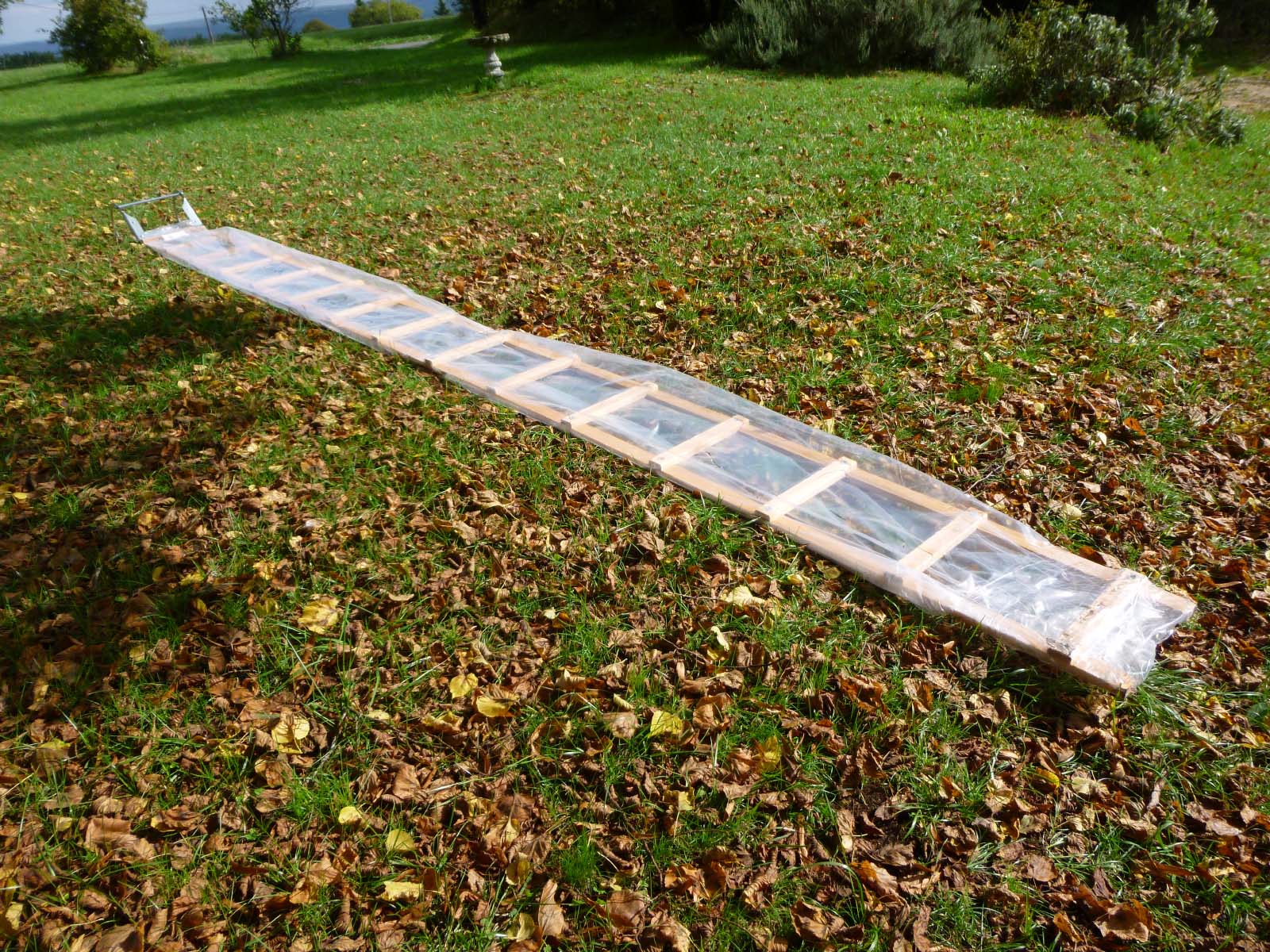
But hey, that’s not the end of it! Just after lunch today, the phone rang and it was a delivery driver asking for directions to my house. I knew immediately that it had to be my new ‘echelle de toit’, my roof ladder. Glory glory, so not another ‘microwave’ incident after all – they really did need two weeks to deliver it, according to the attached label (despatched on 2nd October). I can only surmise that they’d looked for the most economical form of shipment, and presumably if they’d found a bloke on a bike who’d have done it for less, I’d still be waiting. But no matter, it’s here at last. Here it is on my lawn with the ‘accrochement’ attachment that allows it to hang from the roof ridge next to it.

null

null

It took me half an hour or so to attach the ‘accrochement’ which fortunately was of exactly the correct dimensions, and then I was able to put it up onto the roof and try it out. To give you some idea of the scale, the ladder is 5.85 metres long.

null

And then, yes, I did nip up it to give it a go. OK, I did have some minor reservations to start off with as I’ve not done that kind of thing for a few years (ahem… quite a few actually) but in no time at all I was giving my chimney a close inspection for the first time. While I was doing so the sky was already beginning to cloud over again, so no time for any pictures, but I did manage to move what remains of the broken capping tiles in the hope of stopping the rain coming down my chimney. Then it was time to get down quickly and move the ladder under the eaves of the house to stop it getting (too) wet – there’s nowhere I have that’s completely under-cover that will take it. The rain is only falling quite lightly at the moment, but it’ll be nice if, when it does start up more heavily again, I don’t have it coming down my chimney any more until I can do the job properly. I’ll just have to wait and see – and now I think that after all today’s activities, I deserve another cup of tea. Or maybe something a little bit stronger as the sun, if it was out, would by now be well over the yard-arm 😉

Beyond a joke

My roof ladder still hasn’t arrived – it will be two weeks this coming Monday – and I’m beginning to fear that this will develop into another ‘microwave’ incident with the supplier taking my money, it never turning up and me the having to battle to get my money back. I’ve already had the ‘smooth words’ in response to a message from me assuring me that it takes a long time to deliver a large object like a ladder across France, but I’m not convinced. Fortunately I used Amazon to process the order so hopefully it shouldn’t be too hard to get a refund.

I’m appalled that it should be such a tricky and uncertain business buying stuff on line and knowing that it will be delivered in a timely way in France. It seems positively medieval that the only way that you can guarantee getting your goods is to go to the shop and pick them up yourself and in my view it goes a long way to explaining why the French economy is in the state that it is. It would appear that on line merchants here can’t really be trusted, which comes as a shock to someone coming from the UK who is used to routinely buying almost anything and everything on line.

And what is really annoying is that having been let down once again, my plans have been put into total disarray. The weather was perfect this past week for me to have climbed up onto my roof and fitted a new rain-proof cap to my chimney and it would have only taken another day or so to have put my wood burner in place. As it is, as I write this we’ve entered a cold snap and the house is almost as cold as it became by the end of last winter. And still I have no heating apart from a small fan heater, which I’ve got running to warm the place up a bit, and the electric wall heaters that I fitted that are effectively unusable for any length of time because of their running cost. I’d been warned that they would be expensive, but it came as a massive shock when I got an electricity bill of over 700€ after last winter, mainly due to running the electric wall heaters, which were not that efficient in warming the place up either.

So you can see why I need to get the wood burner installed. But before doing so I have to cap the chimney and to do that I need the roof ladder. Last year I was let down by a contractor who said he would do the roof work for me and then disappeared off the face of the earth, it being made worse by the fact that he was a fairly close neighbour. That was why I left it too long before it became too late to have the work done and I must prevent the same thing happening again. I now have to decide how to tackle the problem which, as the rain steadily drips down my chimney as I type this, is really now way beyond a joke, let me tell you 😡

Marking time for a few days

I don’t want to push my luck by flying since I found that my carburettor inlet rubbers are a bit perished, and as I’m still waiting for a new pair that I ordered from JBM Industries in the US on 29th September to arrive, I’m effectively grounded. We’ve had a few stormy days (and nights) in the meantime while the X-Air has been tied down at Galinat, but on the way back from the supermarket the other day, I dropped in and checked to make sure that everything was OK and was reassured by how effectively 56NE’s new outdoor covers are performing.

I’ve also been marking time in the house. On the same day that I ordered the carburettor rubbers, I also ordered a roof ladder and the attachment that lets you suspend it from the pitch of the roof, so you can climb up it without it sliding down. I used two different French suppliers for the items and to give credit to the one from whom I purchased the hook attachment, that arrived after three or four days. Even so, considering that it only had to come from Bordeaux and that they had charged a massive 40€ for delivery, I was hardly impressed. I am still waiting, a week later, for the roof ladder to be delivered. I don’t know what it is about French businesses. The French are lovely people but for them, customer service is a totally alien concept. Once they have taken your money, they think that their actually supplying the product that you’ve purchased is a bit of an inconvenience and that you should think yourself lucky to receive it a week or so after handing over your cash. From my experience having run my own small business, they are so out of touch with the modern internet age. In the UK, two or three days delivery for items held in stock is the norm. I routinely buy items from UK Ebay because for one, the same item, if it’s available in France, is almost always more expensive, and for another, I can invariably get it delivered to my home more quickly from the UK.

Here’s another example from the last few days. My car insurance expired at the end of September and as the quote I’d received from my existing provider was much too high (after a claim-free year, I’d expected it to go down but in fact it increased by over 20%!) I decided I’d look around for an alternative provider. Ignore the fact that legally you have to give your existing provider at least 20 days notice of termination, otherwise like it or not you are stuck with them – what a weird idea, so ‘quaintly administrative’ and so French. So where do I look? On the internet, naturally. I find a provider who appears to be offering what I’m looking for at a much reduced price compared to my existing one’s quotation. After a tortuous on-line process of clicking buttons, making a wealth of multi-choices and agreeing to conditions, I expect finally to end up on the last page of the system with a button labelled ‘click to buy’, or something like that. No. I get a button saying ‘click to receive a call from our customer service agent’, which I do and eventually give up on after waiting for an hour or so beside a stubbornly silent telephone 🙁

So I then have another go, find another on-line provider and repeat the whole process all over again, only to find on this occasion that I end up with no button at all and instead a request to now ‘call their customer service department’ on a toll-free number to complete the purchase.

I’m gullible, so I do. I get the usual cheery music and a hearty voice telling me how much they appreciate my call and that I will be dealt with in … four minutes. So I wait and after a while I get the same hearty voice again, reiterating their appreciation and telling me that I’ll be dealt with in … six minutes! OK, I’m not paying, so I decide to hang on. When the voice next comes on and tells me that I’ll be dealt with in … eight minutes, I decide that life is too short and hang up. On Youtube, it’s what’s called ‘a FAIL’ 😕

Third time lucky, this time I find a provider who does the whole thing seamlessly on-line and even gives you a choice of payment profiles, single, quarterly or monthly, and although this is absolutely the norm and how it’s routinely done in the UK, for some reason I end up feeling grateful, even though the list of paperwork that they say I must send by mail is as long as your arm. Unfortunately they rather spoilt it by calling me up early the next morning just as I was getting out of bed and rattling off a whole stream of questions to me in French that, understandably, I found hard to follow. So they told me that I must therefore go to an agent. Naturally, as the reason for completing the tortuous process on-line was precisely because I didn’t want to go to an agent, I told them what they could do with such a request. I subsequently sent all the papers off that they requested and have received confirmation of interim cover, so I’m holding my breath to find out what the next phase of the process will be 😯

STOP PRESS: La Poste just came while I was writing this. I’ve been out to collect the delivery from my post box and it turns out to be my carburettor rubbers from the USA. Good lord, it’s taken less time for a parcel to be delivered to my home from the USA than for my roof ladder to be sent a few kilometres across France. Doesn’t it just go to show what I’ve been saying 😐

Where was I? Oh yes, so what exactly have I been doing during these past days of enforced idleness? Not fixing my lawnmower – again – that’s for sure, which is something I need to do before my grass overwhelms me again. Nope, I’ve been turning my hand back to something that I used to do several years ago, but have since lost the skills and know-how for, namely flight simulator scenery design. I won’t go into it in too much detail, but anyone who runs flight simulator software on their PC knows that it comes with ‘default’ scenery consisting of airports and airfields with buildings and features on that resemble, but are not actually close copies of, their real-life counterparts. Indeed, many smaller airports and airfields are not even included, and to ‘improve’ the default ones and add the ones that are missing, it’s up to independent designers to create the sceneries and upload them to web sites where flight simulator enthusiasts can go to download them.

This is something I used to turn my hand to, and the first couple of videos in the My Trike video gallery were recorded at flight simulator locations I made the sceneries for. With the winter approaching and with the desire not to just be slumped in front of the TV during the long evenings to come, I had a hankering to use the time more productively, by getting back to scenery design. It was sparked when I had the idea to make local ‘sceneries’ for Galinat, where I keep 56NE, and Cavarc, where I went to get my French brevet. I carried out some experimental work, which was successful, but I knew that I needed to brush up on my skills before I tried to go any further, as I would need to create detailed models of the buildings etc at the locations to give them a more ‘realistic’ feel. So in order to do so, I thought I’d see if I could make a model of my house, which over the past few days, I’ve now done. See what you think of the results.

null

null

null

I think I’m just about back where I used to be with levels of skills and know-how similar to what I used to have. So I’m now ready to press on with my new Galinat and Cavarc sceneries and I’ll have to see how I get on. I’ll maybe post some updates on progress from time to time.

We’ve got a lovely day here today – almost pure blue sky, very little, if any, wind and a temperature of just over 21 degrees Celsius. An almost perfect flying day and I wish that now I’ve got them, I could nip across to Galinat, fit my new carburettor rubbers and get airborne. But I can’t because I’m still waiting for my roof ladder to arrive … 😐

Back at 6.30 pm to say that I’m really annoyed – the ladder didn’t arrive so I could have fitted the new carburettor rubbers and had a flight on what has been the best day for more than a week. It’s too late now because of the time it would take to remove 56NE’s covers and fit the rubbers, and I guess I’ll now waste another day too waiting for the ladder to be delivered tomorrow 😡

The weather always wins

In the end, despite all of our super-computers, weather models and fancy forecasting tools, the weather always ends up making fools of us all. All of the weather web sites that I use have been forecasting unsettled weather with thunderstorms for Plazac this week-end (Saturday and Sunday) for the whole of this week. In the event, I wasn’t planning to fly, because I flew on Thursday anyway and when I pre-flighted 56NE I found perished carb rubbers that I flew with anyway but have now ordered replacements for from JBM in the States. But Victor was, and had his flights at Cavarc cancelled because of the forecasts.

Well, this morning was a bit grey and overcast, as it has been in recent days, but I’ve just been outside (at 2.30 pm local time) and the weather seems to be laughing at the forecasters, with bright sunshine and an almost cloudless sky. There’s a freshish breeze from the south, but nothing that would stop anyone flying in an ULM, and I can’t really see any sign of the forecast thunderstorms materialising as things are. But then, what do I know – I could easily be wrong, couldn’t I 😆

Northern sector

I’m trying to systematically cover the whole of the local area around Galinat and where I live so I can eventually get to know it and the local landmarks. Once you’ve done that, flying becomes so much more relaxed because you’re never uncertain of your position, plus you can also spend more time enjoying the scenery. I’ve initially covered the western and south-westerly sectors during my flight to Cavarc and my recent local jolly with Wim, so I thought it was now time to head north.

Although I came down from the north in MYRO, I don’t remember very much about it because the vis wasn’t very good and also it was well over a year ago. So I’ve had a short flight planned to remedy that and after waiting a short while for the haze to clear a bit this morning, during which time I did my earlier posting, I decided that I’d do it this afternoon. Here’s a picture showing my planned route in green and my actual track in red.

null

As you can see, I initially planned to head north-west up to St Geyrac which is a very small village on the way to Perigueux from Rouffignac. In the event, having flown closer to Rouffignac than I’d originally planned to, I decided to give St Geyrac a miss this time, cut the corner and head straight round to Fossemagne. This is a village on the road east from Perigueux to Brive and I’m afraid that having driven through it, it doesn’t seem to have an awful lot to commend it. However, here’s a picture that I took of it.

null

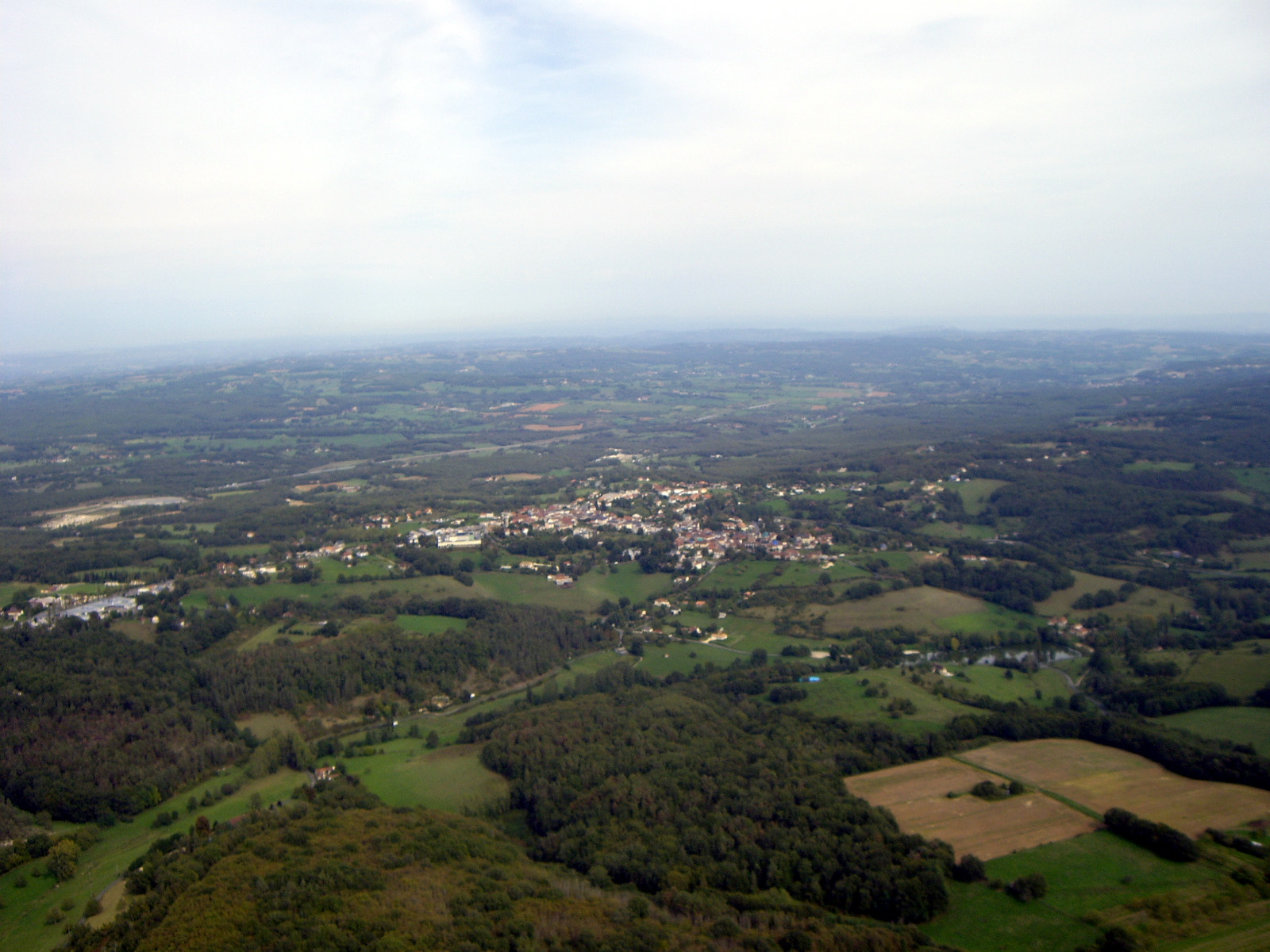
The next place on my planned route was Thenon. This is another village that people tend mainly just to drive through because it straddles the main road and it’s also where you turn right if you’re coming from Perigueux and heading for Montignac. Here’s a shot that I took of it today.

null

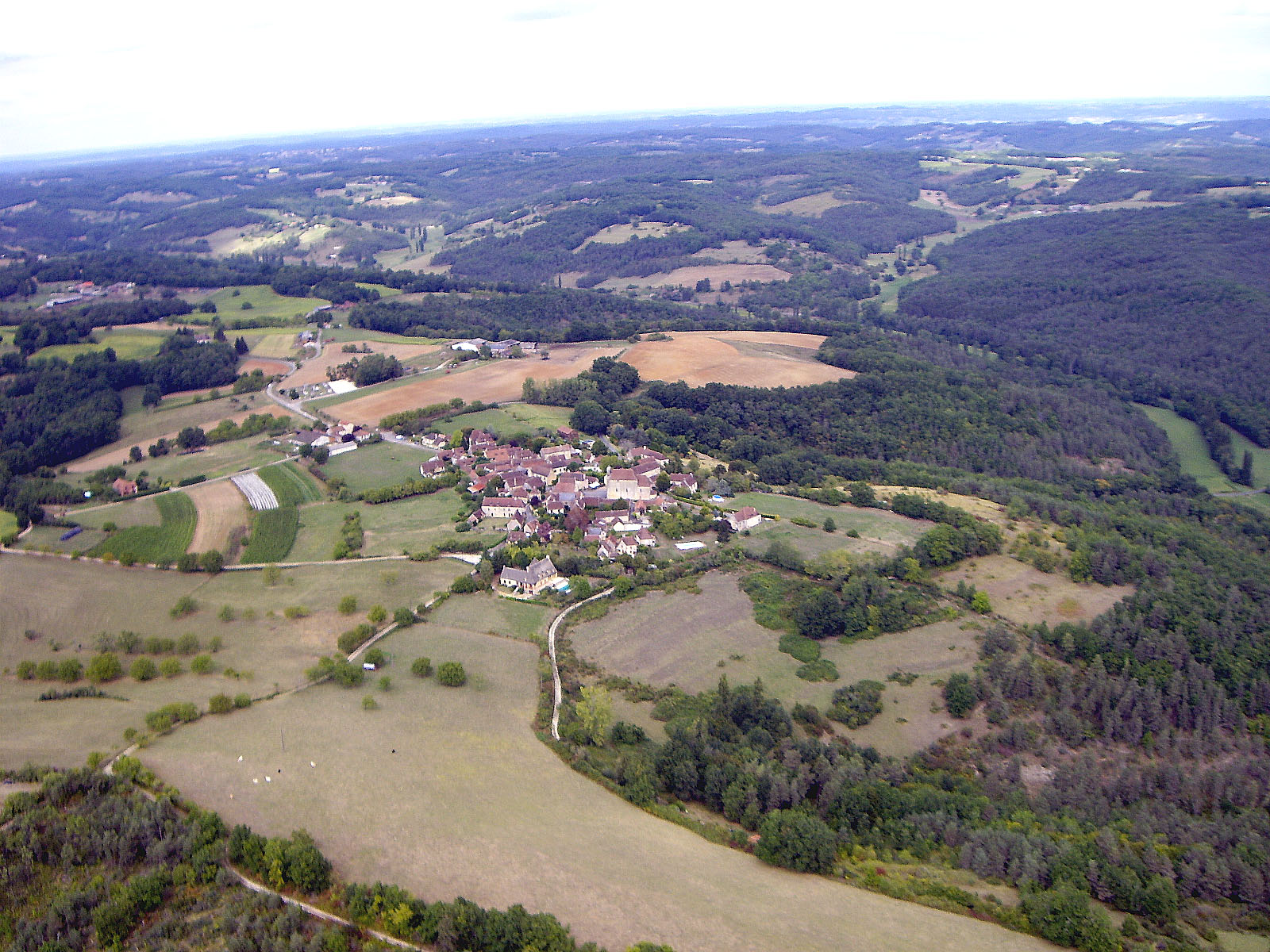
The road from Thenon to Montignac is fairly flat because it follows a tributary of the river Vézère. There are low hills on either side and roughly mid-way between Thenon and Montignac is the village of Auriac-du-Perigord which is really just a sleepy little hamlet. I don’t think that I’ve ever seen more than a dozen or so people there whenever I’ve driven through it, and that was when there was a group of men playing boules in the village centre. However, it’s very pretty and like all of the small villages in the Perigord, beautifully maintained and looked after. Here’s the picture that I shot of it.

null

I then continued on to Montignac which is always worth a fly-by. The picture that I shot today was considerably better than the last time because it was lighter and I was also flying lower than before.

null

The same is true for the Chateau de Losse which I took a shot of as I headed back towards Thonac for my approach back into Galinat.

null

The whole flight took only 40 minutes and I enjoyed it immensely. Having the rudder pedals a bit closer was much more comfortable and, as expected, my toe brakes were much more effective as well. It took me only 15 minutes to get the covers off 56NE and ready for flight as I’d already fuelled up during my previous visit to Galinat. It took 40 minutes or so to get the aircraft parked up and covered which I’m sure I’ll be able to get down to around 30 minutes in the future. I’ve moved it round to the side a bit away from Regis’s ‘hangar’ as I’m sure he’ll want to park his Zenair there, which is now at Galinat. For the time being he’s parked it up high on an up-slope, which is not very satisfactory, and I’ll also have to take some concrete blocks to the airfield so Regis can have his ones back to tie his aircraft down with. And I’ll also have to let him have his wheel chocks back so I’ll need to make some of my own. But I don’t think that that should be too difficult 😉

Next house job planned

The ladder that I bought from Brico Depot to put up my satellite dish isn’t long enough to get me safely up onto the roof of my house so I’ve had to think of another way. I thought that I’d do an internet search for roof ladders – ‘échelles de toit’ or ‘échelles de couverture’ in French – and came up trumps. My thinking is that I’d rather buy the tools to do jobs myself instead of paying someone else to do so because then you’ve always got them should similar problems arise in the future. Or you can always sell them again and get most of your money back, which will always work out cheaper than having someone else do the work, which I’m generally always capable of doing myself. Plus I’ve got the time, of course.

Anyway, I found just what I was looking for on, surprisingly, Amazon.fr, where I can buy a roof ladder of just over 5 metres in length for less than 120€ including delivery. A wooden one is fine for what I want to do – replace some ridge tiles, re-render my chimney and fix some tiles on its top – a fancy aluminium one would cost a lot more and only be worth buying if I was going to use it regularly, which hopefully I won’t be. The ladder doesn’t come with a ‘hook’ to hang it from the ridge by – a ‘crochet de faîtage’ in French – but I can get one of those for just under 60€ without wheels, or 90€ with, from another supplier in Bordeaux.

So I’ll be getting those delivered next week and then I’ll be all ready to do the work. I was quoted a starting price of 400€ by a contractor last year, depending on what he found when he got going, so the saving will leave me with a handy contribution towards my 56NE fuel fund – I’d rather be flying after doing the work myself instead of standing on the ground watching someone else do it. And I’ll have the ladder afterwards so I’ll be able to fix some broken tiles I’ve got, clean moss off the roof, stuff like that. All round I think it should be a ‘win-win’ situation 😉

Annoyed and disappointed

This afternoon I found that for the second time since I’ve been in France, someone has stolen the fuel cap off my car. Unfortunately, the fuel flap on the side of my Astra only locks when I lock the doors and the fuel cap inside simply unscrews. Quite often, like today, I don’t bother to lock the car when I leave it in the supermarket car park and someone was obviously close enough to see that I hadn’t. I thought that the first time was just a ‘once off’ and I’m disappointed that such a thing should have happened for a second time. It’s sad to think that such people are amongst us. Luckily, I still had the temporary cap that I bought to get myself out of trouble the first time, so could just put it straight on. Last time I bought a replacement cap off Ebay. This time I don’t think that I’ll bother 🙁

A good afternoon’s work

When I began to re-assemble 56NE in my back garden in March of this year, one of the first things I found when I was doing the tail was that instead of the rudder cables being attached directly to the operating horns, they were each linked by a small stainless steel shackle. These had the effect of slightly extending the lengths of the cables but at the time I didn’t think any more of it.

However, when I started flying the aircraft, I found that although I could safely fly it, the rudder pedals were a bit too far forward for my comfort. And then various things began to link up in my head – I could never properly reach the toe brakes, which wasn’t a problem in the English X-Air that I’d flown, and when I did apply them, they were never effective enough for my liking. Readers might recall that I spent some time trying to adjust them a short while ago, without complete success, I must say.

Then it finally occurred to me. Bertrand, who had been 56NE’s main pilot before I bought it, is very tall, well over six feet, and is very long in the leg. Let’s just say that I’m not. By extending the rudder cables, he had effectively moved the rudder pedals forward to fit his legs in more comfortably, and this is why I was having the problems that I was. Even the toe brake problem I surmised – by tilting the rudder pedals forward, it would make it much more difficult to get your toes on them properly, so if the pedals were moved back, I thought that not only would I be able to operate the rudder more comfortably but I’d also possibly get more effective toe brakes.

And so it turned out this afternoon. I couldn’t just remove the shackles as there are solid steering rods connecting the rudder pedals to the nose wheel that would need lengthening to compensate. Each rod is only held on by two nuts so it didn’t take long to remove them, take out the shackles and reconnect the rudder cables. I ‘guesstimated’ how much I’d need to lengthen each rod based on the shackle size and I turned out to be dead right in one go, so the steering rods were back on in a jiffy. Time to jump into the pilot’s seat and try them out – perfect. And what about the toe brakes? They now felt as though they’d hold the aircraft while I do my mag checks, which they wouldn’t before. So a good afternoon’s work, taken all round. And I even managed to do my washing as well 🙂

By the way, it appears that we enjoyed a high of 28 degrees Celsius today. I think it was probably hotter on the airfield – my car temperature gauge showed over 30 degrees when I got in to come home – and it certainly felt sweaty enough for that while I was working. The weather forecast is now giving 32 degrees by the end of the week (Thursday and Friday) but with an increasing chance of showers at the same time. So it looks and feels just like summer at the moment – and the sky couldn’t have been bluer today. But it can’t last at this time of the year, and it looks as though we’ll be back to a more seasonal 24 degrees come Saturday and Sunday. So I must take the chance to get the capping tiles onto my chimney this week as then I’ll be able to install my wood-burner at my leisure even if there are showers.

Great fun!

Wim knew that I wanted to fly today so he phoned this morning and suggested that we might go together – he in his Weedhopper and me in 56NE. The trouble was that although the weather forecast was for virtually cloud-free skies and a temperature of 22/23 degrees Celsius, at the time he phoned it was still overcast with hill fog. In fact, not only couldn’t I see the other side of the valley where Galinat is, from my house, but I also couldn’t see beyond the end of the field opposite. We knew that the low cloud would probably burn off, but the question was, by when.

In fact it cleared with plenty of time for us to meet at Galinat as agreed, at around 2.00pm and as I got 56NE ready to fly, I heard and saw Wim flying in from his strip at Fleurac. He shut down his engine after landing but within a few minutes I was ready to go and he started it up again and took off. As this would be the first time we had properly flown together (I’d followed Wim over to Galinat in my first flight in 56NE when I’d taken off from the cow field near my house) I said that I’d follow him leaving a reasonable distance between our aircraft so I could gauge the difference in cruising speeds and see how stable 56NE was flying at around 80 kmh, which is less than optimal. In fact it wasn’t difficult controlling the distance between our aircraft but I did find that because 56NE was flying at a high angle of attack, the extra drag made me use higher engine revs than I otherwise would have in the cruise, even though I was flying more slowly.

After take off we turned left to follow the river Vézère down to Les Eyzies, which I’d done previously when I flew down to Castillonnes. Then I watched Wim sweep round to the right as we headed back up to Fleurac. We flew over the chateau as I did in my previous flight but this time I spotted Wim and Sophie’s house easily, which I couldn’t do before. Then we continued up to Rouffignac and when he arrived there, I saw Wim sweep round to the right again, which I did too several moments later. That took us on a heading towards Plazac and as Wim was then going to land at his strip, he started to descend. I carried on at the same altitude and was surprised how difficult it was to keep his aircraft in constant sight against the textures and colours of the ground at this time of year. I watched as he turned onto final and then turned my attention to my own landing at Galinat.

I had an amusing experience. Whereas I’ve spotted Galinat without too much difficulty each time I’ve flown previously, this time I was a bit too blase and found myself lined up on an adjacent farmer’s field which I was surprised to find looked very similar from a distance. The clue was that as I approached it, it turned out to be far too scruffy to possibly be Galinat, so I decided to do an over-pass and look for Galinat, which I immediately spotted to my left, a little bit lower down the hillside. It was easy enough to safely double-back in a large S turn for an approach and landing on the correct runway this time, and although it all went well, it served as a little lesson that you can’t afford to relax too much down here, until you’re sure you’ve spotted your destination airfield and runway.

Although I didn’t pre-plan the flight into my new little satnav, I did have it running to record the track of the flight, which you can see below. The sharp left and right turns to land at Galinat can be clearly seen in the image.

null

I’ve checked the speed profile of the flight and sure enough, it comes out to an average of around 50 mph (80 kmh) which is roughly the speed at which Wim’s Weedhopper flies. However, it’s noticeable that it varies between roughly 40 mph at times when I was climbing, and 60 mph, as I tried to maintain my distance from Wim’s aircraft. I’ll need to watch this in future, as although 40 mph is above 56NE’s stall speed, it’s not that far above it.

I had another amusing experience after I’d landed. As I taxied round to where I park 56NE, a figure in tee shirt and shorts appeared out of the bushes clutching a camera. After starting to speak in French, he turned out to be an American visitor named Mark who was renting a house locally with a group of friends. He related how he’d watched me fly around, line up and land and seemed quite excited by the whole thing. He said that he wasn’t a pilot himself but that he was very interested and could I take a picture of him sitting in the aircraft? I agreed of course, and he eventually went off the proud owner of a couple of shots taken from each side of the aircraft 🙂

But that wasn’t the end of it. Just afterwards, a middle-aged French couple stopped and asked me the way to someone’s house, who turned out to be the owner of Galinat. So I gave them directions, and off they went too. In the meantime, I had been tweaking some of my tie-down ropes and putting on 56NE’s covers. I then had another visitor, who turned out to be the owner of the single engine aircraft in the hangar at Galinat. It turned out that he’s unable to fly because its certificate has expired and needs renewing but we had to spend several minutes chatting, of course, and catching up on the latest Galinat gossip.

The outcome of chatting with all these visitors was that I didn’t get away from the airfield until nearly one and a half hours after I’d landed, but then again, that’s half of the fun of flying, isn’t it 😉

She was all dressed in black

The last time I saw her…

I cut and stitched the last two sections of 56NE’s covers yesterday, for the over-wing centre section and the rear fuselage. I was then waiting for the brass eyelets that I needed to finish them off, to arrive, which they did in the post today. It didn’t take long to pop the eyelets in, although the hole cutting tool is getting a bit well-hammered and blunt now, after all of the eyelets I’ve inserted, and after lunch I was straight over to Galinat to see how they fitted. It was a bit overcast today, but you can see the results in the following picture. It’s a bit fuzzy because I didn’t take my camera and I grabbed it off a clip of video that I shot while I was there to make sure my old Canon camcorder was still working OK.

null

I’m very pleased with the overall results. These covers really are waterproof. After the showers we’ve had since I put the wing covers on (temporarily!), when I arrived today there were puddles of water lying on the surfaces of the wings that were horizontal. That would never have happened with the old covers, and it meant that even though the rain was quite hard at times, 56NE’s wings have remained totally dry. The last two sections that I added today will complete the job, apart from the undercarriage, which I’ll make some covers for later.

Although the covers aren’t perfectly fitted by any means – you can’t really expect them to be, having been made using measurements taken from the aircraft, then drawing outlines of the cover sections by eye in chalk on sections of tarp laid out on my lawn with a bit added all round for turn-over edges, and then just running then round on my old ex-Ebay Singer electric sewing machine – they’re not too bad for all that and will keep the weather out! They’ll certainly keep 56NE dry come rain or snow, until I can eventually put up a T-hangar some time early in the new year. I still have to insert some more eyelets and add some elastic ties in the tips of the wing covers, and add some ties to join the wing covers together, but that won’t take long and I’ll do it when I next take the covers off, hopefully when I fly this week end, if the weather forecast is correct. They’ll work in the meantime and still give 56NE the full protection that they’re intended to do.

I mentioned that while at Galinat today, I’d shot a few video clips to check out my old Canon camcorder, which actually produces higher quality results than my new small one, that I mainly use for recording flying videos. I’ve turned the clips into a short video that has views of Galinat from several different positions, showing that it’s not ‘yer average airfield’. You can see it by clicking on the following pic.

Galinat Airfield

After fitting the covers today, my mind can now turn to the next job, which is installing my wood-burning stove. It’s already doing that with thoughts of my climbing up onto the roof to fit new chimney cap tiles. Rather than get someone in to do it, I’m now determined to do it myself. After all, my friend Wim did his himself, so why shouldn’t I 😉

Getting ready for winter

Quite a few tractors drove up and down outside my house yesterday delivering trailer-loads of wood to houses along the road. My next-door neighbour had an enormous load delivered and it reminded me, if I needed reminding, that I really must get my wood-burning stove installed. If I miss doing it this month, the weather is bound to change and I couldn’t face a second winter without it. To top it off, we had a bit of a deluge yesterday evening and I’ve not had as much water come down my chimney before, so that makes the job twice as pressing 😐

So I have to press on and get 56NE’s covers finished and fitted so I can turn my attention to these other things. The wing covers have been ready for their trial fitting for a couple of days, so as more rain is forecast and it’s a bit of a dull, grey day, I decided I’d do it this morning. I tried the left wing cover first and was quite pleasantly surprised by how well it fitted. The covers are OK for length, but I’ve made both of them quite a bit too big in the chord. I should have known because I made them bigger than MYRO’s old covers, which actually fit 56NE’s wings quite well. My option will be to notch the covers where the struts are, which will then allow the front and rear ‘underlaps’ to wrap under the wings, so I’ll think about that later on. Here are a couple of pics showing both of the covers fitted temporarily.

null

null

I left them on, actually, as more rain is forecast and they were on quite tightly and won’t blow off even though I’ve not yet fitted elasticated ties to join them on top of the wings. They must work better than MYRO’s old ones, which are getting to be on their last legs and are not at all waterproof now the plastic weave used in their construction is weak and loose. I can tweak them later on when I take them off again. In the meantime I can order some more brass eyelets that I need to finish them off and for the remaining two covers for the central over-wings and the rear fuselage, which I will hopefully be able to get cut and stitched over the next couple of days. The weather forecast is for unsettled weather so it will be a good way to use the time and when they’re done, 56NE will be more or less ready for the winter. Ah, yes, I do want to make some undercarriage covers as well, though but if necessary they can wait a week or so while I deal with the other more urgent matters that I mentioned at the beginning.

Mouse alert!

Yes, it happened again! I had another little visitor, which was not surprising really as most days the kitchen door is left wide open and any small creatures can and do just come strolling in at their leisure. The first signs that my new uninvited guest had taken up residence about a week ago were an up-ended open bag of pistachio nuts that I found on my kitchen work-top one morning surrounded by nibblings, followed later that morning by several whole nuts that had been secreted behind a row of storage jars.

There were few other signs for a few days, but then I began to come across several of those special unhygienic little calling-cards that mice always leave behind them wherever they roam, so I decided that I’d have to do something about it. After my previous experience, I decided that setting up my so-called humane trap would just prolong my agony, so I went straight to plan B, the super-snapper trap that I hoped would despatch the little creature without too much ado.

The morning after the first night that I set up the trap, I came down to find that although I’d set it up properly, the little beggar had succeeded in snaffling the bait off it without setting it off. That was because I’d pushed the tab with a hole in it that holds the bait, too far up the little bar that retains the snapper, but even so, it demonstrated that the clever little devil could operate with a very light touch and some skill! So the next night I bent the tab down a bit and re-set the trap, only to find in the morning that I’d gone too far, that the bait had just been swiped and again the trap hadn’t gone off, because it couldn’t. And I managed to do the same thing again the next night, which probably made the mouse think that he’d found a handy mouse feeder!

But maybe that wasn’t a bad thing, because I guess by this time it was being lulled into a false sense of security. Last night I took special care to set the bait higher by bending the tab a little more and setting it in ‘hair-trigger’ mode right on the tip of the snapper retaining bar. This time the tiny rodent’s luck ran out and I entered the kitchen this morning to find that the trap had done its job. I don’t like having to kill anything if I can avoid it, but my previous experience showed me that when mice move into your house, you have little choice. However, I’m glad to say that the unfortunate little animal, which was actually quite a bit bigger than I’d expected, didn’t suffer and had obviously been despatched quickly and cleanly. And it had also enjoyed the benefit of several warm, comfortable, well-fed days of hospitality at my expense before its sudden and unexpected demise.

A usefully productive day

Max and Katie left late this morning with their little caravan, having decided to head north via Clermont-Ferrand in the Auvergne and the Massif Central. It was nice having someone around the house and I’ll miss them, as will Toddie, because Katie spoiled him something rotten and he loved her for it 🙂

After a brief lunch, I decided to get stuck back into 56NE’s new covers. I want to get them finished because the sooner I do, the sooner I can get onto installing my wood burner and stopping the rain coming down my chimney, both essentials for this winter. Wim and Regis dropped in for a coffee yesterday and said they’d give me a hand when I’m ready, so I’d like to get cracking on it as soon as possible before the weather changes for the worse.

I’d finished stitching one wing cover as of a couple of days ago, so this afternoon I started on the second. The new sewing machine needles have turned out to be a real godsend. Whereas I was snapping my original Singer ones every few minutes it seemed, the ‘cheap Chinese’ ones that I bought off Ebay have been working like a charm! Today I managed to stitch the complete second wing cover, which came as a surprise in itself because the first one took much longer to do, but without snapping one needle! OK, the thread snapped a few times but you expect that with heavy work such as this, but I think it didn’t take as long as the first one just because I managed to complete the whole cover without having to keep changing needles!

So tomorrow I’ll be able to insert all of the brass eyelets and hopefully, in the afternoon, go over to Galinat and try them out. I’ll also at the same time be able to measure up for the central over-wing and rear fuselage covers, neither of which should take that long to make with the new method I’m using compared to how I made MYRO’s covers originally, and with those the new covers will be more or less complete. I’d like to make some ‘spat-type’ wheel covers to keep the rain off them and also a new, slightly larger engine cover if I can, although the latter’s not essential if time becomes a problem as the current one covers the engine and exhaust quite adequately.

So all in all, I’m happy with the way things have gone today, and I’m now enjoying the glass of red wine that I’m sipping while enjoying the soothing sounds of Classic FM before having an early night 😉

Some pics at last

A few of my friends have been interested for a while now in seeing pics of my local area, especially ones taken from the air. But it’s been difficult for me to take any up to now as getting to grips with 56NE, which I still must regard as an unfamiliar aircraft, and getting to know the local area, have taken priority over taking pics. But today I was able to divert my attention a bit to taking a few as I’m now pretty confident in the aircraft and more familiar with the local terrain.

Max And Katie came back to my place yesterday after suffering a minor mishap with some bolts shearing off on their caravan, so we went off to Brico Depot yesterday afternoon to buy some larger bolts, nuts etc to do the repair. We decided that as it wouldn’t take that long, Max ought to do a proper job that would last rather than a quick repair, so after he got cracking this afternoon, I was able to leave him to it and get a flight in in 56NE.

None of the pics are of very good quality, I’m afraid. The reason I think, is that my little Pentax Optio has now seen better days. It’s been bashed, banged, sat upon and generally knocked around and I doubt that it’s giving even the 7 Mpixels that it was only ever designed to do, let alone anything like the quality that point-and-shoot cameras are routinely capable of nowadays. So it’s obviously time for me to look for a replacement. In the meantime, I’ll just have to make do, however, and here’s a general shot I took while heading towards Fleurac.

null

I took it to give people a general idea of what it’s like flying here. I don’t think it’s everyone’s cuppa tea, especially if you’re the kind of pilot who constantly worries about engine failures and forced landings, who I’m sure would find it a bit of a nightmare. I’m not one of those, but even I’ve taken some time to get used to looking down and seeing just hills and trees and remaining relaxed about things. Now here are some more. Almost immediately after taking off from Galinat, your track takes you over the beautiful Chateau Belcayre, on the bank of the River Vézère.

null

Then I turned left today and headed towards the village of St Léon sur Vézère, which came up under my left wing

null

The village is incredibly pretty but actually consists mainly of several rather up-market restaurants. Then I turned north to head up to the village of Fleurac. I didn’t take a shot of the village itself because it’s tiny and dominated really by the Chateau de Fleurac, as below, which has its own helipad.

null

From Fleurac, it’s only a skip and a hop over to Rouffignac, which is shown in the following pic.

null

I then turned onto a south-easterly heading to skirt round the southern edge of the village of Plazac, to the east of which, on the top of the hill, I live.

null

I then flew over my house and although I couldn’t see Max or Katie (they saw me though), I could spot their little caravan on my front grass. I didn’t take any pics for safety reasons, as I’d descended quite a bit, and I then turned to the north-east to pass by the little village of Fanlac as shown below.

null

After Fanlac, I turned onto an easterly heading for Montignac. By this time, the cloud cover had increased and the additional shade began to make the shots I took a bit dark. Here’s a general shot of Montignac.

null

This was as far as I went today before turning back towards Galinat and heading for home. But before I got there I passed over the magnificent Chateau de Losse, just to the east of the village of Thonac, and Thonac itself. The following shots do neither justice, I’m afraid.

null

null

From well before Thonac, the strip at Galinat was clearly visible and once I’d turned left over the village, I was in effect on a long final. I landed safely and shut down after a flight of only 30 minutes, but it was one that I greatly enjoyed after not having flown for over two weeks, since I refurbished 56NE’s prop. I’m now looking forward to many more of the same – and especially with a half-decent camera 😉

Back in the groove

On Thursday my dear friends Ken (who owns the X-Air that I helped get re-permitted back in early 2011) and Pauline dropped in on their way back to their home in England from Spain. It was lovely to see them and chat under my old lime tree over a meal and a few drinks. We enjoyed a temperature of around 31 or 32 degrees Celsius but apparently they hadn’t been so lucky in Spain, having had to endure almost a week of cold days and nights and torrential rain! It just shows you how fickle the weather gods can be!

After they’d left, Max, a fellow member of microlightforum.com, and his lovely girlfriend Katie arrived. They had been in France for a few days and were on their way further south, to Carcassonne and Montpelier, before returning home this coming week. They had what Max referred to, a bit optimistically, as a ‘teardrop’ caravan. In fact it rather resembled an escape pod after it had been detached from the mother ship, but being towed on mini wheels, and as I told him one evening, it was about as big as a medium-size saucepan. However, it somehow accommodated the both of them which I thought was a great testimony to the flexibility of youth, as I think I’d have had problems just climbing into it through the two little side doors 😀

They stayed over for a couple of nights and we had great fun and a lot of laughs together in that time. I was able to show them quite a bit of the local area and although we couldn’t fly, they got a bit of an idea of what it’s like having a microlight down here when I took them to see 56NE at Galinat. The long spell of warm, sunny weather came to an end on Friday and we had lunch under cover at an outdoor cafe with the rain falling outside. They left yesterday morning leaving behind showers and rumbles of thunder, so I hope that the weather will be a bit kinder to them as they drive further south.

Yesterday we had a dull day which was much cooler than recently, with low cloud and showers. However, I was pleased when La Poste arrived and deposited the new sewing machine needles that I’d ordered and my new 5″ satnav, in my post box. As I couldn’t do much else anyway, I adapted the satnav straight away to run my MemoryMap system and was absolutely delighted with the results. In fact, it’s better than my previous 5″ model that has stopped working properly, so at least something positive has come out of having to buy a replacement. The screen of the new one is fractionally (only a millimetre or two) smaller than that of the original but somehow, although the original’s was bright, the new one’s screen is even brighter! That will be a considerable advantage down here when the sun’s at its brightest.

This morning I awoke to steady light-to-medium rain which, at the time of writing – about 12.15 pm – has just stopped. The forecast for the week is for much cooler (down from the low 30 degrees Celsius to the low 20’s), more unsettled weather, although I hope to be able to get some flying in. The winds, although predominantly from a north-westerly direction, are not forecast to be very strong or gusty and the forecast indicates that although possibly staying a bit cloudy, some of the next few days will remain dry. But even so, now I’ve got my new sewing machine needles, I’ve got plenty to do finishing off 56NE’s new heavy, waterproof covers. So it looks as though I’ve got a plan for the coming week and I’m right back in the groove again. Time now for another cuppa tea 😉

Drat and double drat!

To use those immortal words. I still haven’t flown since I refitted 56NE’s prop but I don’t mind too much as the rather brisk northerly breezes have persisted ever since. Instead, as some thundery showers are possibly now being forecast for the end of the week (Friday maybe, but certainly going into Saturday) I decided that my time would be better spent on finishing off 56NE’s heavy new wing covers, since as I found out the last time it rained, MYRO’s old ones, which are on at the moment, are nowhere near waterproof. As you can see below, I’ve cleared a space in my lounge for the job as the wing covers are not only pretty big but also a bit stiff and inflexible to work on.

null

I had two sewing machine needles left when I started yesterday and one of those broke yesterday afternoon when I was turning the cover in the machine. So although I ordered some more the other day, I’ve been very careful with my last one ever since. Well, I was sewing away happily a few minutes ago and there was an ominous loud bonk which I immediately knew signalled the end of the needle and therefore the end of sewing for today. And not just today, until the new needles arrive actually, which could be tomorrow if I’m lucky but is more likely to be Thursday. I doubt that’ll give me enough time to finish the covers off in time before the rain arrives, so it’s a bit irritating. But c’est la vie, I suppose. The upside is that I might just as well go and buy some more fuel and go flying, nothing else for it. Can’t think of a better way to pass the time while I wait for the new needles to arrive 🙂

I’ve just come back at 6.45 pm to say that I could kick myself. I drove up to Rouffignac this afternoon and bought some petrol so I now have a fresh 20 litres of fuel for 56NE. When I got back I checked out some video stuff, had a leisurely meal and then took Toddie out for a stroll around the estate. I’ve now realised that it’s a perfect flying evening – it’s still over 30 degrees Celsius but the heat of the day has passed and the wind, which has been quite brisk all day, has fallen away to nothing. If I’d been paying more attention, I could have hoofed it over to Galinat and got a flight in. Sunset isn’t until 8.30 pm but by the time I’ve got myself organised, driven there, taken all the covers off and fuelled and pre-flighted the aircraft, I’d be pushing myself for time.

Stupid – there’s a chance that the same thing could happen tomorrow but it’s the wind that is the wild-card at the moment. It didn’t drop last night the way it has this evening, so what’s the chance it will again tomorrow? Only way to find out is to pay a bit more attention 😐

To Montignac and back

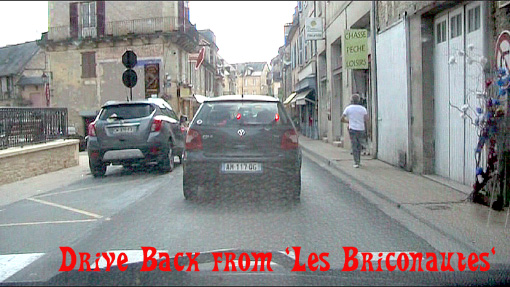
The internet is incredibly slow down her, but I managed to upload the two videos that I mentioned in my last post by leaving the computer running while I was in bed. So here they are, and you can view them by clicking on the pics below. But beware, as I shot the whole journey there and back, each one is just over 19 minutes long!

To Les Briconautes

Back from Les Briconautes

I know that the videos ran fine on my computer before uploading them but haven’t been able to check them in full since because there isn’t the band-width down here. So if anyone finds any errors, I’d be grateful if they’d drop me a message to let me know.

I also recorded my drive out to Galinat and back yesterday to refit 56NE’s prop, so I’ll process those and upload them too as soon as I get the chance.

Prop back on again

I drove across to Galinat this morning and refitted 56NE’s prop. I had a bit of a late night last night messing around with video stuff and left home later than I’d originally planned, so by the time I’d finished the job, it was a bit too late to fly. But the weather was a bit ‘funny’ this morning and the wind was much brisker than had been forecast, so I’d decided that I wouldn’t fly today anyway, and leave it to during the coming week when hopefully conditions will be better.

When I arrived, I was pleased to find 56NE exactly as I’d left it with the covers all in place and the tie-down ropes all still nice and taught. It didn’t take very long to get the prop on and while I was doing it, I revised my idea of what the securing bolt torque should be. The figure of 20 ft-lbs that I quoted in my last post I decided was a bit high and was for one particular make of wooden prop that I’d found on the internet. I think that a lower figure of 11-14 ft-lbs is more typical and as I didn’t want to risk crushing the wood, I ended up torquing the bolts up to 15 ft-lbs. I’ll be monitoring them every flight to start with and re-torquing after a few hours, so I think that it’ll work out OK at that figure. If they do slacken off significantly, I’ll soon know and be able to add a bit more to them. Here are a couple of pics showing the prop finally back on the aircraft. I think it doesn’t look too bad.

null

null

When I drove to ‘Les Briconautes’ and back for the extra paint stripper that I needed to finish the job, I rigged up a camcorder mount in my car and recorded the drive in each direction. These are the videos that I mentioned above, and I’ve now knocked them into shape so they’re ready to view. I also recorded the drive to Galinat and back today but haven’t had a chance just yet to turn them into proper videos. I’ll be putting the ‘Les Briconautes’ videos onto My Trike as soon as I can – they are each over 500 MB in size and uploading them will take time because of the slowness of the internet down here. When they’re up, I hope that people will be able to get a better idea of what it’s really like here, and when they’re done, I’ll also be uploading the Galinat ones as well.

Right proper

Just like it ough’er be mate. Oh dear, sometimes I try a little bit too hard with this stuff, but just to say that 56NE’s prop is done, finished and is now cushtey (sorry again). Must stop watching those old re-runs of Only Fools and Horses 🙂

As Russ said in his comment, perseverance usually pays off, and so it did on this occasion. But not without a heck of a lot of elbow grease and scraping. But in the end, it was worth it when all of the old varnish had been removed. I haven’t worked much with wood for some time and I’d forgotten what a delightful material it can be, the more so when it’s clean, smooth and with beautiful sensuous curves, just like 56NE’s prop when I eventually got it all cleaned up. Here’s a pic taken at that stage.

null

Unfortunately, I didn’t take any photos before I started work to compare things with, but take it from me, this was a huge improvement on how it looked before. Where some areas of old varnish had flaked off, moisture had been in contact with the wood itself and although it hadn’t done any real damage, it had left some unsightly black marks, which I’d largely been able to eradicate by very careful sanding. Sure, there were some old repairs done with fibreglass, nothing serious, which I intended to tidy up a bit but at the end of the day this is a wooden prop from 1998, so it’s done pretty well to survive in the kind of condition it’s in, from what I’ve read on the internet. I doubt that it’s been regularly waxed and re-varnished every couple of years, which wooden props are supposed to be, let alone been mollycoddled and lovingly serviced on a regular basis!

I redid all of the old repairs using Isopon, which I swear by after watching a model builder using it with plywood to construct a scale model of the Queen Elizabeth, which eventually ended up as an exhibit at Thorpe Park (I won’t bore you with the details of what my connection was with that). Unfortunately, Isopon ends up being rather dark, so I had to think of some way to tone the repairs down a bit, which I decided I’d do by using a varnish with a bit of colour added. The prop originally had yellow painted tips, which incidentally, had been the hardest parts to clean off, and I also wanted to retain them on the finished article. But first I needed to apply a light coat of varnish to seal the surface. Many weeks ago, I’d bought a can of clear spray varnish and I decided that this would be ideal for the job. Here’s a shot that I took after I’d given the prop its sealing coat.

null

Next I masked the tips and replaced the bright yellow tip ends using a can of furniture-type spray that I’d found at ‘Les Briconautes’. That was the last job I did yesterday and after I’d left them to dry for a short while, I carefully moved the prop into my ‘cave’ with the masking on for them to dry and harden overnight. When I got the prop out again this morning and removed the masking, they looked absolutely splendid. The decision I then took was, with hindsight, a mistake. The coloured varnish which I then wanted to apply a nice, thick, protective couple of coats of, I could only get in brush-on form. What I should have then done was mask up the yellow tips and varnish just the ‘bare’ wood, but I didn’t. I varnished over everything, including the new yellow tips. This isn’t a disaster as the next pic shows, but with hindsight, if I’d masked the tips, colour-varnished just the bare wood and then given the whole lot a final coat of spray-on clear varnish, as I did, the tips would have stayed brighter than they have done. But not to worry – if we keep it to ourselves, nobody will ever know 😉

null

I’m very pleased with the finished result. I’m glad that I ended up stripping the whole prop and refinishing it as I’d originally planned on just rubbing down the ‘bad’ bits and spraying them in by hand. I always knew that this would be a bodge-up and I don’t like bodge-ups at the best of times. The prop is now inside its cover in the back of my car, ready to be re-fitted tomorrow. After finding that the bolts were all a bit loose when I took the prop off, I’ve tried to find the correct torque-wrench settings on the internet. From the diameter of the bolts (8mm, 5/16″) I think that about 20 lb-ft should be about right, so that’s what I’ve decided to go with. I also found that with wooden props, bolt torque should be checked every 25 hours due to the wood ‘breathing’ with changes in atmosphere, so that’s what I’ll do in future. But for now, I can’t wait to get the prop back on again and hopefully get an hour or so’s flying in. The temperature tomorrow will about about 27 degrees Celsius with winds picking up in the afternoon. But the winds will be only light in the morning, so that will be the best time to go. Temperatures are forecast to increase to the lower/mid 30’s next week so it looks as though we can expect thermic daytime conditions, but I’ll have to see how it goes and play things by ear. But at least I’ll have a flyable aircraft back again 🙂

Prop work

After all the delays, setbacks and other distractions of the past few days, I vowed that I had to get started today on 56NE’s prop. I need to strip off the varnish coat, which is damaged and flaking in places, clean it up, fill it where needed and and rub it down so I can give it a new, fresh coat. I had a small can of paint stripper that I’d brought with me from England but somehow I knew in the back of my mind that this wasn’t going to be a nice straightforward job.

One of the reasons for that is that, quite frankly, modern paint strippers just don’t work, at least they don’t work anything like as well as they did ‘when I was a lad’. The reason for this is that environmental concerns, backed up by new laws for all I know, mean that the good-old strippers that we had and that used to due the job a treat are no longer sold. Time was when you could apply a bit of paint stripper to the paint or whatever on the item that you wanted to strip and literally see it start to bubble up within a few seconds, or minutes at most. Then all you had to do was give it a bit of a go with a scraper, sometimes just give it a wipe even, and the job was done with maybe a need for a second coat in places to make it really clean.

That’s now all gone by the board and is just a distant memory for people like me who used to strip and repaint old motorbikes and cars in our youth as though it was going out of fashion. Sure, the blurb on the tins nowadays promises the earth – ‘Strip up to 10 coats with just one application’ – but the trouble is, it just doesn’t deliver. I found it was so when I needed to strip the paint off the second-hand pod that I acquired when I did the repair on MYRO. I never succeeded however much I tried and in the end had to compromise and do the best job possible with much more paint left on than I would have liked. And so it was with that background that I set to on 56NE’s prop today.

I’d like to say that this time it was different – I slapped the stripper on according to the instructions, the varnish cooperated by bubbling up and it was just a matter of removing it with a plastic scraper. But I can’t. It was a bloody awful job – no matter how much stripper I applied, the varnish would just wrinkle a bit around the edges and then when I began scraping, it was hard varnish that I was scraping off, no matter how long I’d left it for the stripper to ‘penetrate’ and soften it, as the tin said it would. So naturally, after a few hours, as it was only a 300 ml tin, I ran out and had to go and buy some more. So it was off to ‘Les Briconautes’ in Montignac to seek out a can of ‘Décapant universel’. I found it all right, and the tin made the same old claims, except this time in French.

The can design made it appear that this stripper was a real baddie – watch out or it would strip the hair off your cat if you weren’t looking – but actually it was the stripper itself that turned out to be the pussy. It didn’t even seem to work as well as the stuff I’d brought from England, but maybe that was just because by now I was losing the will to live. I applied the gel, left it and then began scraping only to find that once again, once the frilly edge bits had gone, I was scraping off hard varnish. So much for 10 coats! And as for the yellow paint on the prop tips, that has defied my every attempt to get it off – not even hardly being softened by this stuff that’s supposed to remove ‘all types of paint, varnish etc’ with ease.

I ended up earlier more or less getting all of the varnish off – at least, enough probably for me to rub the prop down and apply a new, fresh coat – but I’ve still got a lot of yellow paint to get off the prop tips. I’m thinking that I might gingerly try a heat gun tomorrow but I fear that it’s going to be a long, hard slog to get all of it off and the whole prop clean enough for me to be happy enough to go onto the next stage 🙁

EDF. In the nick of time

As I’ve mentioned on several previous occasions, I’ve found EDF here in France to be the most inefficient, badly managed, uncommunicative and generally bloody awful organisation that I’ve ever had to deal with. They’ve been a thorn in my side ever since I came to France, for over 15 months at the time of writing, and still my problems with them grind on and on 🙁

I talked about what happened when 400 volts was fed into my house in a previous post HERE which is something I still hold EDF responsible for. But despite my sending EDF several detailed letters containing a number of pertinent questions about that incident, events prior to it and what I view as their responsibility for it, after more than 4 months I have still not received any kind of substantive reply from them. In fact after much delay I recently did receive a reply from their ‘customer service’ department but it was totally bland and made no reference to any of my previous correspondence.

I made a financial claim in respect of my possessions that were destroyed by the electrical overload, which EDF have never acknowledged. After the incident during which my house could easily have caught fire and been destroyed I insisted on EDF switching my electrical supply from 400 volts 3-phase to 220 volts single. Afterwards, they imposed a charge for having done so which I have refused to pay on the grounds that if they had told me my house was connected to a 3-phase 400 volt system in advance of my taking out a supply contract, I would have declined and they would have had to switch it over to 220 volts, a job that only took an engineer about 25 minutes when it was done.

So we reached an impasse and if EDF employed sensible people in customer facing roles, you’d have thought that they would have been in touch to see what could be done about it. But of course, this has not happened as the only language that EDF understands under such circumstances consists of bullying and threats. And so it was that on Friday of last week, I received a message saying that unless I paid the disputed charge, they would send along an engineer to cut off my supply. I immediately phoned customer services who told me that if I had a dispute with EDF, I should pay the disputed sum and then claim it back off them. I was gobsmacked and just laughed back in their face – if they would not communicate with me when I ‘owed’ them money, what would be the chance of their doing so if I paid it and the boot was on the other foot? I also said that as this ridiculous situation had now gone on for so long and EDF obviously had no intention of acting in good faith to resolve it, I now had no choice but to refer it to the ‘le médiateur national de l’energie’, which I would do as soon as possible.

‘Le médiateur’ acts when there is a dispute between an energy supplier and one of its customers to independently consider all aspects of the dispute, including legal, and make a recommendation that can be binding on both parties. It can be ignored if either party still wishes to continue with eg a legal claim, but usually it is in the interests of both parties to accept it and act accordingly. The thing about ‘le médiateur’ is that once a matter has been referred, it is automatically frozen and actions on both sides, including punitive ones by the energy company, must be frozen.

I didn’t have this in mind particularly when I spent hours yesterday writing yet another letter to EDF and then preparing the detailed dossier of correspondence etc in relation to my claim that ‘le médiateur’ requires. As EDF customer services had told me on Friday that there was no date set for my disconnection, I had originally intended to prepare the dossier for submission over the next couple of days, but I decided that I might as well get it out of the way so I could at last turn my full attention back to the 56NE. And lucky that I did!

The first thing this morning I got a call on my mobile, which was fortunately switched on, from EDF, or more precisely, an engineer from ERDF, asking me if I would be at home this morning. I said that I would and in the meantime, after I’d breakfasted, took the opportunity to pop down to Plazac to send both my latest letter to EDF and the dossier to ‘le médiateur’. On my return, there was a ERDF van waiting outside with, as it turned out, the engineer inside who had previously carried out my change-over from 3-phase to single phase. He was highly apologetic as he said that as there was an unpaid bill, he’d come to disconnect my supply. I asked him about the outstanding amount and told him that it related to the work he’d done to switch over my electrical supply, which I had no intention of paying and as EDF had failed to provide me with an effective response over a period of more than 4 months (‘le médiateur’ actually specifies a period of 2 months) I had now referred the matter to ‘le médiateur’. This turned out to be my trump card! The engineer is a very nice chap and he looked quite relieved as he typed this information into his hand-held and said that in that case, he would take no further action. We chatted for a few more minutes before we shook hands and he drove off.

So like all bullies, EDF have shown themselves to be nasty and spiteful as well. Having told me that no date had been set for disconnecting my electricity, this turned out to be a lie. It was already in train and was set to happen immediately. They didn’t care about my personal situation, the food in my fridge and freezer or anything else. All they were concerned about was achieving their own objectives by whatever means, whether they are in the right or wrong, with absolutely no consideration for their customer and no recognition whatsoever of their customer’s rights. What an appalling organisation they are and it’s about time that something was done about it. My own campaign against them may be insignificant in itself, but if that’s what everyone thought and did nothing, then nothing would ever change. And that’s why I’m keeping on keeping on 😐

So now what?

With all the problems of the last few days firmly behind me, I can now get back to thinking about some more constructive things. For one, I can turn my attention to getting hold of and adapting a replacement 5″ ‘cheap Chinese satnav’ for use as a nav GPS down here. I’ll keep readers posted on that one because I’ll have good things happening with it. The pic in my ‘Cavarc’ posting shows what can be done with the freely available, current and up-to-date VFR chart that’s officially posted on the Internet and updated in March every year. It’s provided for flight planning purposes, a bit like SkyDemon Light is in the UK, and shows airspace, metars and notams. But there the similarity ends. You can create a route on the chart on your screen but cannot save it or use it for navigational purposes in the aircraft. For that you are expected to purchase a paper one from the official source. I’ve solved that last problem, turning it into a ‘free’ and really useful practical navigational tool that will make it possible to spread my wings much further afield than the local area in 56NE without any of the usual navigational hassles that affect you in France.

I also took 56NE’s prop off at the beginning of the week with the intention of re-varnishing it. The varnish was a bit ‘flaky’ when I purchased the aircraft but I made things worse over the winter. I left the prop on after starting the engine for the first time and covered it by wrapping part of MYRO’s old covers around it. I thought that this would protect it from the elements but instead all it seems to have done is retain the moisture and hold it against the prop’s varnish covering, causing more damage. It’s not too bad, though, but I thought I’d better do the job before I started to fly 56NE regularly. I should add that when I took the prop off, I had a rather salutary experience. I hadn’t checked the tightness of the prop securing bolts since I re-attached the prop several months ago. This was a mistake because when I came to unscrew them at the beginning of this week, all of them were very loose. Not ‘finger-tight’ loose, but still much looser than they should have been from a safety point of view.

The final thing that I need to get back onto is completing 56NE’s outdoor covers. The parts of MYRO’s old covers that I’ve used (wings, rear fuselage) are not waterproof and I need to finish off the wings and rear fuselage covers that I started to make from the heavy black tarpaulin that I bought especially, but haven’t yet done so. With the other priorities that I have (woodburner stove installation, roof work and kitchen installation) there’s no way that I’ll be able to put up a hangar for 56NE at Galinat this side of the new year, so it’s essential that the covers it does have are strong and weatherproof.

And there’s one last thing that I have mentioned several time previously and that I still have to deal with. My dispute with EDF is still rumbling on well into its second year. From my experience, EDF is the most awful, badly managed company that I’ve ever come across. It could never survive in the real world against proper competition and quite frankly is a reflection of the very worst side of France. They ignore letters and attempt to bully and steamroller their clients to get what they want even when they are in the wrong and have caused the problems themselves in the first place. But I am not just going to pay up and give in as many people do. It’s been and still is a gruelling and debilitating battle but it’s one that I’m determined to see through to the end. And I’m determined to win it 😐

2 day rollercoaster ride!

And what a ride it’s been! At one point during it, it looked as though My Trike might disappear for ever but then there was a break-through and the web site came back from the dead. And finally it looks as though the day has been saved after all, but not without a great deal of time and effort. And quite a bit of bloody-minded persistence from me, too, as I’ll go on to explain.

So what’s been going on? Well, it’s all been to do with how My Trike is ‘hosted’. It needs special hardware and software for a web site to actually appear on the Internet and these are provided by what are called hosting companies who provide all kinds of hosting packages of different sizes and with different functions. While I was running an Internet-based e-commerce business, I needed a commercial package that was quite powerful and naturally cost a bit more. I was able to include My Trike in it at no additional cost, so in some ways my business subsidised the My Trike web site.

When I sold off my business and retired, I was still left with the hosting package and it was problematic terminating it because of the difficulties involved in moving My Trike, even within the same hosting company. However, it eventually became more pressing because at the end of the day, there was no way that I could justify the monthly expenditure involved just for My Trike. And so I set wheels in motion a couple of days ago to make the necessary changes, never knowing what would transpire.

Whenever you make any significant changes to any software that’s installed on any computer hardware, or even to the hardware itself, the golden rule is that you make back ups of anything that’s important that you don’t want to get lost or damaged. My Trike consists of a whole bunch of ‘fixed data’, such as images and video files, other ‘mobile data’ in the form of blog postings and comments going back over many years, and the software necessary to bring it all together, WordPress. In order to bring it all together, WordPress creates and employs what is referred to as a MySQL database, and it’s this which is absolutely key to making the whole shebang operate in a user-friendly and seamless way. The fixed data can always be recreated if lost so long as you have kept copies of it, which I have, on my own PC, but if the database is lost or corrupted, the web site is gone forever.

Luckily my hosting company, Heart Internet based in the UK, provide two back up tools, one for a ‘total web site’ backup and the other for backing up your database, so using those was the first stage in the transfer process. Both take an inordinate amount of time to operate down here in France because Internet speed here is dire and both involve creating back up files that are then downloaded onto your PC. Now, it seems that the only way that you can move a web site from one package to another is to create the second package on the necessarily new server, delete the web site from the original package on the old server and then recreate it again using your backed up files on the second. Critically, once you have deleted it from the original package, you are then wholly reliant on your backed up files, and if they are corrupt, damaged or don’t work for any reason, then you are right up the creek. You can probably see where this is leading…

So having arrived at the stage in the game where the second package had been created and the original one deleted, the moment came to apply the ‘total web site’ backup that I’d made earlier. In theory, this should have put all of the folders and files of the web site back into place on the new server, except that it didn’t. So then I did what I should have done originally and checked what the back up contained – easy enough because it was in the form of a Zip file – only to find that a huge amount of stuff wasn’t present.

But although this was a bit of a setback, it wasn’t in any way terminal. So long as I still had my database, I could recreate the whole of the rest of the web site over time by installing WordPress on the new server, uploading all of the other missing stuff again (a huge amount of data that would take hours and hours due to the speed of the Internet) and then recovering my database that would tell WordPress how to configure itself and put in place all of the hundreds of postings and comments that My Trike contains. So that’s what I began to do two days ago and continued with, through into the early hours of yesterday. First I had to set up a new copy of WordPress, then I had to change its ‘theme’ to the one that I’d used for My Trike and finally I had to re-install the WordPress ‘plug-ins’ that I’d used to perform the special functions like showing images and videos, running slide-shows and so on. I got to the point several times where I’d done all of that and all that was needed was to recover the database from the back up file that I’d kept safely stored on my PC, only to find that when I did that, WordPress immediately fell over and refused to run due to an ‘internal server error’. This usually means that something, somewhere isn’t configured correctly, and as it occurred as soon as the database back up was applied, it pointed a finger towards that as being the culprit.

So time to contact Heart Internet’s customer services. Now, I’ve been a Heart customer for many years during which time they have grown from being quite small to quite large, and in all that time I’ve enjoyed a very positive and cordial relationship with them. In the early days, you always got the same people in customer services who you got to know by name, because it was only small, but now the list of names seems almost endless. My gripe was that I’d used the Heart Internet back up tools that I’d trusted to do the job they were intended to do, but which apparently had let me down and placed me in a very difficult position. I know from my IT past that companies like Heart take regular server back ups of their own in case of a system breakdown, and I suggested that one way I could get out of trouble would be if under the circumstances, after I’d gone to the lengths of recreating my ‘total web site’ myself by hand, they could provide me with a copy of my database from their server back up. They said that they could – but at a cost.

I ‘stepped back in amazement’! How could they do that, when I was only in the position I was because I had used the tools that they had provided in good faith, and they hadn’t worked! I pointed out that I had already paid for those tools within the total cost of my package, indeed, over many years, and as I’d used them in the manner intended, I didn’t then expect to pay again to obtain the same results that the tools should have produced for me, but in a different way. I suggested that it was Heart’s responsibility to provide the data that I needed from their server back up as I’d only lost it because of the failure of their back up tools.

But they were adamant that they would charge for a copy of my database back up which they said would solve the problems I was experiencing. Without being over-dramatic, I saw this as being a form of blackmail. I also thought that my own database back up file appeared to be clean, complete and usable from what I could see by opening it in an editor, which would mean that if it were, their server copy wouldn’t actually be necessary. We were evidently in an impasse, so I decided that I’d leave things in abeyance for the time being and concentrate on rebuilding the rest of the web site. Then I would apply pressure onto Heart to insist on their demonstrating what I needed to do to apply my own database file, and if it didn’t work because their tool with which it had been created hadn’t performed properly, see what they were prepared to do about it. See what I mean by bloody-minded persistence!

It was at this stage when I’d added a single post talking about the situation to the then otherwise empty new copy of My Trike, that my old mate Bruce in Australia dropped by. He saw the post and added a comment saying that he agreed with me entirely and although I don’t know whether the post or Bruce’s comment had any effect, last thing yesterday evening things changed. A new guy came on duty in customer services who clearly had some sympathy with my position. He dropped a copy of the server database back up into the root file of My Trike at no charge and then set out to look for the reason why I was experiencing such problems. His name was Nick Lingard and I owe him a personal debt of gratitude. Nick suggested that I might like to make a copy of my own database back up available to them so they could take a look at it, which I did, and after a couple of messages between us, I left My Trike with its ‘internal server error’ and went to bed.

He and his colleague Nicholas Brown decided that overnight they’d find out the real reasons for my difficulties instead of treating them in a merely superficial way and trying to sell more Heart services on the back of them – ie the server database backup that was in fact unnecessary and wouldn’t actually have solved the problem anyway. This is all their colleagues with whom I’d been in contact during the day had apparently wanted to do but thankfully for me, the two Nicks approached things in a thoroughly much more professional way. When I got up this morning, My Trike still wasn’t working but Nicholas Brown confirmed that I’d been applying my database back up correctly in a way that should have worked but that subsequently Worpress was throwing up a configuration error that was not directly related to the database back up itself. Instead, it pointed towards a missing file in one of the plug-ins that I’d reinstalled. So I had to upload a new copy of the plug-in, back out of the database back up that I’d applied so I could get into the WordPress dashboard and re-activate the plug-in and then re-apply the database back up. Voila! To my relief, this time My Trike came up on the screen in front of me when I opened it in my browser!

So that’s how the day was saved. At the time of writing, I’m still uploading a large number of replacement image and video files that will take several more hours, but it will be successful. I have passed on my thanks to Nick Lingard and Nicholas Brown at Heart who in my book, did an excellent job. I can’t say the same about some of their colleagues, though. Compared to them, the two Nicks showed a proper understanding of how to support customers instead of just trying to fob them off or wring a bit more money out of them. And it’s thanks to them that my relationship with Heart Internet, although shaken by events, is still intact.

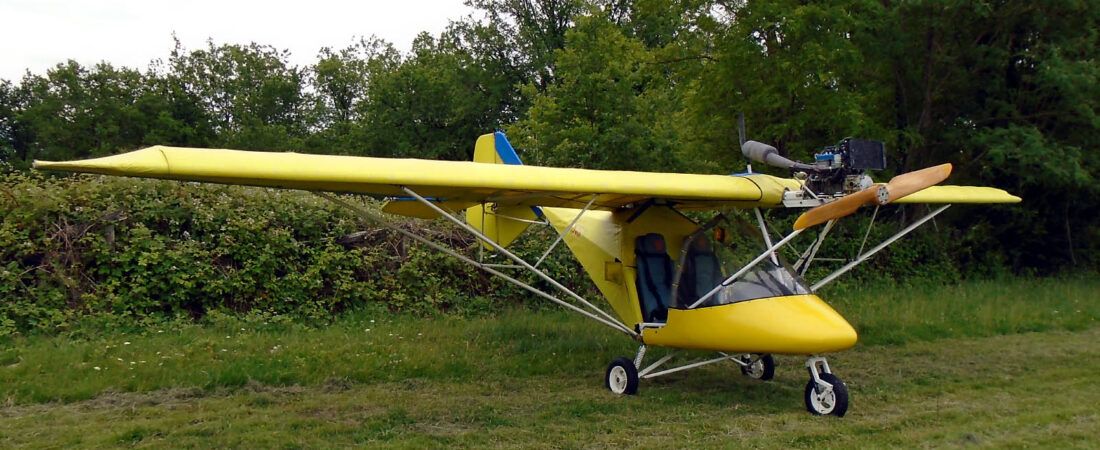
Come on, own up!

Who nicked Cavarc? I flew all the way down there, as planned, only to find that when I got there, I couldn’t see the airfield! So who nicked it? It was a bit frustrating but I decided that under the circumstances, I’d just head back to Galinat, which is what I did.

null

I phoned Victor when I got back and he said that I more or less flew over the windsock at Cavarc, which didn’t surprise me in the least. There’s a lake just north of the airfield and having found that, I flew out over it and then turned onto the various legs for a circuit, and as I’d remembered the features from a few weeks ago, I was on the button. But when I was on the downwind leg, which Victor confirmed I had been, I was danged if I could see the runway. So at that point I decided to head for home. My thinking was that even though I’d started with over 40 litres in the tanks, this was the best thing to do in an unfamiliar aircraft with unknown fuel consumption and endurance.

The flight had only taken about 35/40 minutes from Galinat as expected, but I thought that as this was the first time I’d ventured farther afield, I’d prefer to have time in hand at the Galinat end in order to find the field again and land rather than burn fuel over Cavarc in what might have been a fruitless search. I was also relying on my 7″ GPS which I’d mounted at high level to avoid reflections, but its performance still left a great deal to be desired and I must replace it soon with another 5″ model with a nice bright screen to make cross-countries like this a lot easier.

I’d started the morning off by checking 56NE over and doing two jobs on it. First, I re-tensioned the wing covers by tightening up the webbing straps that link them. I knew that I’d probably have to do that because it says in the X-Air manual to re-tension them if the wings have been re-rigged, after one flight. I also adjusted my brake cables to make my toe brakes more effective. Not enough, as it happened, so I’ll need to pull some more cable through the adjusters next time. While I was working, Regis turned up with his ‘debroussailleuse’ to trim the weeds inside his old hangar framework and also we had a couple of landings, the first by a CT variant (I think) and the second by an old Sky Ranger. I introduced myself to the CT crew who, after chatting with Christian for a bit, who had also arrived, took off again before I did so myself at 11:45 am.

The flight down to Cavarc was great fun after I’d settled down and relaxed as my confidence in 56NE steadily grows. The scenery was beautiful but as by now the air was already beginning to get pretty bumpy with a temperature of around 25/26 degrees Celsius, once again I didn’t think it wise to be turning my attention to taking pictures. I stayed more or less dead on track according to my GPS history and returned to Galinat after my short but fruitless search for the airfield on the reciprocal of the outbound track so I was able to recognise many key features along the way. I’m pretty sure that Wim’s water tower that pin-points the location of Galinat was visible from some way out but I decided that rather than just locate the airfield and land, I’d do a few minutes over the local area. I quite easily recognised the road out of Les Eyzies going up to the village of Thonac and quickly found Thonac itself. After circling around a few times so I can get to recognise the local features, I turned my attention to finding Galinat, spotting it quite quickly and setting myself up for a straight-in approach.

When I landed, there was nobody else there, mainly because it was 1:15 pm and therefore lunch time. So my flight time was exactly 1 hours 30 minutes and when I checked the tank contents, I estimate that there was the best part of 20 litres remaining. So that gave a consumption of only 20/22 litres approx in 1.5 hours, or around 15 litres an hour, which I was very happy with. I had been up to just under 2000 feet on the QNH but had spent most of my time at around 1500 feet. I’d passed over some gorgeous scenery and some lovely villages and had been able to watch the canoeists on the Dordogne and the Vézère in the beautiful bright sunlight that had made the water sparkle. I’d also ventured quite a way from home and landed back safely again, so apart from not landing at Cavarc (having found it, darn it), I rated the flight as a success. A landing at Cavarc can come on another day and with a bit of luck, when I’m a bit more confident and organised, I’ll be able to take a few pictures too, eh Russ 😉

First flight from Galinat

If someone were to ask me what most distinguishes flying in the Dordogne from flying where I was before, say, in south-east England, I’d say that it’s the variety and shear number of insects that are attacking you continuously while you’re preparing and pre-flighting your aircraft. And they really mean business. They are constantly going for your eyes, mouth and ears and only take your arms and legs as second choice. And some of them are such hardy little whotsits that even when you swat em really hard against your skin, they just shrug it off and come back for more, even more determined than they were before 😐

So that’s what I faced this afternoon when I was getting 56NE ready to go at around 5.00 pm. I would have liked to have flown at around 9.30 am because the air was so cool, fresh and still, but I’d promised to give Regis a hand to try to sort out a brake problem on his Zenair this morning. Wim was there too because although he had planned to fly early, he’d encountered a problem that sounds like either fuel starvation or possibly a split carb rubber, that had prevented him taking off. We finished off at Regis’s at about lunch time, so after I’d returned home and had a light meal, I got myself ready to fly later in the afternoon, when it was becoming cooler (30 degrees Celsius today, 33 degrees tomorrow) and a bit less thermic than it undoubtedly was in the full heat of the day.

So there I was sitting on the runway at about 5.20 pm with a small audience who had noticed 56NE taxying as they were driving past. Not having taken off from Galinat before, as I’d had plenty of time, I had walked the whole length of the runway to make sure that there were no potholes or any other surprises. In the dry weather we’ve been having, the ground is like concrete but I learnt my lesson with the MYRO incident and don’t aim to have a repeat performance if I can avoid it. I need to adjust my wheel brakes because the toe brake levers are travelling too far for the brakes to hold properly, and with the slight down-slope at Galinat, I couldn’t do a proper mag check at 3000 rpm without beginning to accelerate down the runway. I’d done one previously after starting the engine, though, so no real problem, but it’s something that I need to fix.

Because of the problem with my little 5″ GPS, I’d loaded the route I intended to fly into my 7″ one. The trouble is that the latter has a screen that’s far too dark and in the afternoon light, it appeared practically invisible when I checked it as I climbed away. So not a lot of good then, leaving me the option to do a circuit and land or do a more abbreviated local flight that would allow me to use local features to find my way back to the airfield. I chose the latter – what the heck, in for a penny, in for a pound. I soon passed over my first planned feature, the Chateau de Belcayre on the north bank of the River Vézère. It looked even more beautiful from the air than I’d expected, but I couldn’t take a photograph because my workload was already higher than I’d planned for and there was no need to make even more demands on myself.

Wim smiles when I say how useful my little GPS is, but he’s been flying locally for over 20 years, knows the area like the back of his hand and doesn’t even need a chart. I missed my little GPS but every now and again could just make out my position and heading on the 7″ one, although I could never have used it to fly down through France as I did with the other one. It was an experience all of its own flying here – one minute the valley was far below the aircraft and the next the trees felt as though they were only just under the wheels as I flew over a hill (they weren’t of course, they have to be more than 150 metres below to stay legal if there’s a house or structure on the hilltop 😉 ).

I had the lovely little village of St Leon sur Vézère under my left wing so I knew where I was, and then decided that I’d turn to the right and see if I could find the airfield. Wim had told me about a hilltop water tower that is just to the west of Galinat and I soon spotted it, then sure enough, there was the airfield with its runway and hangar. The air was still a bit bumpy, so I decided that the best thing would be to return and land and try again tomorrow morning when it will hopefully be a repeat of today. So that’s what I did. Although there was a bit of a tail-wind, the landing was uneventful. I kept my speed up (normal approach speed is 80 kmh) just in case the sink/lift/windshear in the valley got a bit twitchy, but no problem and the touchdown was fine, if not exactly a greaser 🙂

The flight was only 20 minutes, but it was new and exciting and I enjoyed it. A few more like that I and hopefully my familiarity with the local area and conditions will come on in leaps and bounds. Something I must be careful of is the sloping ground – I taxied to my tie-down spot and went too far up the hill and when I switched the engine off, 56NE tilted back onto its tail skid. No harm done of course, but something to avoid in the future. It was only a short flight, but it was a big leap forward for me. The trouble was that removing and replacing the covers took more than twice as long as the flight itself, so I need to go a bit further afield next time to make the effort worthwhile. I’ll have to see what I can come up with 😉

Fixed it!

The starter mechanism on my ‘debroussailleuse’ that is, and frankly, I was rather surprised that I managed to. Trying to re-coil the recoil spring was like trying to teach a wild snake to dance the tango – every time I relaxed my concentration and/or eased my grip on it, it would find the tiniest gap and then leap out at me at high speed and try to hit me in the eye. I found that it was impossible to rewind it using just my fingers – I needed a former of about the right diameter to wrap it around. This came in the unlikely guise of a short cast-off length of white plastic tube left over from my toilet installation 🙂

I managed to do it once and get it fitted back into the dome-shaped plastic cover that houses the pulley but then couldn’t see how to connect it to the pulley itself to get the recoil action to work. By the time I’d worked that out and tried to carefully bend the inner end of the spring to get it into the slot on the starter cord pulley, the spring had managed to sense my weakness and took the first opportunity afforded to it to leap out of the housing like a demented jack-in-the-box and wrap itself in knots.

The answer I found was to cut an angled slot in the end of the plastic pipe that then automatically lined the end of the spring up with the connecting slot in the pulley once it was released from the pipe and pushed into the pulley housing. OK, easier said than done, but by this time I knew that I’d sussed it and it knew it was heading for defeat. My ‘piece de resistance’ was adding a short length of wire to the pull cord so when it was pulled out of the housing and joined to the pull cord handle, there was already a small amount of tension on it. By then the starter mechanism knew that it had been beaten by a worthy adversary and all fight went out of it. I was triumphant as I re-attached it to the machine and gave it its first few pulls. Perfect. Pity the ruddy machine wouldn’t then start, though 😐

Day of pure frustration

Yesterday I had to do a bit of shopping and some clearing up so it wasn’t worth trying to fit in doing anything at Galinat. But today I thought I’d go over there, do a bit of tidying up around 56NE and possibly even get in a short flight. As you can see, I’ve decided to stop referring to just ‘the X-Air’ and use its registration instead as I think that all aircraft have a personality of their own and their own unique identity.

I arrived at the field just after lunch and the strength of the wind ruled out a local ‘familiarity’ flight. Although it was straight down the runway, it wouldn’t have been worth flying in wind that strong as up to now I only have experience of one landing there and with far less wind than was blowing today, the lift, sink and wind shear over the valley on approach were already quite pronounced. So more practice in less demanding conditions will be called for before I start pushing the envelope too far in what is also an aircraft with which I’m still unfamiliar. But in any case, I’d decided that my time would be better spent tidying up around the aircraft to make it easier to prepare for flight and tie down and cover up again afterwards.

Regis and I had secured 56NE on Saturday within the metal framework that is all that remains of his old hangar, but even at the time, it was obvious that it would be far from ideal as a permanent arrangement. The ground inside was very uneven and thick with weeds and due to the slope of the land, the clearance beneath the ‘uphill’ wing was so low that getting around the aircraft was very difficult. There was also another problem. Regis turned over a large balk of old timber that was on the ground and underneath were gozillions of tiny ants. I happened to kneel down close to them in my shorts for a few moments because of the wing clearance problem that I just mentioned and a few got on my leg. In an instant I was being eaten alive! Shortly afterwards, Regis dropped a cover on the ground and when he picked it up, some fell on him, and I can tell you, he won’t be doing that again in a hurry 😆

But seriously, my nightmare was that they’d find their way into the aircraft cabin, so as the old hangar framework was providing absolutely no shelter, I’d already decided before going to Galinat that I’d move 56NE out of it onto a more suitable area. This decision was re-affirmed when I came to move the aircraft because with the downwards slope, it would have been easy to lose control of the aircraft manhandling it by myself and either knock a wing tip on one of the side supports or, even worse, have it roll uncontrollably out and down the hill. Here are a couple of shots that I took showing 56NE inside the hangar framework.

null

null

They make things look worse than they actually were because of all the scrubby vegetation that they include, but in all honesty, the true situation wasn’t really a lot better than it looks in them 😐

Here’s a shot I took of 56NE after I’d rolled it out of the hangar and parked it with wheel chocks into the wind.

null

I decided that for the future, I’d park 56NE with its nose pointing north tied down between Regis’s hangar framework and the other hangar. The ground is fairly level there which would make getting the aircraft ready for flight and storing it away again afterwards pretty easy and by clearing a bit of undergrowth away behind its new position, I’d be able to push it back a bit towards a little bit of overhead shelter provided by a large tree. I’d taken my ‘debrousailleuse’ with me and was just about to get started when Christian, the owner of Galinat, turned up. We exchanged greetings and I told him what I planned to do. He said that that was OK and after a few more minutes conversation, he was off again.

I topped my machine’s fuel tank up, started the engine and got cracking. I’d only managed to clear a small area when in the blink of an eye, a wayward tape from Regis’s old hangar covering got caught round the blade, so I had to stop the engine immediately to untangle it. When I went to restart it, the starter cord pulled through the handle and disappeared into the starter housing. I could hardly believe it, but even worse was to come. I’d brought my tool kit with me, so it was an easy matter to get to the starter pulley, which I gingerly removed to get to the starter cord. But not gingerly enough, apparently, because before I knew it the starter recoil spring shot out of the housing and uncoiled itself like an insane jack-in-thebox 🙁

I tried several times to rewind it and get it back in again, but without luck and only succeeded in getting my hands covered in grease. And I’d not taken anything to wipe them on, naturally, so I was stuck with them. By this time I was beginning to think that retreat was the better part of valour and because I’d cleared just enough to reverse 56NE’s tail into, I decided to cut my losses, re-position the aircraft and tie it back down. I put two concrete blocks under each wing and one each under its nose and tail and I think that that will be more than enough to secure it in the kind of winds that we’ll be getting over the next week or so. Here’s how it looked afterwards.

null

null

I popped all the ‘debroussailleuse’ starter bits into an old plastic shopping bag that I happened to have with me and hopefully they’ll be easier to re-assemble in the quieter environment of home. I was really frustrated by the turn of events, but although I came home not feeling that I’d got much done, actually moving 56NE to where it’s now tied down did represent a little bit of progress. Not much, just a little 😉