
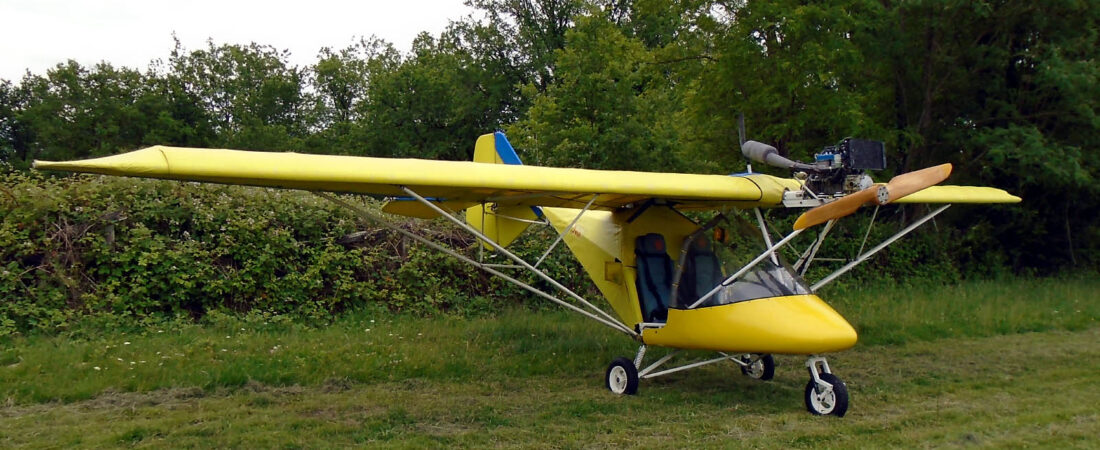


Here’s the follow-up to my ‘loss of power after take off’ video, two days after the event itself.
It was already very hot this morning – pushing 30 degrees C – when I started work. First I removed and re-gapped the plugs. The Rotax manual is very confusing as far as the NGK BR8ES plugs that are used in my X-Air’s engine. On one page it implies that they should be set to a tiny gap – 16-20 thou” – and on the next 24-28 thou”. I’ve always had mine gapped to 25 thou” and have had no problems up to now with this engine or the 582 blue top that I had in my previous X-Air, so I re-gapped them to 24 thou”.
Then I went to start the engine. For the first time I had problems getting it running with choke but just got it started without, I guess because of the high ambient temperature. My X-Air engine has a grey top and suffers from the universal 582 grey top problem of not starting when warm. Nobody knows why and it seems that all (or nearly all) grey top owners are plagued by it. More of that later.
When it got going it showed an initial fuel pressure of 0.2 bar at 2000 RPM that Rotax suggests should be the warm-up revs. I disagree, I think the figure should be 2500-3000. At 3000 rpm the fuel pressure rose to 0.3 bar, mid-way between Rotax’s minimum and maximum figures of 0.2 and 0.4 bar. I kept the revs at around 2800 rpm until the engine was up to temperature at which time I intended to run it up to full power for around 60 seconds a couple of times.
A mag check at 4000 rpm was perfect – I’d fitted a new stator in 2019 when I was preparing the X-Air to fly it over to France. At that figure I began to notice bubbles rising in the fuel filter and initially thought that this must be the reason for the previous fuel starvation problem. However, although the stream momentarily became worse, after a while it became minimal again before stopping entirely during my high power trials.
The first time I ran the engine up to what was a maximum static figure of around 6200 rpm, the fuel pressure initially rose to a high of 0.4 bar but then fell back a bit without dropping, I think, below 0.3 bar. While those revs were maintained, it slowly increased again to between 0.3 and 0.4 bar.
The next time that I ran the engine up the fuel pressure rose to 0.4 bar and hardly dropped below that figure and even when I reduced the revs slowly to around 2800 rpm, it stayed just north of 0.3 bar. I wonder if this indicated that there might have been some kind of blockage as a result of fuel evaporation in the Mikuni fuel pump?
At this point I was quite confident that the engine could maintain take off and climb revs for a safe period of time and decided to go for a take off and return for a normal landing (at Malbec we have to take off down the slope and land up it and there’s no go-around on landing). When I did so I watched the fuel pressure gauge very carefully. Initially it held 0.4 bar but then began to fall back during the climb out, passing what I regard as normal at 0.3 bar right down until it reached what Rotax says is the minimum for the engine of 0.2 bar. I was ready at that point to switch on the electric fuel pump but the engine was running normally and then the fuel pressure began to recover to around 0.3 bar which allowed me to make a normal landing.
After landing I did an inspection of the fuel system and found that there was a small amount of muck visible in the fuel filter. More ominously, on closer inspection I found that one of the fuel lines from the pump to the rear carb was externally cracked on a bend (see image below). This was especially alarming because this was a piece that I’d replaced with brand new tubing in only 2019 and I think that this amount of degradation is unexpected and unacceptable in such a short time in what was supposed to be good quality tubing.
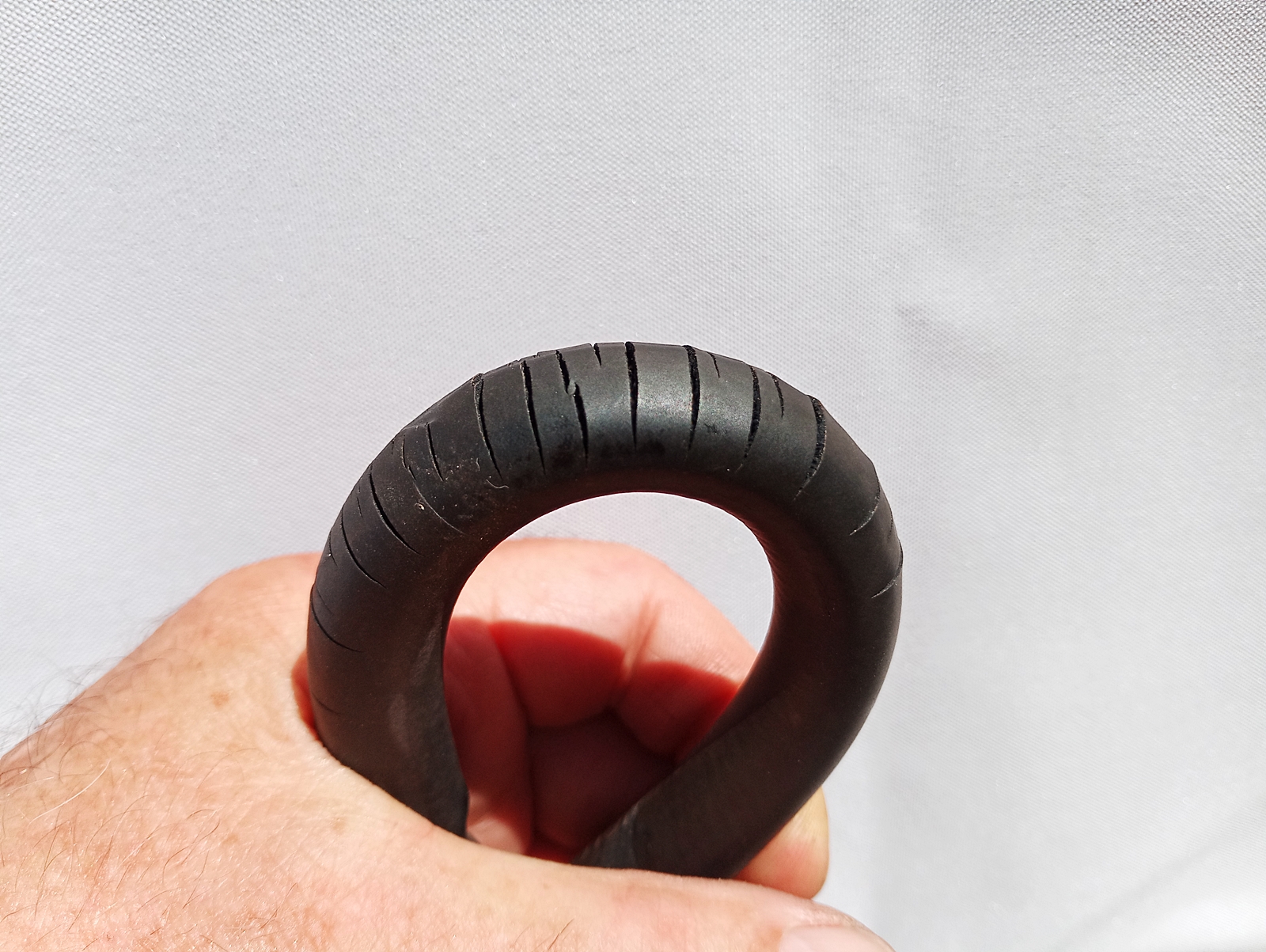
This piece of tubing could not be responsible for the bubbles that I saw rising earlier in the fuel filter, though, as it was on the wrong side of the pump. I think that the bubbles were more likely to be trapped fuel vapour and this could have been a contributory factor in my opinion to the previous fuel starvation problem that led to the power loss. I also think that the tubing, even in its present state, did not contribute to the previous power loss as it wasn’t leaking.
I still think that there’s more to it on account of the fluctuating fuel pressure. It can’t be right for the pressure to be showing 0.4 bar at full power during take off and climb out, falling to 0.2 bar and then recovering almost to the earlier high figure. Something has to be causing that and the most likely culprits in my view are the fuel filter and the pump.
I refurbed the pump in 2019 and the aircraft has not flown many hours since then, mainly because of Covid. It could be that the pump’s internals have been damaged eg by an excess of alcohol in the fuel or the pump had become slightly blocked as a result of fuel evaporation. I’ll be removing and stripping the pump to see if there are any causes for concern but will not be looking to replace it, unless there are, at this stage.
The filter is a different kettle of fish. That I will be replacing in any case as it does contain some visible muck and may for all I know be partially blocked by the dreaded alcohol/water sludge growth as the aicraft has been standing since the end of last year and would therefore be a good candidate for it. My bet is that this is at the heart of the problem, but only time will tell when it’s been replaced.
By the way, I couldn’t run the engine after I’d replaced the bad fuel tubing. I tried to but as I mentioned previously, it wouldn’t start in what had become the quite intense heat. Eventually cranking the engine flattened the battery which also happened the night before. I’m very disappointed about this because the battery was brand new in 2019 when I was preparing the X-Air to be flown to France. Unfortunately though, mainly because of Covid, it has been standing without being charged much for excessively long periods and I think that that has almost killed it 🙁
 English
 Nederlands
 Français
 Deutsch
 Italiano
 Latviešu valoda
 Português
 Español