
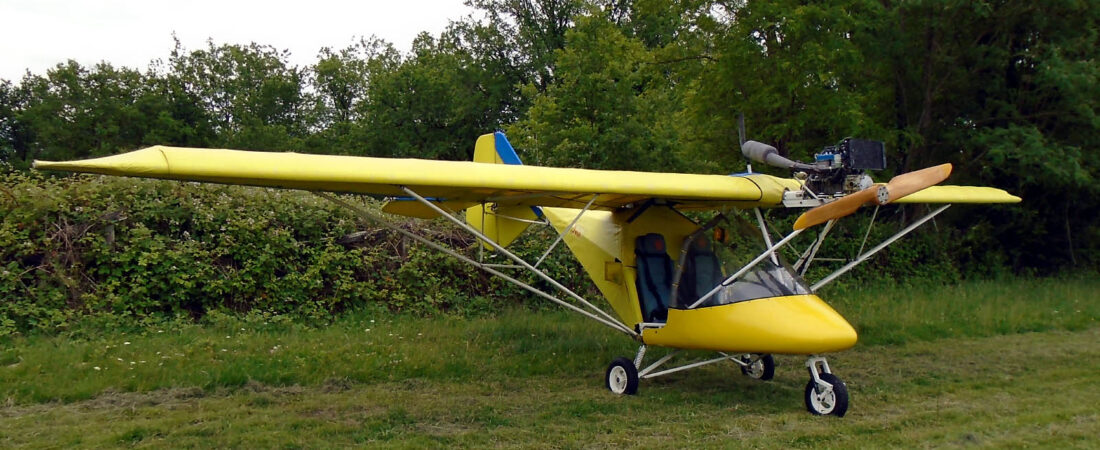


Well, not quite, but I couldn’t resist the headline. The new shock absorbers arrived yesterday but I couldn’t fit them because I had to cut the grass as rain was forecast for today. It duly arrived, but mainly during the night, but as it’s still a bit cool with a few spits of rain in the air, I shall fit them tomorrow when the weather’s forecast to be back to being warm and dry again.
But I have had a chance to compare them to the old ones, and here’s the surprise. The new ones are much closer in style to the old ones than to the ones fitted on my friends’ UK built X-Air as you can see by comparing the following pic to the one in my last post.

The new ones are slightly longer than the old, which will help to deal with the slight canting in of 56NE’s main wheels, but have the same number of spring coils (13 compared to the 8 of the UK version). Why should this be? I don’t know for sure, but think that this is probably one of the several modifications that were made when the X-Air received its approval under the UK’s microlight ‘Section S’ regime. It’s also understandable. The more coils there are in a given length, the smaller the gaps are between them and the less travel they allow when the shock absorber and its spring are compressed. And the more travel you have, the more accommodating the suspension is to ‘hard’ landings, as I recently found to my cost.
As I mentioned in my last post, when I contacted Fournales Suspension SA during last week, they confirmed that the travel on the X-Air suspension should be 58mm, and although I can see that from the picture I posted of them this would probably be achievable by the UK spec shocks, I doubt that either the old or the ‘original equipment’ new ones that I have just received from Randkar would be compressible to such an extent. Is this important? I think it is, at the fringes at least.
Usually, as I’ve found up to now, you can make the odd ‘hard’ landing without any problems, but with runways being what they are in this part of the world, there is always the opportunity, especially when landing on a piste that you’re not familiar with, that you might end up with one that’s a tad harder than usual. If that happens, whereas you would probably get away with just a red face with ‘UK spec’ shocks fitted, the chance is that you could end up with a broken suspension leg, as I did, with the lower travel ‘French spec’ shocks. The solution? Obvious – if in doubt, go around – don’t ever take the chance of dumping it down hard if you can possibly avoid it.
On a more positive note, it looks as though the latest X-Air shocks, which are made by Endurance in India (not surprising really, as that’s where the X-Air is made), are of a slightly improved design. The ones that are currently fitted to 56NE, which I now think after all were original equipment, have a shorter cylinder than the new ones with an exposed rod or leg that’s visible in the above pic (chrome plated). In the new ones, the leg is fully enclosed, an improvement that by keeping out dirt and contamination will probably lead to the units having a longer life. Hopefully, not that that will concern me too much, as I can’t see me fitting a new set during the rest of my flying career. I only hope that by voicing such a comment that I don’t provoke the gods and end up doing another hard landing next week 😐
 English
 Nederlands
 Français
 Deutsch
 Italiano
 Latviešu valoda
 Português
 Español