
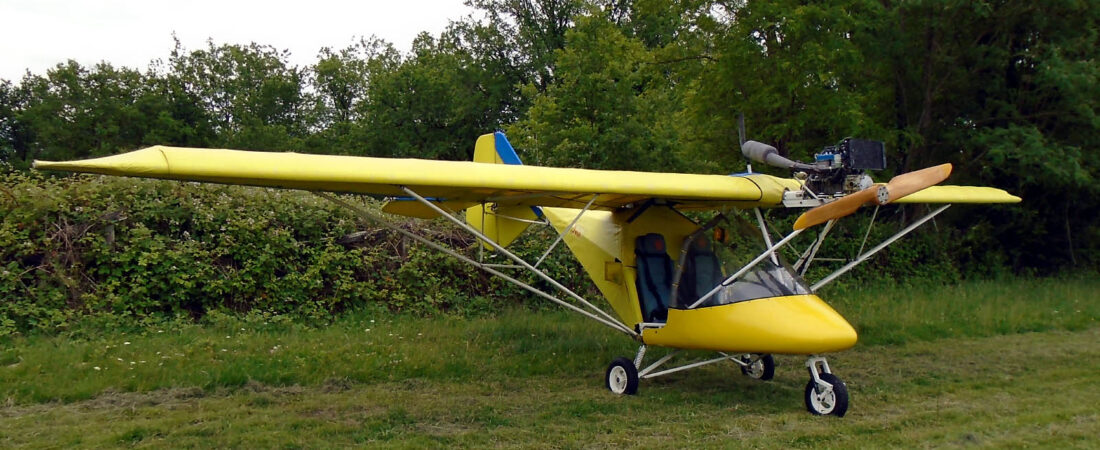


Yesterday was a non-starter as far as flying was concerned. The Met Office forecast said that with high pressure coming into play, we could expect a bright day with a bit of cloud and an easterly wind. Instead we got solid low cloud with no sight of the sun all day so I doubt there was any VFR flying going on in the whole of South-East England 😐
But today was different. It didn’t look as though it was going to be as I was driving down to Linton because although there was sunshine and a fairly brisk ENE wind, there was quite a bit of low cloud scudding across with it too. However, I needed to go to the field anyway because I want to cut my large tarpaulin up to make some better covers for MYRO and I have to have some accurate measurements that I can only get from the aircraft itself.
When I arrived at the field, I saw immediately why it’s urgent for me to adapt the tarpaulin that I used to cover MYRO up last weekend. Lucky I did too because there was evidence that an enormous amount of water had fallen on the field and MYRO during the past week. Somehow the rain running off MYRO’s left wing had found a gap in the folds of the tarpaulin and had flowed into what eventually became a large water container with no outlet. As a result, the weight of the water which turned out to be quite a few gallons, had caused MYRO to tip backwards onto its tail skid. When I arrived I immediately saw that MYRO’s nose was up in the air and the weight of water was such that not only had it lifted MYRO’s nose but also the tyre weighted with concrete that MYRO’s nose is tied down to. Amazing 😯
Fortunately no damage had been done and after I’d released the water, MYRO came back down to earth none the worse for the experience. It was also totally dry showing how well the tarp had worked, but this emphasises why it has to be cut up and converted into ‘fitted’ covers to prevent such a thing happening in the future.
It was gone mid-day by the time I’d got MYRO ready to go. I’d planned a flight out over Leeds Castle, round Maidstone and across to Sevenoaks, down to Tonbridge and Tunbridge Wells, across to Pembury and back to Linton via Marden, so as by now the sky was wall-to-wall blue, that’s what I did! I also took my camcorder with me so I could try the other suction mount that I got off Ebay, mounted on top of the panel and with the camcorder facing straight ahead. I set everything up and it was immediately obvious that this is probably a better arrangement than the one I used last time. For a start I could see on the flip open screen how it was aimed and could also reach the camcorder controls to switch it on and off in flight if I wanted to and also check that it was working 😉
So off I went from the short winter runway. There was a strong, gusting left crosswind and as I climbed, I soon found that the blue sky was actually very deceptive. In fact there was an inversion layer topping out somewhere between 1500 and 2000 feet and within it, it was very, very murky indeed. This somewhat detracted from the pleasure of the flight but mainly it meant that whatever happened with the camcorder, the results were bound to be rather poor. As it happens, when I checked the footage afterwards, I found that the results were not as bad as I expected. Not good, but not that bad and certainly a good enough test of the new camcorder position 🙂
Just as well really, because although I took my still camera with me, I only took a single shot, of Leeds Castle when I flew to the west of it, and here it is.

So that was it. It was a nice flight and I’m really glad that I was able to do it. When I’ve had a chance to edit the camcorder footage I’ll see if it’s worth including in the Gallery. It probably will be. And just to finish off, I must mention the landing back at Linton. I knew that it was going to be tricky from my take off earlier because the wind was gusting up to 30 mph or so from about 30 degrees left of the runway centre line and when I got back, it was obvious that nothing had changed in the meantime. When I was on final, I tried a crabbing approach, then a wing down approach and then a combination of both. I was working hard with the stick and rudder the whole way down and for a time it felt as though I was stirring porridge, I was waggling the stick so much around and from side to side. In conditions like that, you have to watch your speed very carefully – be a bit too fast if anything because with a strong ‘on-the-nose’ wind component, even with a short runway to land on, you’ll still pull up with plenty to spare so long as you don’t take it too far.
And so it proved. Although I was ready to bang power back on again and go around, it wasn’t necessary and I ended up with quite a controlled, gentle touchdown. I unfortunately heard afterwards that Lee, who had come in a bit earlier in his Quantum, hadn’t been quite so lucky. The wind had caught him out and unfortunately his nose wheel also appears to have found a soft bit of runway and dug in, causing damage to his forks. He wasn’t hurt at all but I just hope the damage to his Quantum isn’t too bad.
 English
 Nederlands
 Français
 Deutsch
 Italiano
 Latviešu valoda
 Português
 Español