Now what?

Been thinking about what comes next after fixing the leak in my kitchen. I had a big problem with my toilet cistern overflowing but that seems to have abated now that the water pressure in my house is down to a more acceptable level after fitting the new pressure reducing valve. The ball valve in the cistern now stops the water inflow but shortly after water begins running down into the toilet bowl.

This is what happens with just about every toilet you ever come across in France because the ‘standard design’ is basically so poor. It’s an anathema to a UK ex-pat because we hate to see water being wasted, especially when it’s metred, plus you also end up with lime scaling staining in the bowl.

But for now I’ll just live with it, probably until I can get around to totally revamping my bathroom, especially if I can paint over the mold on the panel that the toilet is suspended on caused by the overflowing water and make it look more presentable.

So next on my list is my planning. I submitted my plans for my house extension just over a couple of years ago and was asked to provide some more information – nothing much but enough to prevent my receiving a ‘tacit approval’. The way the system works here is that if within 3 months of submitting your plans to the local mairie you have heard nothing, that means that they have been approved.

You then have to erect a panel on the roadway that can be viewed by the public outlining your project and if during the following 3 months nobody objects to your plans (they’d be unlikely to succeed anyway as the local planning authority will already have deemed them acceptable) you can eventually get cracking.

I visited the local planning office in Rouffignac a week or so ago showing my responses to the original request for more information and they told me that with them included in my planning dossier, it will be approved. They also suggested that in view of the time that’s passed, I’d do better cancelling my first dossier and submitting a new one to give me a full three years after approval to commence the work.

If I want to start my extension in the spring I really need to get the new submission in ASAP because of the time scales that I’ve mentioned above. Then I’ll be able to talk to my contractor in the autumn so he can build my work into his 2019 schedule. So rehashing my plannig dossier is a priority.

The next target, which should be simple to achieve, is to get my X-Air advertised for sale. It’s all ready to go and all I need to do is test fly it, later this week as the forecast looks to be pretty good, and take some more pictures as the ones I already have don’t show it after its recent spruce up. After advertising it all I’ll then be able to do is wait.

And finally there’s the Savannah. I have the replacement wing slat and plastic wing tip to do the repair necessary after I damaged the wing while I was turning to take off to head to the UK back in June. Looking ahead, my plans are now to make that trip some time between Monday 10 and Friday 21 September as my friend whose field I will be landing on will be back in the UK then and I’ll also be back in France in time for my next check-up scan on 25 September.

So no pressure on getting the repair work done. I sprayed the wing tip white today and have by cordless drill on charge as I type this, so should be all set up to remove the damaged parts tomorrow. Whether I’ll then continue and fit the new replacements I’ll have to wait and see, but it’ll be nice to make a start anyway.

That just leaves my car to get back repaired, hopefully also this week, and my garden and probably Malbec to mow after the showers we’ve had recently which will start the weeds growing at high speed if not the grass. So with all that lot, I’ve got a pretty well defined plan of action over the next few days, if not weeks. And who knows, with all of the above going on, I might even be able to fit in a little bit of flying too 😉

Finishing off the job

I’d thought about going flying this morning but didn’t have enough time to before the temperature began escalating after I’d visited Madeleine and Manja, Victor’s daughter, selling off their ‘junk’ at today’s Fleurac flea market. But just as well, because it gave me the chance to finish off making good after yesterday’s plumbing repair.

My idea was to make a simple thin plywood panel that could be slotted over the water supply inlet ball valve, thus holding it at its bottom, and held in place at its top by the cupboard shelf. And it worked fine as the following shots show.

null

null

I had a suitable plywood offcut that I cut the panel itself out of using a small electric angle grinder with a thin cutting wheel. It was the first time that I’d done that and I found that the result was far better than using a jig or circular saw which always ends up fraying the cut edge of the plywood. That didn’t happen with the angle grinder.

I also cut out the slot for the ball valve handle using the same tool and it made a neat enough job. I just gave the panel a coat of white spray gloss and it was dry enough to put in place after being outside for ony a few minutes in the hot sun.

The cupboard back panel is still stained from the leak and I couldn’t do anything about that today as I didn’t have any of the special paint that you need to cover water stains, so I’ll have to deal with that later.

So that was that – job done. I’ve got my cupboard back and also my kitchen table that many of the cupboard’s contacts have been standing on for …errr… several weeks (months actually).

And the good news is that having got this job out of the way, my decks are clear to start on the Savannah’s wing this week. All I’ll then need is to get my car back repaired and things will start to look as though they’re getting back into shape again.

Wasps

I was just reading a letter about wasps in the DT Online and the useful role that they play in ‘cleaning up our environment’.

Trouble is over here in France we’re now getting them about 2 inches in length. If you tackle a nest that they’ve made in a hole in your wall (I had one near my backdoor a while back) they all come out and attack you in force and as they only have to touch you for the briefest moment with their sting to inflict a painful injury as I found to my cost, you’re wise to beat a hasty retreat.

Lord help any children or pets in the vicinity.

I patched a hole in my roof where a tile had broken a couple of days ago in anticipation of thunderstorms and before I knew it a number of smaller wasps emerged and attacked me while I was at the top of the ladder. One stung me in my eye (on my eyelid actually) but fortunately I was able to descend safely and put vinegar on the site (and, painfully, in my eye also) very quickly to mitigate the discomfort.

So fine for all you real and budding ecologists out there, if the damn things stayed in the countryside where they belong. But they don’t and inevitably end up in conflict with we humans. There can then be only one outcome, but as there seems to be so many more of the blighters this year, it’s unfortunate but probably not catastrophic for the global ecosystem.

No leaks now

On New Year’s Day I was unfortunate to find that I had a water leak behind the floor cabinet in the corner of my kitchen. This was doubly unfortunate because as well as being an unpleasant start to the new year, this cabinet was the first one that I had fitted, so you could call it the principal cabinet, and initially I thought that access to the source of the link would be impossible without ripping all of my kitchen cabinets out again.

And the leak also came at a bad time for me personally, just before the end of my eight months of chemotherapy treatment, so I was at a very low ebb physically and mentally. As a result since then I’ve limped along on a daily basis managing the leak by mopping it up when I had to, catching what I could with a container and turning the water off overnight and whenever I left the house.

But even the latter became ineffective because the stop-cock controlling the water supply was very old and eventually let enough water by even when in the ‘off’ position to allow the leak to continue.

So things had to be brought to a head and this started a month or so ago when I at last had the physical and mental determination to tackle the problem head-on. I started by cutting a section out of the back of the cabinet to get a better idea of what was going on and found that the source of the leak was a pressure reduction valve that I knew was there and had thought about renewing at the time I began fitting the kitchen but didn’t, so more fool me.

I tried to take it apart ‘in situ’ but couldn’t, but in doing so managed to slow the leak down a bit. However, this was nowhere near enough and it became obvious that I would have to take the bull by the horns and do whatever was necessary to deal with the problem once and for all. So a couple of weeks ago I enlarged the cut-out in the back of the cabinet so I could clearly see what was going to be involved.

And what I found came as a pleasant surprise. With better access I could see that with care, I could replace both the stop-cock and the pressure reducing valve without having to move the cabinet at all, so with that in mind, I researched and ordered a modern replacement pressure reducer (much smaller and neater) of the required size on line.

It arrived a day or so ago so yesterday I popped down to les Briconautes in Montignac to purchase all of the other fittings and other items that I would need and today I did the job. But with all of the usual problems.

The pipework in which the old valve was fitted is 16mm in diameter so that was the size of the fittings that I bought. I wanted a ball valve rather than a stop cock because all of the latter that I’ve bought while in France have been of appalling quality and have failed early, whereas my experience with ball valves has been better.

I wanted the type with a handle with ears but of course, that being the most popular, it was naturally out of stock, so I had to make do with the type with the longer lever handle. And I also picked up a short length of 16mm diameter copper tube. Or so I thought.

Unfortunately, I didn’t check closely enough and it was only when I had cut a short length to finish the installation off that I realised that what I’d actually picked up was 18mm. So back I went to Montignac having had to wait until les Briconautes reopened after their lunch break and what did I find? 16mm diameter copper tube is the most widely used for general plumbing purposes so, of course, yet again they were out of stock and had none at all on the premises.

So that left me with just one choice – to drive all the way to Brico Depot in Trellissac, the UK owned store (same owners as B & Q) who rarely go out of stock of anything and on whom you can usually rely to have just what you need on their shelves. And this was the case, of course, with 16mm diameter copper tube.

So I have made a decision once and for all, to stop trying to source ANY items locally that I need for jobs in my house and garden. It’s always the same – I always end up going to Trellissac/Périgueux anyway and like today, spending more time driving backwards and forwards than actually doing the work. So that’s it, for the last time.

The job itself turned out to be much simpler than I had ever anticipated and was soon done, as the following shot shows. So at last I’m without a leak in my kitchen.

null

All I have to do now is cut and paint a plywood panel to cover the hole in the back of the cabinet. If I cut a slot in it to slip over the handle of the ball valve, it will be held in place by the cabinet shelf and there will then always be an access panel should it ever be needed again. And what a relief it will be to get all of the stuff back into the cabinet that has been standing for months on my kitchen table and at various other locations, in my spare bedroom and elsewhere.

I’ll sleep a little easier tonight 😉

Some good news

Cooler weather forecast for today – 30°C, down from 36/37°, still pretty warm but not scorching as it has been – so a good day to get myself over to Malbec and finish the varnishing on the X-Air. I can’t sell it until it’s done and I must get it advertised on Le Bon Coin ASAP while there’s still a goodly bit of the season still to run.

There’s no point keeping it. I can’t fly three ULMs and the longer it stays holed up in the barn the older it gets and the more it deteriorates. ULMs like all aircraft, need to have the air under their wings and flowing through their structure. They just get dirty and more shabby the longer they stay hangared and that’s why it was so important to get the varnishing work done on the X-Air, so it looks as fresh, clean and bright as possible for the old aircraft that it now is.

The morning started off refreshingly cool with a bit of cloud but this was a trap for the unwary or foolish, like me, with work to do who should have started early to take advantage of the cool conditions. However, I didn’t and didn’t start work until gone 11.00 am and it wasn’t long thereafter before the sunshine broke through and things began to warm up quite a bit.

The only advantage of this was that the varnish I was using soon dried and I had no worries about insects or other flying matter landing on my work and spoiling it. I soon finished off the small amount of yellow that was left to do, mainly on the rear fuselage cover, and then I wanted to re-do the blue cover between the upper wing sufaces and re-touch small areas on the aelerons that were showing signs of wear.

I’d found a small amount of blue left over by the previous owners that must be over six or seven years old but still appeared to be in good condition and I was just hoping that it would be enough. In fact with thinner added it proved to be more than ample and by early afternoon the X-Air was standing before me looking spick-and-span in its bright yellow and blue glory.

It didn’t look half bad and if this coat lasts as long as the last one has done (six or seven years by my estimation) then the X-Air’s next owner will be getting a bargain with the selling price that I’ll be putting it up for, especially when you bear in mind that the varnish will also be protecting the dacron covers from the effects of UV.

Because of the temperature, when I’d finished I was able to completely cover the X-Air up immediately to protect it from dust, dirt and animal waste, mouse and wasp droppings mainly, that are a bit of a problem in the barn. I haven’t used the black PVC covers that I made when I first acquired the X-Air for the last few months because they are beginning to fall apart a bit due to the effects of UV when it was standing outside. This wasn’t a good idea, however, as they can still provide enough protection against the muck in the barn, so today I replaced them as the shots below show.

null

null

null

null

null

As I said to Wim today, I already have some suitable pics of the X-Air to be used in an ad on Le Bon Coin, so all I need to do now is give it a test flight in the next few days and put the ad up. Then it will just be a question of waiting to see what happens. We are expecting a little bit of rain over the next couple of days after which it should be a bit cooler but still with only light winds. So ideal weather for a test flight and I look forward to getting the old girl back in the air again.

And I’ve just received another bit of good news too. My local mechanic has now had a chance to look at my car and come to some conclusions about the repair. He has told me that it doesn’t need any new parts at all, so so much for the 1,600€ quoted by the pirates in Paris to fit a new turbo. He has told me that the only problem he has found so far has been an internal problem with the fuel pump that was causing fuel to be pumped straight into the engine and was caused by a fault with three bolts inside the pump.

He didn’t have time to explain exactly what the fault was, but I suspect it was something to do with high pressure fuel being fed in volume into the particulate filter as I described in my previous post, although I’m not sure. But in any case, he said that after rectifying the fault he has run the engine for the first time since the incident occurred over a month ago, but only briefly to prevent any damage.

Before he can declare it a complete fix, however, he has to clear all of the old oil and diesel out of the engine and run the engine for longer. I’m keeping my fingers crossed and hoping that it will run as it did before with no nasty fumes or noises. Now that really will be good news and music to my ears 😉

Every little helps

I hardly flew at all last year because of my illness and I’m not exactly doing much catching up this year, partly because of aircraft being U/S (damage to Savannah wing tip when I was preparing to take off to fly to the UK) and also because of the extreme temperatures that we’re getting this year.

With 37° C being forecast again for today, it starts to become dangerously thermic from quite early on, mid-day or even a bit earlier. As Wim was saying on Sunday, the only times you can think about flying are early in the morning and quite late in the evening, from around 8.30 pm, because the high temperatures and associated variable winds persist for quite a long time even after the sun has started to go down.

My plan for today was to finish off the varnishing of the X-Air and with that in mind, I got a reasonably early night so I could make an early start this morning, before the temperature began to build up too much. I also thought that if I took with me the 20 litres of fuel that I had ready, I could also top up the Weedhopper so I could do the same tomorrow, make an early start but this time get a flight in.

And with the frustration of not flying gnawing at me, I also thought that I’d take my flight bag with me ‘just in case’ – after all, you never know, as I had the last flight that I did with Wim still in my GPS, there might be an opportunity to get airborne and repeat it 😉

OK, you can guess what happened. By the time that I’d topped the Weedhopper’s tanks up, it was still fairly cool and calm with a bit of mist hanging over the landscape. What pilot could possibly have resisted it? I quickly got the Weedhopper onto the runway, warmed up the engine (no short-cuts there) and was away at 9.25. Here’s the route that I took, as before.

null

After taking off, I swung left to fly over Madeleine and Victor’s house and Wim’s airfield. Then I continued up to Rouffignac and with a slight change of course, on up to Coteau de l’Herme camp site where I turned right to head for Condat.

My original intention was to land at Condat but as I could see the owner’s van there, I decided not to but to continue on to Terrasson instead. Whenever he and I meet up, we always end up chatting for ages and I couldn’t risk that today with the threat of heavy thermals building up 🙂

As last time, there was no sign of movement at Terrasson and after I’d landed, it appeared that the grass still hadn’t been mown since Wim and I were last there on 22 July. My flying time from Malbec was 35 minutes and I didn’t hang around on the ground too long, allowing myself only 5 minutes to record my flying times and have a quick pee. As every pilot knows, best to answer calls of Nature when on the ground rather than be caught short while in the air…

Then a take off in the opposite direction to the one in which I’d landed (no appreciable wind) and off to Galinat where I landed 20 minutes later. And not too soon as the approach over the trees was already becoming quite bumpy, so with that in mind another quick turn-round and off back to Malbec.

The climb out from Galinat was actually more bumpy than the approach, which made me wonder what I might expect when I got back to Malbec. I generally allow myself a long, steady approach at Malbec when conditions are like that and did so again today. Even so, the lift and sink as you descend closer to the threshold was fairly violent but I managed to control it and landed just before the marked threshold.

We set the threshold just beyond where the curvature of the slope levels out so as to allow for such eventualities so under the circumstances, I was quite pleased with that and would take it any day of the week. Time from Galinat, 10 minutes as per usual and a total flying time of 65 minutes. Not very long, but every little helps.

I still haven’t got a complete handle on the Weedhopper’s fuel burn, but from what I could tell, it appeared to have used only about 12 litres in that time. So quite amazing compared to what I was getting with MYRO with the same engine and including three take offs and landings too.

As the air was fairly still, I tried to get a feel for the speeds at various rpm’s, which were 80 kmh (normal AX3 Weedhopper cruising speed) at 5200 rpm, 90 kmh (same as the 582 powered X-Air) at 5500 rpm and over 100 kmh at 6000 rpm. The latter cannot be sustained continuously, of course, but is nevertheless quite impressive.

So taken all round, a very satisfying morning. But I really must get around to finishing off the X-Air though… goodness knows when… 😕

French frustrations!!

I’ve mentioned many times before about the problems you run into just ‘doing things’ here in France that you never thought about before because they just never arose. This morning was a case in point.

The temperature is rising again this week, back to a possible 40 degrees C by the weekend. This not only makes daytime flying impossible but it also makes working outside uncomfortable to say the least. So having sorted out all of the outstanding ‘other’ things as I thought (I’ll come back to that in a moment), I wanted to get back to finishing off the outstanding work on the X-Air.

So this morning I was out of the door for a (reasonably) early start only needing to drop into Bricojem in Rouffignac on the way to Malbec to pick up some acetone thinner and another cheapo paintbrush. But what do I find? Bricojem are ‘sold out’ of acetone. Can you believe that?

The problem is that the only idea they have of ‘stock contol’ over here is, ‘Is there any more on the shelf? No? OK, better order some more – it’ll just be a week, come back later’. The only problem is that when you need it NOW the only alternative that you have is to go elsewhere – and elsewhere is either Périgueux (half a day lost) or les Briconautes at Montignac.

The latter is much closer but in completely the opposite direction away from Malbec, back past where I live, but with no other choice, that’s what I had to do. So by the time I’d got what I wanted, that was the end of my ‘early start’ and with the temperature climbing rapidly, that’s another day gone, the more so as I think that I’m already feeling the heat somewhat as a result of the lingering effects of my illness.

So what else? Oh yes. I’ve been chasing les Noyers, the Savannah centre, since June for a replacement plastic wing tip to effect the repair on the Savannah, which has been grounded the whole time ever since. But without luck – phone hardly ever being answered, no response to emails and a grossly excessive price being quoted for the part which I had little choice but to accept.

So in a final act of desperation I gave Steve and Brian, the guys at Sandtoft Ultralights in Derbyshire a ring, who are the Savannah importers for the UK, to see if they could help in any way. ‘No problem!’ said Steve, we’ve got a couple of spares in a box because a while back we brought in two Savannah Classics whose wings were changed over during construction to VGs, which use a different wing tip. Give me your address and I’ll put one in the post for you’.

What an incredibly kind gesture and Steve even declined my offer of carriage – ‘Nah… it’s only a couple of quid’. Amazing blokes so kudos to Sandtoft Ultralights.

But then what? This morning, totally out of the blue with no prior notification after many unacknowledged calls and emails from me, I get a call from les Noyers. ‘We have your wing tip’. Thanks for nothing, really. I’ve said it before and I’ll say it again. ‘France’ and ‘Customer Service’ are two mutually excusive concepts.

Have you heard? Banks and other high-tech organisations will be FLOODING from London to Paris as a result of Brexit. Yeah, pull the other one… 😕

Kia update

I can at last breathe at least a partial sigh of relief. Pascal the transporter driver delivered my car to my local mechanic here in the Dordogne just after 10.00 am yesterday. I was surprised that he arrived so early thinking that he’d driven down from northern France but in fact it transpired that he lives down here in Bergerac, that he’d driven north to pick it up on Thursday and had brought it back the same day.

Apart from a little nick in the plastic trim on the lower part of the driver’s door it appears to be none the worse for its sojourn of a month in Paris except that when we started to dig deeper, we found that the battery was too flat to get a proper reading on my mechanic’s diagnostic software. But closer examination revealed something much more concerning.

The garage in Paris had told me that the car needed a replacement turbo and if not for the exorbitant price quoted, it would have been the easiest thing in the world to tell them to go ahead in order to bring matters to a close. However, I just didn’t trust them and it turns out my suspicions were totally justified.

It didn’t take much for my trusted local mechanic to find that (a) the turbo had never been touched let alone diagnosed as faulty and (b) when he did get access to it, there is absolutely nothing wrong with it. So the Paris garage would have had me pay for a replacement and then informed me that unfortunately other problems had been encountered along the way.

As soon as we pulled the dipstick, we found immediately what had gone wrong, because the oil level was some way above the full mark. I had assiduously checked all of the fluid levels before heading north back on 25 June as I always do before a long run so knew that whatever the reason was, it had occurred during the engine incident. The answer, of course, was that the level was higher than usual because of the ingress of diesel fuel.

This explained why in the moments before the engine let go I had smelt diesel that I thought was coming from the vehicle in front but evidently wasn’t. It also explained why my ‘low fuel’ warning light had unexpectedly come on – fuel was being pumped out of the tank into the engine.

So it seems that the problem has nothing to do with the turbo and is almost certainly something to do with the ECU (engine control unit), fuel pump or most likely the DPF (diesel particulate filter). The latter removes the larger soot particles from the exhaust before it is emitted into the atmosphere and does so at high temperature fuelled by burning a limited supply of fuel fed into it direct from the fuel pump.

This is known as ‘passive regeneration’ as it’s a totally automatic system requiring no direct driver itervention of any kind. If the ECU delivers slightly too much fuel for some reason or another, then there’s a return tube from the DPF direct into the engine where it apparently (so I understand) mixes with the engine oil. Not ideal I’d have thought but as it usually works, who am I to criticise the design aspects.

However, if as a result of some failure in the DPF itself or the ECU or the fuel pump a grossly excessive amount of fuel is sent continuously to the DPF, then you can have big problems. In the worst case scenario, if the engine is not shut down in time, it can start to run by burning its own oil supply and become uncontrollable. If this happens the engine cannot be shut down at all and can end up blowing up.

So this is now where we are but it just goes to show what scum the garage in Paris actually were. They had no idea what the cause of the engine problem was and therefore no idea how to repair it. All they had wanted to do was take my money.

My trusted mechanic tells me that it all depends now on how long the engine was running with its lubricating oil becoming more and more diluted and therefore how much internal damage might have been caused to pistons, bores and bearings.

Without pre-stripping the engine, which could not be justified economically, we’ll only know when the cause of the problem has been traced and rectified, any new parts that are needed have been fitted, the oil has been drained and replaced and the engine run.

But thank God it’s being done by him and not the bunch of crooks in Paris into whose hands my car had been delivered by the breakdown company there. 😐

‘S’ is for Slippery

Here’s an update on my last posting about the problems I’ve been having after my car’s engine expired near Paris back on 25 June. I’d agreed terms with Pascal, a breakdown recovery contractor, to uplift it from the garage where it’s been ever since and bring it back down to the Dordogne where I can arrange for the repair to be diagnosed and carried out by a trusted mechanic.

I didn’t want to raise the question of a release fee with the garage as that would have been an open invitation for them to make up a figure and quote me, so I was keeping my fingers crossed that if the subject was raised when Pascal arrived to take the vehicle away, any amount quoted would not be extortionate. In that case, Pascal said that he would pick it up for me to reimburse him when he arrived with the vehicle.

As it happens, Pascal phoned the garage a couple of days ago and then contacted me to say that they’d quoted a figure to him of 60€, which I was quite happy with and told him to go ahead and pay it on the day. Shortly afterwards I myself received a telephone call from the garage and said that OK, 60€ was OK by me, to which the reply was, ‘No, no, the amount is 90€!’

So what I can only interpret as the garage’s deviousness has continued right to the very end of the sorry saga. I had no choice but to agree to the charge in order to bring matters to an end and contacted Pascal to tell him that he should go ahead and pay it. In reply, he said that he’d be able to pick my car up today and earlier on I received the following picture by SMS.

null

So at last I’ve managed to extract my car from the garage’s hands and I think that it could have been worse. The name of the garage is Point S in Villeneuve la Garenne and during my dealings with them, I have come to the conclusion that ‘S’ stands for slippery. However, on second thoughts, maybe they should change their name to Point G, because the French for slippery is ‘glissant’ 😉

I’m now just looking forward to my car arriving back with me on Monday and can only hope that that will be the start of bringing what I think can only be described as an unedifying story to an end. At least I hope so.

The darker side of France

null

Regular readers will recall that right back on 25 June I headed north in my Kia to pick up the wing slat from Centre Les Noyers, the Savannah people, to repair 77ASY, but that before arriving there my engine expired and my car ended up in the breakdown company’s depot in the north-west suburbs of Paris.

It would have remained there untouched for at least two weeks according to my roadside assistance company and when I queried this, they said that if I wanted to I could look for a garage myself. So the next day I rang the breakdown company requesting their assistance using their local knowledge (my roadside assistance company is based in Nantes, hundreds of kilometres away) and sure enough, they said that my car would be moved to a local garage who could do the repair once they’d inspected it and identified the problem.

So far so good. I let things be until the next week as the garage told me that due to their volume of work, my car would join the end of the queue and would not be inspected even, for at least a week to ten days, so when I dropped in there a week later in Victor’s Citroen Aircross to clear it out, I again asked when they’d be able to look at it.

Once again, the answer was not encouraging, during some time the following week was the earliest that they could promise, so I just had to bite the bullet and wait. Eventually I received a phone call. They said that the problem was the turbo and that if they couldn’t ‘clean’ it, I’d need a replacement. Not unexpectedly, I then got a follow-up call saying that I’d definitely need a replacement but that they couldn’t give me a ‘devis’ (repair estimate) for the moment, as the only turbo they could find cost 500€, which they thought to be too expensive.

For the moment, then I felt optimistic as it appeared that the garage had my interests at heart. That was until the next day when I received a phone call saying that the total cost of the repair was 1600€, not unreasonable for a main-stream, high street garage, which I knew this one not to be having been there myself. When I asked how much of that was for the turbo itself, I was told 1200€!

Naturally I asked how come if 500€ was too expensive the day before, they now wanted 1200€ but was met with almost dumb silence, so I asked for the estimate to be emailed to me. Sure enough, it included 3 hours labour at a reasonable 65€/hour, a full oil change (not required, but OK) plus some other odd items, but right at the top there was the turbo at 1200€.

They had tried to disguise the brand but not enough for me to be able to find it on the internet. I was shocked to find that not only was it a poor quality Portuguese item (I was told later) but that I could source it myself for 4-500€ and the garage, as trade, much cheaper. Indeed, I could myself source much better quality exchange units on the internet for 3-400€, so it was pretty obvious that I was being ripped off.

I suggested to the garage that I’d source an exchange turbo, quite adequate for a vehicle of the age of mine, but the garage wouldn’t have it, for reasons of ‘guarantee’ they explained, which merely confirmed my view, as this is quite a common practice here in France. Evidently they supposed that this old fool would fall for their game and they’d make a killing, but they failed to recognise who they were up against.

The first thing I did was to call the roadside assistance, who are part of my insurance company. After explaining what was going on and having their client service agent agreeing that the price was excessive (‘prix de voleur’ or thief’s price) they said that as I’d arranged for the vehicle to go there, they’d fulfilled all their obligations under their contract and the problem was all mine.

I told them that I didn’t accept that as my car was moved to a garage selected by the breakdown company who was their agent but they refused to budge and effectively washed their hands of the problem and abandoned me, their client, to my fate. So you can guess that when the whole matter is resolved and I have my car back, which insurance policy will be summarily terminated with the reasons being explained in full.

My priority was therefore to remove my car from the garage as soon as possible, so my next port of call was the breakdown company who took it to the garage in the first place. My idea was to get it moved the few kilometres from the garage back to their depot and as I blamed them to a large part for the subsequent problem, I hoped that they’d do this for free, or at least for a very reduced price. Their first question was, ‘Who will be paying, my insurance company or me?’ and I said that for the time being at least, they should assume that it would be me.

After a minute or two they came back with their response – the cost of bringing my car back to their depot would be 200€, a figure that I found gobsmacking for reasons that will become clear shortly. They then said that they could give me a preferential rate for bringing the vehicle the whole way back to my house, so I told them to go ahead. First they began to quote me to transport it to Angers and when I queried that and told them that I lived in Plazac, they began working on their numbers again.

Imagine if I’d said, ‘OK, go ahead’ on the basis of the figure they’d quoted and my car had ended up in Angers at the house of someone else in their computer system. It doesn’t bear thinking about, and neither did the price that they eventually quoted of 4000€, which is somewhere around the current value of my car (4-4500€) in full working order.

So that was two avenues closed during which my view developed over a considerable period that the French are not only useless at customer service but in fact don’t even know what it is, was confirmed in spades. The lesson is, don’t expect to rely on anyone providing a service here in France, even one that you’ve already paid for and might reasonably expect to receive, because when it suits them they will drop you like a ton of bricks and/or look for an opportunity to rip you off.

So where was I at that point? Luckily I had already come across two websites, Shiply and Fretbay, on which you can ask providers of transport to quote for jobs, on this occasion the transport of my Kia Sportage from Villeneuve-la-Garenne, Paris, to Plazac. Quotes began to flood almost immediately into my mail box and pretty soon it became obvious that I could get the job done by a contractor using a proper flatbed breakdown vehicle with a winch to load the car as it won’t start, for around 500€, which puts the original breakdown company’s ‘special’ quote of 4000€ somewhat into perspective.

The stumbling block was that I wanted to get the vehicle uplifted and away from the garage by the end of this week, which was a problem for some contractors who need anything from seven to ten days notice. I ended up doing a deal with Pascal for not the lowest price that I received because he promised to do what I wanted by this coming Friday, Thursday even, as he understood the reason for my urgency when I explained the situation to him.

So that just leaves one last problem. Here in France, it’s common for garages to charge for their devis as they argue that it takes them time to inspect and diagnose the problem. This may or may not be unreasonable but they usually inform you what the charge will be and this did not happen on this occasion. Also, if you decide to remove the vehicle afterwards, not only do you have to settle the devis beforehand but if you have taken too long to arrange the removal, they might also charge you for ‘stockage’ (parking) while it was in their care.

My natural reponse would be to counter both of those charges because (a) the repair cost was much higher than they’d implied it would be, (b) they didn’t inform me what the cost of the devis would be beforehand and (c) as they had sat on my car for three weeks without even looking at it, my taking less than a week to uplift it from their premises is more than reasonable and should not be chargeable.

But it’s the old story, they have my car. Despite my view of the garage’s actions as I’ve set out here, I’ve adopted a very reasonable and friendly tone in all of my dealings with them. As of now, when I said that despite great difficulty due to my being in the Dordogne and my car being with them in Paris, I’d managed to arrange for it to be picked up by the end of this week at the latest, and hopefully Thursday, they said that that would be fine and no ‘frais’ or charges were mentioned.

The problem however, will be if when the transporter arrives to load my car up, they play silly beggars and refuse to release it until an additonal charge is paid. I’ve told Pascal that if that happens, there’s nothing that I can do beforehand, as if I ask them if I owe anything, I’m sure that they will make a figure up and ask me to pay it. So in the event, I’ve said to Pascal that if a figure of 100€ or less is proposed either he should refer it to me and I’ll settle it by debit card or, as he has suggested, he’ll pay it and add it to the amount I’ve left to pay after subtracting my deposit.

So there you have it, a sorry saga that has been as gruelling as it’s been long as it’s all been conducted in French, of course. I’ve found someone locally who is prepared to have my car dropped off at his place, find out what’s wrong and repair it for much, much less than the Paris garage’s figure, so all I can do now is keep my fingers crossed, hope that the uplift from the Paris garage goes as planned without a hitch and it’s safely delivered to my mechanic here in the Dordogne.

But what a salutary lesson it has been on how things are done here in France, how you can so easily fall into the clutches of people with reprehensible morals and how even those whom you have paid to guard and protect your interests in a crisis will drop you like a hot brick when it suits them to do so.

Two Weedhoppers

We enjoyed a great little flight today and for the first time Wim’s single seat Weedhopper, known affectionately as the Red Baron, and my two-seater flew together. The rough idea was to fly ‘in formation’ but there were too many turns and course changes to do that for very long. Even so, as we were flying at about the same speed I had Wim’s aircraft in sight nearly the whole of the time.

We left fairly early, at about 9.30 am, because we knew that as the day heated up it would become more thermic and less enjoyable in our two rather light little aircraft. Wim initially flew into Malbec and our planned route was to head for Condat via Rouffignac and Camping le Coteau de l’Herm, the latter having been acquired this year by Victor’s daughter and son-in-law.

Then we planned to continue on to the airfield operated by the ULM Club at Terrasson that up to today I’d flown over but never landed at, and finally to head for Galinat and then our respective home airfields.

Everything went according to plan and it was great fun. I stayed quite close to Wim as far as Rouffignac but due to the sweeping turn that he made over le Coteau de l’Herm, I lost quite a bit of ground and lost sight of him a bit below me for a short time. However, I then spotted him again and followed him into the by now well-known airfield at Condat with its long, sloping hard runway. Here are some shots of the two Weedhoppers parked on the apron there.

null

null

Then on to Terrasson, which is a large commune with new and old sectors situated straddling the two banks of the river Vézère. The next few shots show it while I was approaching the town, the last of which giving a glimpse of the ‘old town’ with its big old church perched on the hill.

null

null

null

null

Here are some shots of the two Weedhoppers parked facing the west sides of the hangars on the airfield of the ULM club. Yet again on what was an ideal flying morning, there was nobody but us to be seen. Sadly, French ULMistes don’t seem to appreciate how fortunate they are with the relaxed (and therefore relatively inexpensive) flying regime in their country and don’t seem to be half as enthusiastic about flying as we ‘foreigners’ are.

null

null

null

From Terrasson, I took the lead for the first time for the leg to Galinat. In fact, Wim took off just after me and initially overtook me in my Rotax 503 powered two-seater in his 447 powered single seat aircraft. This was partly due to the fact that I began a steeper climb to go over the hills whereas Wim climbed less steeply to skirt around them, but by the time that I took the following shot of Montignac-Lascaux as I flew by, I was back in front again at higher altitude.

null

I landed just before Wim at Galinat and here are the two aircraft parked there afterwards. Sadly, due to inactivity, Galinat is not as spick-and-span as it used to be and when I have more time, I must go and give Christian a hand as I promised I would a few weeks ago, to get things back into shape.

null

null

Afterwards we left separately, Wim to head off for his airfield at Plazac, and me for Malbec. All in all, I clocked a flying time of just under 1½ hours and my best landing of the day? The last one at Malbec, the trickiest of them all. Very satisfying 🙂

Très français, très chic!

When I told my consultant on Thursday that I’d driven to the hospital in a 2CV her reply was , ‘Ah, très chic!’ So it was doubly so today when I drove to Malbec in Victor’s 2CV and then pulled my little French Weedhopper out of the barn for its first flight landing away from the airfield.

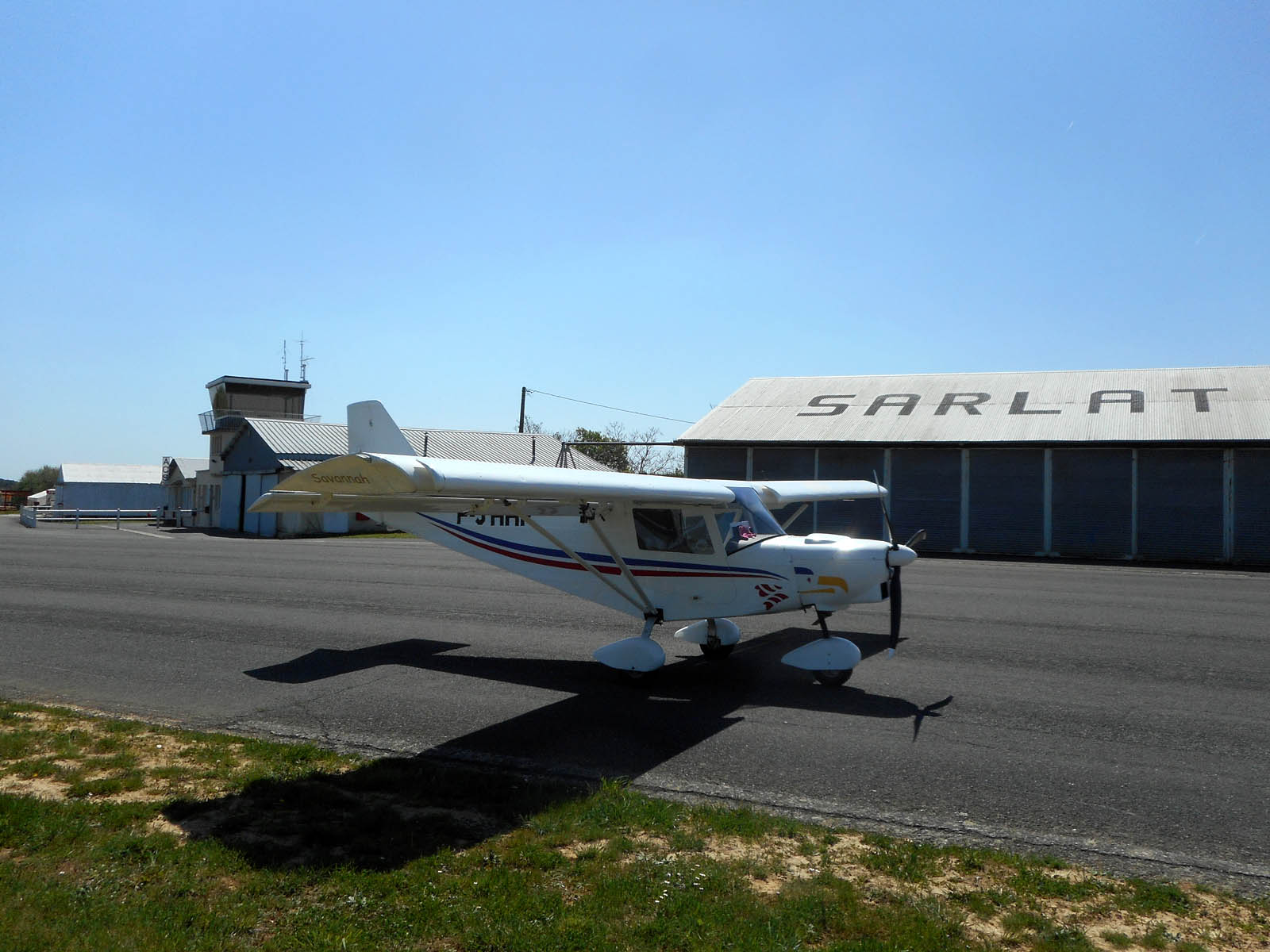
My plan was just to ‘do’ the usual local airfields with which I’m very familiar on a small local tour lasting about an hour or so taking in Galinat, with its 450 metre up-sloping grass runway, Condat with its enormous up-sloping hard runway on which you could land a turbo twin and Sarlat with it’s long, flat hard runway that I expected to be quite busy on a day like today at this time of the year.

Sarlat only accepts radio equipped aircraft for that very reason and also because there’s parachuting there at this time of the year. However, although I saw the jump aircraft taking off, there didn’t seem to be any parachuting going on today.

Today was forecast to be benign early on but becoming a scorcher later, so my plan was to get away by about 9.00 am or so in order to get back again before it became too thermic. However, due to the usual unforeseen hiccups eg I’d forgotten that I’d removed the velcro from the back of my tablet that’s needed to attach it to its mounting bracket in the Weedhopper, so after getting hold of some more off Victor that saved me driving all the way home again, it was 10.25 am before I actually got away.

After passing over Victor and Madeleine’s house my first heading was for a landing at Galinat that should have taken not much more than 10 minutes or so. However, as I approached the airfield from the direction of Thonac, I could see that there were obstructions on the runway. These turned out to be hay bales that are everywhere in all the fields at the moment as the farmers have been very busy as a result of the fine weather harvesting fodder for their animals.

I decided that there wasn’t sufficient space to avoid the ones along the side of the runway so after passing along its length, turned left and took a heading for Condat without landing. It was a pity because with Galinat’s runway being so long with a slight up-slope, it’s a great place to come in a bit fast and practise your flare and hold-off when you’ve had a bit of a lay-off from flying, as I have.

After leaving Galinat behind me, I took a couple of shots through 28AAD’s windows. First a shot looking forward with Condat’s runway in the left-centre of the screen in the middle distance and then one of Aubas with its little ‘barrage’ (weir) on the river Vézère.

The Dordogne from the cabin of Weedhopper 28AAD

Aubas from the cabin of Weedhopper 28AAD

As usual (almost), when I got set up to land at Condat there was a choppy cross-wind and I had the surprising experience of a sudden very high nose-up attitude in the Weedhopper after landing, with its nose wheel way up off the ground while rolling on its main wheels. I can’t remember ever experiencing such a thing with MYRO and I wonder if its due to the French Weedhopper having larger diameter main wheels? Mind you, I can’t remember its happening with the X-Air either so it probably isn’t and it was maybe just due to a sudden strong gust hitting me just after I’d touched down.

Here are some shots that I took of 28AAD at Condat after I’d signed Roland’s movements book that the police insist that he keeps.

Weedhopper 28AAD at Condat sur Vézère

Weedhopper 28AAD at Condat sur Vézère

Weedhopper 28AAD at Condat sur Vézère

Then off to Sarlat. After taking off at Condat, you fly towards the face of a low range of small hills. Usually in the Savannah, and even the X-Air, I pay no attention to them because by the time I reach them I’m already at height. However, this wasn’t the case with the Weedhopper, which was climbing at only 500 ft/min at about 6200 rpm on its little 503 engine, so just to be sure I turned slowly away from them to the right towards Montignac, until I was satisfied that I’d more than cleared them.

Then on to the town of Sarlat. And it was then that I realised just how slow the Weedhopper is! I didn’t think too much of it at the time, but I now realise why people thought that I was crackers to fly MYRO from the UK right down to the Dordogne. Compared to the Savannah especially, it seemed to take an age to see Sarlat come up and pass by under my right wing, and yet another one to get into the overhead of Sarlat-Domme aerodrome.

It became clear as I approached the overhead that something was going on at the airfield. There were many more aircraft than normal on the parking and even the grass in front of the tower together with flags and banners and initially I was worried that I was gatecrashing some event or other. I hadn’t bothered to read the NOTAMs and this was a lesson learned, even for local flights to ‘well known’ airfields at this time of year.

However, I then spotted another small aircraft landing on runway 10, which I was setting myself up for, so decided to continue and landed nicely without incident. I decided that in view of the number of parked aircraft, I’d park the Weedhopper away from the main parking outside what used to be the ULM club hangar and walk along the side of the taxiway to the ‘Acceuil’ to sign the movements sheet.

There were lots of people milling around together with Breitling banners, tables for this and that and so on, but I don’t know what the event was actually for. I’d seen the parachute jump aircraft departing shortly after I’d landed but there was what appeared to be a separate group over to one side outside the parachuting marquee, so I don’t have a clue what it was all in aid off. However, I found the movements book, which had been moved from its usual place and taken outside, signed it and decided to get away a bit pronto as the wind already seemed to be rising, which it always seems to at Sarlat because of the airfield being located on the top of a plateau.

Before I went though, here are some shots that I took of the Weedhopper on its parking place outside the old ULM club hangar.

Weedhopper 28AAD at Sarlat-Domme

Weedhopper 28AAD at Sarlat-Domme

Weedhopper 28AAD at Sarlat-Domme

The flight back to Malbec took exactly 30 minutes and whereas I’d had some leaway for speed and height for the landings at both Condat an Sarlat, this time at Malbec I didn’t. As I hadn’t flown for several weeks, it made me concentrate as although it wasn’t yet too strong, there was already a choppy cross-wind gusting from the right on the approach. But I needn’t have worried. It wasn’t my best ever landing, but they all don’t have to be, and after touching down and taxying up the runway, I switched off outside the Savannah’s hangar with a smile on my face.

I’d done what I’d wanted to do and achieved what I’d wanted to achieve, so that was good at a time when I’m still coming back after my chemo. Any niggles? Not really, other than the Weedhopper’s slow speed over the ground, which I’m not accustomed to these days after the Savannah. I also thought that there was a lot of vibration, maybe due to an unbalanced prop. After shortening it a bit, I’d taken care to balance it as I thought, but maybe my efforts weren’t quite good enough.

I also noticed that where the Weed has been standing in the front of the barn fully exposed to the hot morning sunshine, its engine cover had stuck to the propeller’s painted tips and a thick chunk of paint had been removed from one end when I took the cover off. Whether this would be enough to account for the imbalance I do not know, but I think that it’s something that I’ll need to look into when I have the time.

But otherwise, what a great morning’s flying and how wise to get away when I did to miss the rising winds and turbulence that are both active and increasing as I type this, just before the start of the England-Sweden World Cup football match. So I must go!!

One down, one to go

Problems, that is. As I said I was going to in my last post, yesterday I was off back up north again in Victor’s Citroen that he’d kindly loaned me for the journey. I left home at 7.00 am and the first job was to clear out my car which at the time of writing is still in a garage in Villeneuve la Garenne in the northern Paris suburbs, where I arrived in the early afternoon. The drive around the Paris Péripherique was the usual mayhem but fortunately my little satnav didn’t let me down and I got to within 500 metres of the garage before missing the right turn, going straight on and having to go around the block in chaotic traffic.

As well as doing the usual tyre, brake and suspension work, the garage was stacked up with vehicles like mine awaiting more major repairs and after I’d emptied it of my stuff and transferred the ladder and board on its roof to the Citroen, I was disappointed to be told that I’d be lucky to get any news on its repair this week, but more likely next. So my breakdown assistance were more or less right about the leadtime, except if I hadn’t intervened and got the Kia moved from the breakdown company’s yard to a garage when I did, the leadtime wouldn’t presumably have started until they had got around to arranging it themselves some days hence.

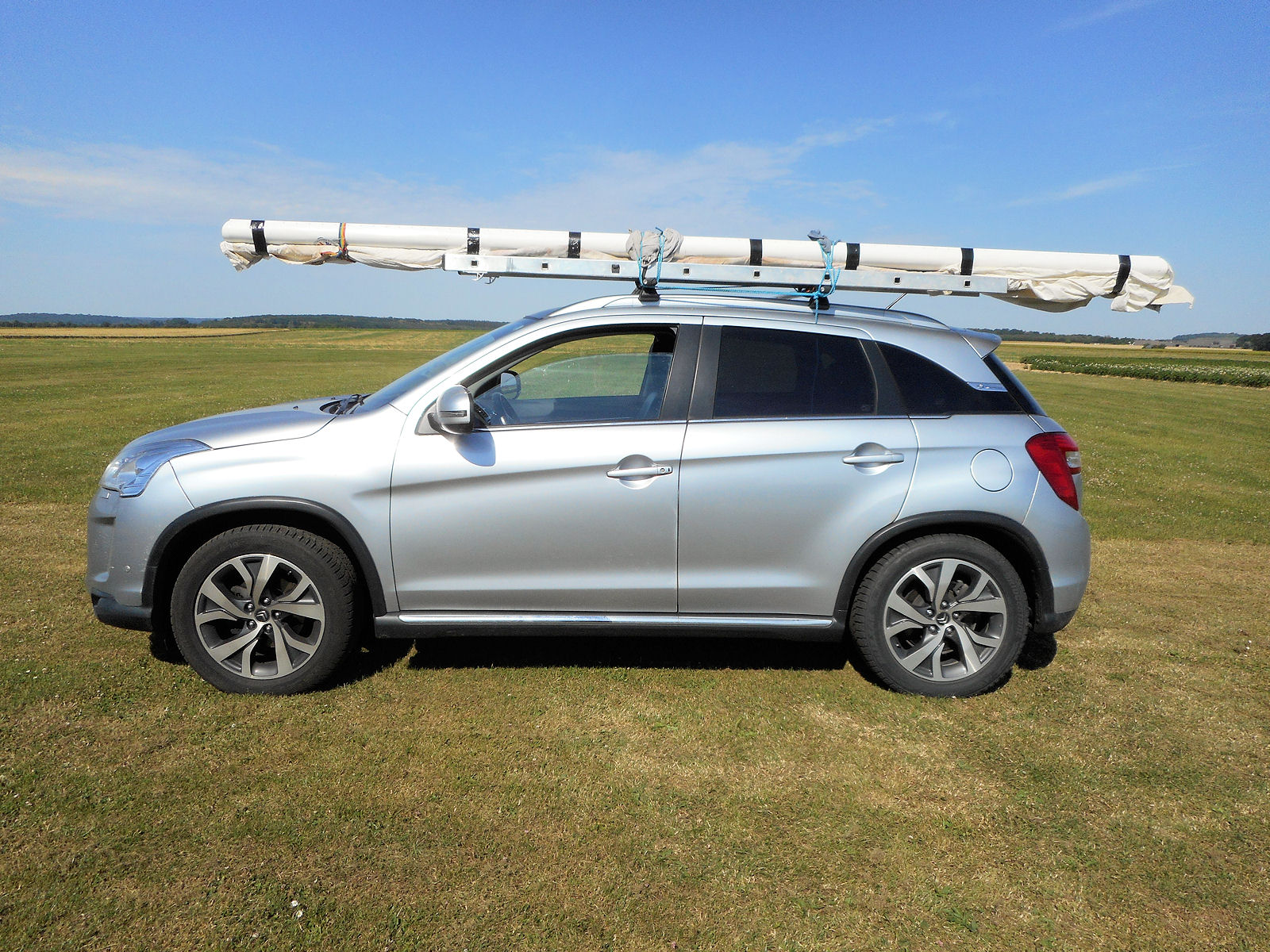
But anyway, I’ve just got to bite the bullet and be patient until a message or email drops into my inbox from the garage with the vital information that I need. So then I could turn my attention to the next problem, namely that of the Savannah’s damaged slat. Readers may wonder why I was originally heading north with a ladder and board on my car’s roof, and here’s the reason.

I reasoned that many French Savannah owners who go for the slat-to-VG wing conversion wouldn’t do the job themselves but would instead deliver their aircraft to Centre Les Noyers, the Savannah distributor, to do the work for them. Afterwards they’d have little or no interest in having their old slats returned to them, especially if based some way away from Les Noyers when the transport costs would be prohibitive and the chance of having them delivered undamaged would not be that great.

I therefore thought that Les Noyers must surely end up with a pile of old slats in the back of one of their hangars which might otherwise end up only going for scrap, so gave them a telephone call to find out. The answer that I received was, ‘Yes, what colour is your aircraft?’ and to cut a long story short, I ended up doing a good deal with them for a second-hand white one. And that was the reason for having the ladder and board on my car roof as a means of holding the slat safely and securely for transit during the 7 hour drive from Les Noyers, which is situated between Beauvais and Pontoise in northern France, and the Dordogne.

So after leaving the garage in Villeneuve la Garenne behind me, I headed off to the north-west and Les Noyers, where I arrived in the latter part of the afternoon, by which time the day had become scorching and airless. The journey was also not helped by the fact that all French roads that don’t have a central ‘separator’ between the opposing traffic flows have now had a 80 kmh speed limit slapped onto them, further slowing things down, but eventually I found myself outside the Les Noyers offices and hangars waiting for the lady who runs the office but was working from home because it was so hot, to arrive to open it up for me.

null

null

Les Noyers have a very neat and tidy setup which is surprising in one way in that there is no approach road to the office or a car park. Instead everything, the office and hangars, is set in the middle of neatly mowed grass which you have to drive over as the lovely lady also did to greet me shortly after I’d arrived.

null

null

After re-emerging into the back of the office from an adjacent hangar with a white slat she and I enjoyed a conversation about this and that while I drank a welcome can of cold Perrier and it was then time to load the slat onto the car roof. I turned down a kind offer of help because with the long drive that awaited, I wanted to do the job myself so I knew that it was done exactly as I wanted, and it took me over half-an hour in scorching sun before it was loaded to my satisfaction.

null

null

It was then time to start heading homeward. After my experience the week before, I’d already decided that I’d spend the night in the Première Classe hotel at Orléans West, where I arrived at around 9.00 pm. By then stormy weather was threatening and I kept my fingers crossed in case it did start to rain heavily and weakened the duck tape that I’d used to secure the slat to the wooden board. Luckily that didn’t happen.

On this occasion I found the hotel to be disappointing compared to the one I’d stayed in at Nenterre the week before. For starters the evening and night were hot and muggy and unlike the hotel in Nanterre, this room didn’t have any kind of air conditioning or cooling even, so although very tired by this time, I slept rather fitfully.

Also, you hear some nightmare stories about these budget hotels and I have to say that when I inspected my bed before getting into it, although the bed was well-made and the sheets etc were neat and tidy, I found that they contained a few black hairs which could have meant that they hadn’t been changed after the previous guest. I have no idea however, if this was actually the case.

After taking a quick breakfast in the hotel, I eventually got away from Orléans this morning at about 7.30 am. With the slat on board, I took the drive back very easy, never driving over 105-110 kmh and averaging around 100-105 kmh so as not to expose the slat to any excessive air pressure that might have caused it to bend. The journey therefore took a bit longer but I was rewarded by arriving at my house dead on midday with the slat in the same condition in which it had left Les Noyers.

I was also delighted to find on inspecting it closely before taking it into the hangar that it’s actually in better general condition than the one that it’ll be replacing, so once again a minor disaster will result in the aircraft being improved. And now that the slat’s in the hangar at Malbec, it means that that’s a problem solved, leaving me immediately with just that of my car repair to resolve.

I just hope that that goes as smoothly as getting hold of the replacement slat did, but I can now only wait and see 😉

Another bloody disaster!

No apologies for the language, but I’m getting fed up of seemingly every time I set foot outside my door I get another kick in the teeth. Last year was bad enough due to my health problems but this year isn’t shaping up to be much better with my being hit continuously by one setback after another.

I still have plumbing problems in my house. There’s a water pressure reducer behind the kitchen cabinets that I installed some time ago (and have never even got around to finishing for various reasons) that’s leaking. In order to avoid puddles emerging on my floor from under said units I have placed a container under the leak, which I have to periodically empty out, and turn the water off overnight and whenever I go out to avoid its filling up too quickly.

I still fear that the only way that I’ll be able to solve the problem will be by replacing the leaking item and that will I am pretty sure involve ripping the kitchen units out completely. It’s a great thought that, ripping all of the stuff out that I haven’t even finished putting in yet.

I’ve also got a leaky toilet. Some readers will recall that shortly after I moved into my house, I installed a brand new toilet. Like all toilets in France, it soon began to leak water out of its cistern into the toilet bowl which is annoying because as well as wasting water, which is all metered in France, you get a disgusting build up of lime scale in no time at all. Like I say, every toilet in France that I’ve come across is the same and it’s due to the standard design not being effective, unlike in the UK.

But you can live with it, except that pretty soon it got worse and the plastic float valve that controls the level of water in the cistern also began to fail (yes, it also had a standard NF mark on it) and water began to overflow not only into the toilet bowl but also out of the cistern and over the floor. My toilet, which came with a guarantee of course, except the till receipt has faded to pure white (lesson – photocopy all ‘big ticket’ till receipts) so I could and can do nothing about it, is of suspended design concealed behind a wall panel and I had reservations about that when I installed it. However, I had no choice but to rip off the upper part of the panel to obtain (limited) access to the cistern in order to replace the faulty float valve.

But I did it thinking that that would be it. But no. Now it’s happening all over again, but this time much worse, even though the replacement float valve that I fitted had the NF mark on it and was the most expensive one in the store at the time. My conclusion, while the panel in my toilet augments its layer of black mould if I forget to turn off the supply valve whenever I use the toilet, is that French plumbing components are rubbish and there’s no doubt in my mind that when I redo the toilet, as I inevitably will have to, I’ll bring one over from the UK.

But that’s not all, of course, because as well as those problems I still have the damage to my Savannah’s wing slat to deal with that was, admittedly, caused solely by my own bad judgement, not that that makes me feel any better about it. But anyway, I thought of a way to solve it, at least for now, at minimal cost and so it was that last Sunday I was all ready to drive north to pick up a replacement slat that would save me the time, effort and cost of doing the VG conversion that I originally thought might be the only solution.

null

null

My plan was to head north, pick up the slat and return home the same day making for a long day but one that should have been quite manageable. However, it wasn’t to be, and this was the sight that greeted me last Monday evening.

null

null

That’s the Seine at Nanterre, a suburb of Paris, viewed from the window of the Première Classe Hotel there. So what happened, you might ask?

The day was going well and I’d reached the south-western suburbs of Paris quite comfortably but while driving up a slight incline in traffic at only around 60 kmh or so, all hell suddenly broke loose in my engine. Just before I’d noticed that my fuel warning light was on, which I’d found surprising, and thought that I caught a whiff of diesel, when all of a sudden something let go and my engine began emitting such an enormous cloud of thick smoke that I couldn’t see the car behind. At the same time, the engine began to accelerate uncontrollably at which time I slipped the gear into neutral, turned off the ignition and coasted to a halt.

The engine stopped after a short while not to start again and I was left at the side of the road 7 hours from my home with my hazards flashing. Luckily, I have roadside assistance and eventually a break-down truck arrived and loaded my car on board. The driver’s next job is to find a local garage to take the vehicle to, but despite phoning at least 10 (more I think) he couldn’t find one. So that meant taking my car another hour further north to his firm’s depot in the Paris suburbs.

My assistance contract provides me with a taxi to take me home if the distance involved is less than 100 kilometres and a hire car if it’s greater but the problem was that by then the hour was getting late. This culminated in my missing a call from Enterprise Car Rental at La Défense in Paris due to my phone battery running low and my having to be put up in a hotel for the night.

The two girls in the office of the ‘dépanneur’ (Ets Péripherique Nord) were angels and insisted on staying until I was safely in a taxi heading for the hotel which meant that instead of closing the office and heading for home and their families at 6.30 pm, they were there until well after 8.00 pm, for which I was truly grateful.

The hotel was ‘cheap and cheerful’ but I didn’t need much more than a clean room, a shower and a bed for the night, all of which it provided as the following pic shows.

null

So now what? I’m back in the Dordogne after being provided the next day by my assistance with a nippy little Ford Fiesta from Enterprise Car Rental. However, my own car is still stuck up in the western suburbs of Paris with a few things in its boot, including my tool box, and the board and part of my ladder that was to take the replacement wing slat, still on its roof.

My assistance said tough, but they couldn’t find a local garage that could even look at my car for at least two weeks, let alone repair it, assuming that it is repairable. I refused to accept this. I’m afraid that like many people in France I suspected that they wanted to get away with putting in the minimum effort to solve the problem and therefore decided to see what I could do myself.

I decided to start with the ‘dépanneur’ and see what local contacts they had, and within 5 minutes they’d not only found a local garage but had also arranged for my car to be moved there the following day (Saturday).

In the meantime my kind friend Victor has once again loaned me his 2CV as it’s impossible to live here without a car. Even more generously, he’s offered me his Citroen SUV to head back north again in, which I’m going to do on Monday, a week exactly after the last time. The garage with my car has said that in the meantime, although they probably won’t have had a chance to assess the damage, my things will be safe and that I’ll be able to pick them up in the afternoon.

I’m also planning to continue my journey and pick up the replacement wing slat but until I get back home again on Tuesday (I’m planning to spend the night in the Première Classe hotel at Orléans Ouest) I’ll be keeping my fingers crossed. Then I’ll just be on tenterhooks waiting for news on my car repair 😕

Back on the piste again

We had another glorious day today with a clear blue sky all day and warm sunshine but with just enough wind to keep things a bit fresh. So it was a good day to pull the Weedhopper out of the back of the barn and give it a good wash and clean. And it really needed it. I only gave it a cursory clean while I was repairing and renovating it back in 2016 and with its having been stored in the back of the Savannah’s hangar for the whole of last year, it had built up a good coat of grime both inside and out.

Here are a couple of shots of 2/3 of my ‘fleet’ after I’d pulled the X-Air and the Weedhopper out of the barn before I started work.

null

null

And here’s a shot of the Weedhopper just before it got its first dose of clean water for at least three years or so. Not that it stayed clean for very long as soon as I got going with the sponge.

null

I took my house broom over to Malbec with me because I wanted to give the wings a good brushing to remove as much dust and other muck as I could before starting on them with the sponge. I’d spotted a lot of ‘debris’ on the left one and when I brushed it off I realised that it consisted of mouse droppings. I don’t know whether they had fallen from the roof or the mice had been spending time on top of the wing but I counted myself fortunate that they didn’t appear to have done any further damage.

It took me between two and three hours to finish off the job as I gave every surface a going over with the sponge and the screen, pod and the interior a further wipe with the wash leather so I didn’t leave any smears behind. But it was well worth the effort and it was a sight for (my) sore eyes to see the Weedhopper eventually glistening in the sunlight back again at the top of Malbec’s runway.

null

null

null

null

null

Even MYRO’s old panel had a good shine on it in the sunlight, although it was practically impossible to take a good picture of the Weed’s interior because of the redness caused by the bright sunlight shining through its Ultralam covers.

null

As its engine hadn’t been run for a few weeks, I wanted to give the Weed a few fast taxies on Malbec’s runway, which I did with nothing going amiss. A flight, though, was out of the question because although the wind direction would have been basically on the nose for landing, the air would have been very thermic due to the quite intense heat of the day and from time to time there were also some unpredictable powerful gusts of 45kmh (28mph) which could have made things a bit too tricky.

Here are some final shots that I took before taxying the Weedhopper through the airfield entrance and back up to the area in front of the barn.

null

null

null

null

Although renewing the yellow varnish on the X-Air is next on my list of jobs, I put it at the back of the barn as I’d like very much if I could to do a bit of flying in the Weedhopper over the week-end. That’s if the weather plays ball, of course, because the hot weather and strong gusting winds are forecast to continue into next week. However, under such conditions, things are usually much more settled in the morning and early evening, so that’s when I plan to go. Now it’ll just be a matter of seeing how things work out.

Getting organised – again

As of today, I haven’t flown for over a month, since the day on which I aborted my planned flight to the UK actually. This has mainly been due to the fact that I really haven’t felt well enough. I did do some flights in the Savannah a few weeks ago when I didn’t feel too bad and even took Wim’s family for flights around Montignac from Galinat, but somehow between then and the day of my UK flight, things had crept up on me without my realising it.

This showed itself in a couple of ways – one was a feeling of general malaise, not so much being generally unwell, more of just being some way below par, and the other was constant discomfort in my stomach and chest. I now realise that this was due to the lingering effects of the chemotherapy – I did have 8 months of it which from what I’ve since learnt is quite a lot – and I have been advised that it could still be several more weeks, even months, before the chemicals clear completely out of my system.

I’m prepared to believe it too because I still have tingling and lack of sensation in my little fingers and big toes and ‘chemo nails’ which are much more yellowy than normal with vertical ridges on them. My fingernails also tend to split very easily, for example even if I merely catch them on my duvet cover when making my bed. But in the last couple of weeks things have improved greatly and I can now say that I almost feel completely normal again.

I don’t know whether there’s actually a connection, but a few weeks ago I read somewhere that mangoes contain everything that you need to achieve a balanced digestive system and if you suffer from a constantly upset stomach that you should eat a mango every day. So that’s what I started doing – every morning with my breakfast, not a whole mango but just a large slice – and I thought nothing more of it. However, after a week or so I suddenly realised that I felt well again and my stomach and chest pains had disappeared.

I don’t think that it was due to a placebo effect because I’ve since stopped regularly eating mango and I still not only feel fine but am actually eating normally (ie everything) again and am feeling better by the day. So well in fact, that I’ve been motivated to start working on my aircraft again and not only have I obtained the special varnish and thinner to use on the X-Air so I can get it tidied up and advertised for sale, but also on the Weedhopper.

null

The Weedhopper has been in the back of the barn since I moved the X-Air to the front so I could start preparing the wings for varnishing. It’s filthy and I’ll be getting both it and the X-Air out again for a wash and brush up while the weather is so good. I was working on the Weed today, doing what I’ll tell in a moment, and when at the end of the afternoon I went back to my car, which was standing in the shade of the barn, its temperature gauge read 38 degrees Celsius. It fell back when I started the engine but only by a couple of degrees, so today was a real scorcher.

Not the best day then to be working on an aircraft in the back of the barn. But at the end of the day it was well worth the sweat and discomfort, because today I was finishing the Weedhopper off by installing its radio ready for when I next fly it, which will hopefully be this week-end if it’s not too hot and thermic. Unlike in the UK where the mandatory changeover to 8.33kHz is imminent, here in France we have a concession that means it won’t happen until 2021.

That means that my trusty little Vertex VXA-220 (not to mention the Icom in my Savannah) still has another couple of years of life in it, so it’s worth my while copying the same kit installation that I have in the X-Air over into the Weedhopper so the set-up can just be switched over at will. The Velcro pads that attached the kit to MYRO’s panel are still in the Weedhopper so it was just a matter of rigging up a PTT button and connection and as I already had a suitable miniature button and some cable, I just had to order a couple of twin pole Binder connectors (giving me a spare, just in case) and a suitable handlebar grip to go onto the Weedhopper’s control column.

I made up the Binder connection a couple of days ago so today was just about drilling the control column for the PTT cable and fitting the button. The Weed came to me with just a bare control column tube with no rubber grip on it, but I solved that problem by mounting the new PTT button on a plastic washer of the same diameter as the column, placing the washer and button on its top and then sliding a handlebar grip, into which I’d already cut a suitable size hole, down over it to keep everything in place. I also took the precaution of routing the PTT cable through a length of small bore transparent fuel tubing to protect it where it emerges through the hole I’d drilled in the column.

I was well pleased with the final result which is quite neat and tidy and much better I think than the horrible wooden handles on the control columns in the X-Air, as the following pics show. And although it was too hot and turbulent today for any ULMs to be flying, when I tuned in I did pick up an English-speaking pilot, possibly a Ryanair flight going into Bergerac, communicating with the regional Aquitaine frequency, so I know that the system works OK.

null

null

null

And by the way, a cautionary note for everyone who uses fuel containing alcohol, as I do in the Weedhopper and the X-Air. Wim and I were thinking about flying our Weedhoppers up to the Charente last week-end, to Club Aero-Focus where we enjoyed a fantastic Fête de la St Jean evening during our west coast tour back in 2015. We decided not to go after all and just as well that we did, because this week the new rubber primer bulb that I fitted to the Weedhopper only two years ago failed.

It had actually perished at each end where the connections are and one end failed completely and split with fuel gushing out of it. If this had happened in the air, not only would I have suffered engine failure due to fuel starvation with all that that entails (forced landing etc) but while it was happening, I’d also have had fuel gushing into the cabin and over my left leg. The consequences of this hardly bear thinking about, so from now on, I’ll be replacing the new one that I also fitted this week every two years, or a bit less probably, to be on the safe side.

It’s forecast to be sunny but cooler tomorrow so probably a good day to get both the Weedhopper and the X-Air out into the open for a good clean-up. I’ve also got news on the Savannah. I’ve found a way to effect the repair to its right wing slat at quite a low cost without going to the extent of fitting the VG kit, which is quite expensive but would also be quite a time-consuming business when I have other things that I need to do. But more about that later when I come to do it 😉

Bit of fun

I’ve had a bit of time on my hands for the past few evenings and while idly browsing through My Trike, I realised that I’d let a few areas slip, not the main body of the blog but peripheral ones. Up in the top right hand corner of the home page there are several links, one of which is entitled ‘Jigsaw Puzzles’.

I added this page quite a while ago just as a bit of fun really having found solving on-line jigsaw puzzles quite addictive. However, with other priorities taking up my attention, after a bright start I allowed the page to fall somewhat into decline, which I think is a bit of a pity.

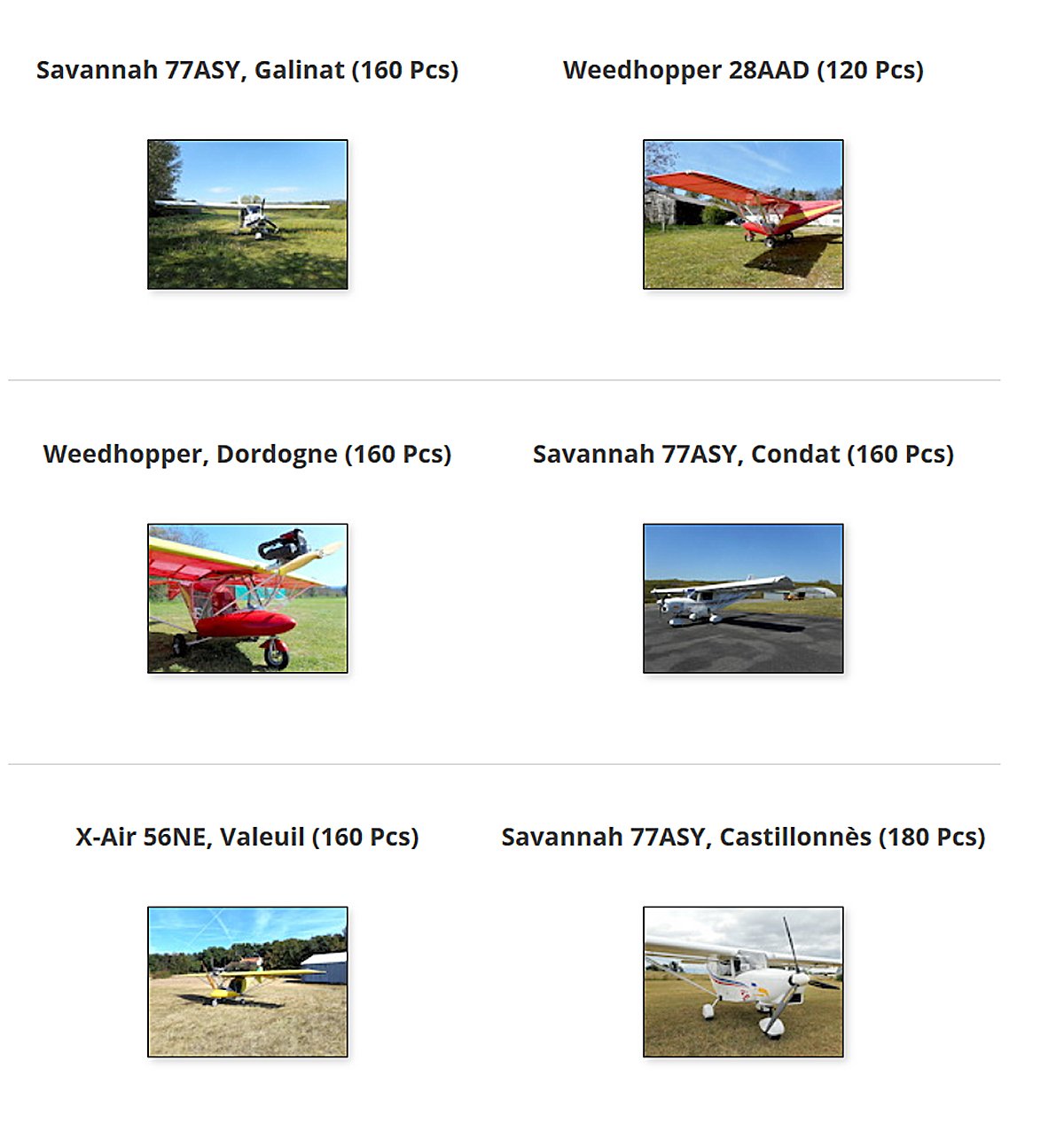
So I decided to do something about it and after dipping into my ever expanding library of photographs, have added half a dozen more jigsaw puzzles to the page content, as shown by the following image.

null

Whereas I started with puzzles having only a hundred pieces or so that could be finished in 15 to 20 minutes, the new ones have more and are more challenging. When I did the most recent one of the Savannah that has 180 pieces it took me half an hour or so and I found that it was good fun to do as well.

So if you fancy a bit of fun and are into on-line games, give my new jigsaw puzzles a try by clicking on THIS LINK.

Incidentally, I also found that after making a good start I’d allowed my gallery of aircraft photographs to slip into a state of decline. So I’ve also taken action to address that problem and have added some decent shots of G-MYRO, my old UK Cyclone AX3, together with completely new sections on my French Weedhopper and X-Air. Take a look if you have the time by clicking HERE.

Disappointment all round

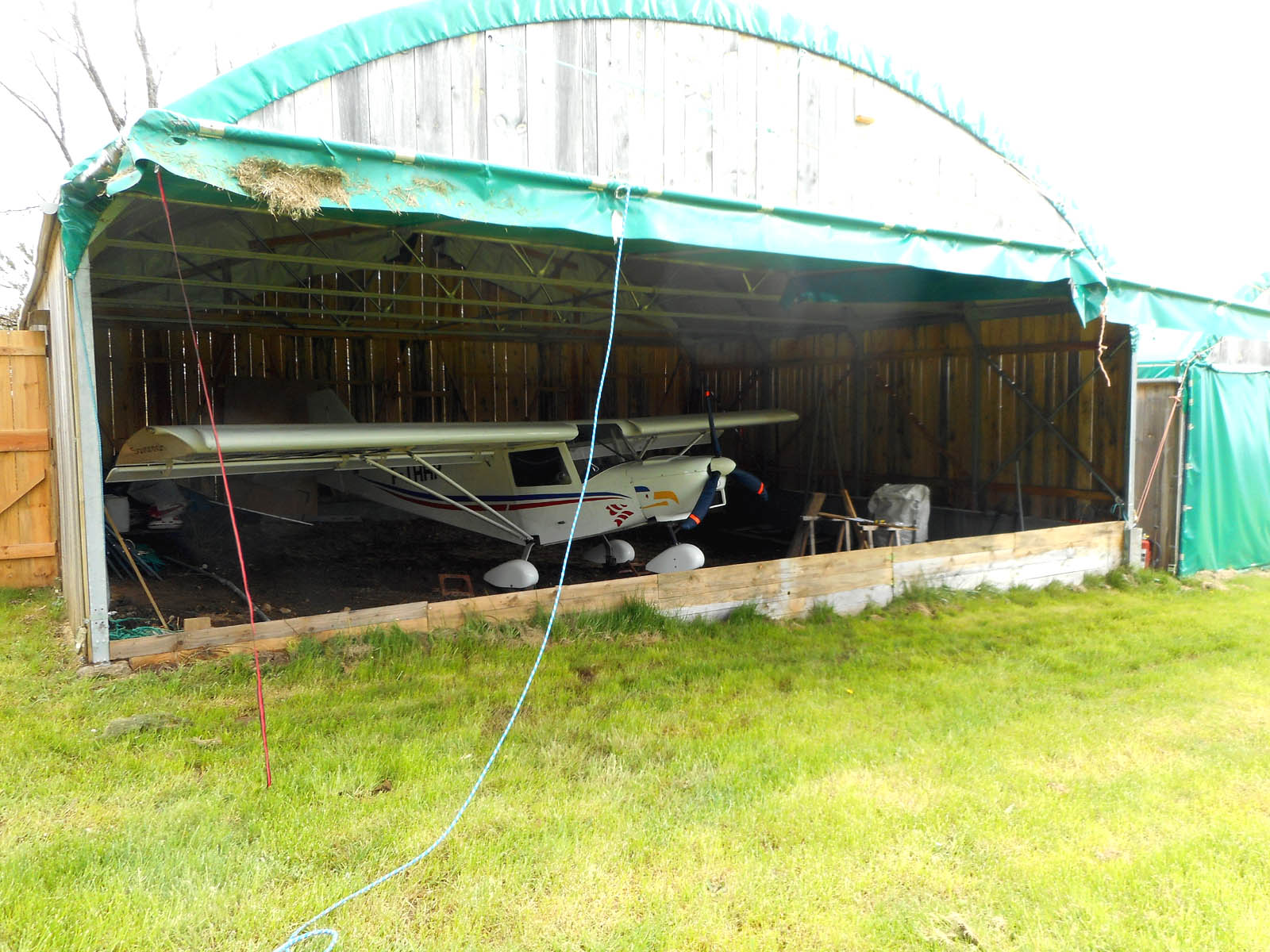
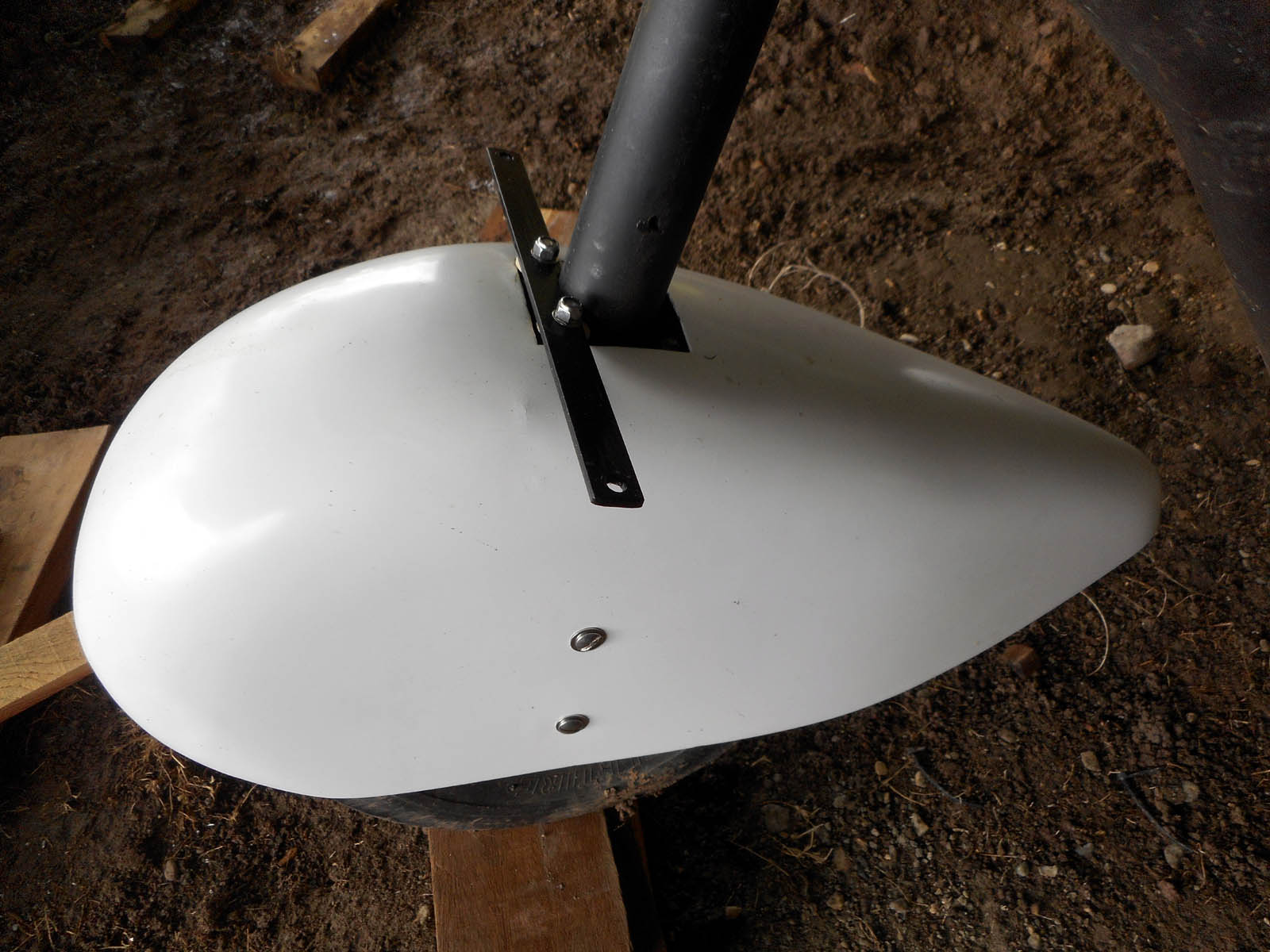
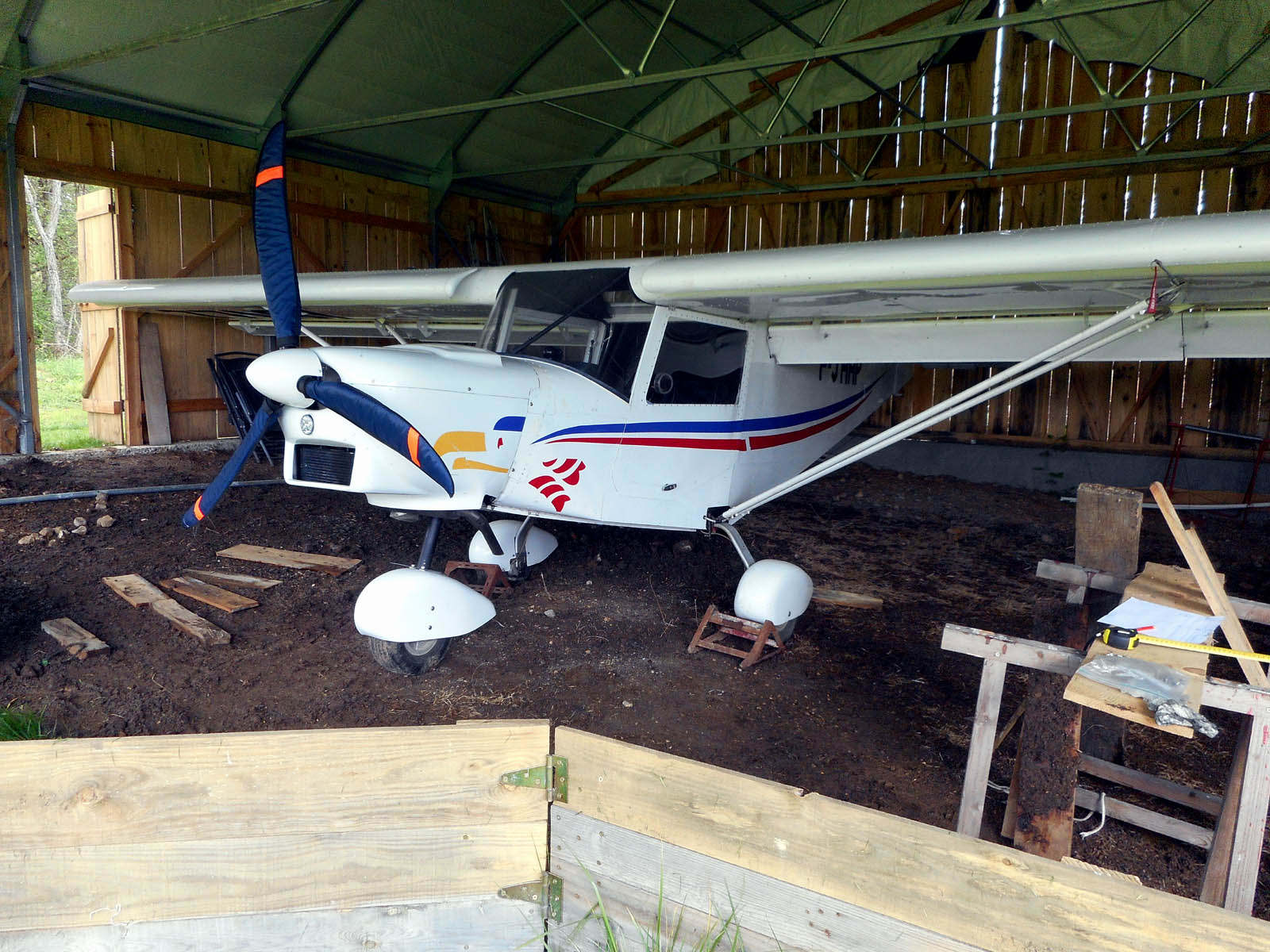
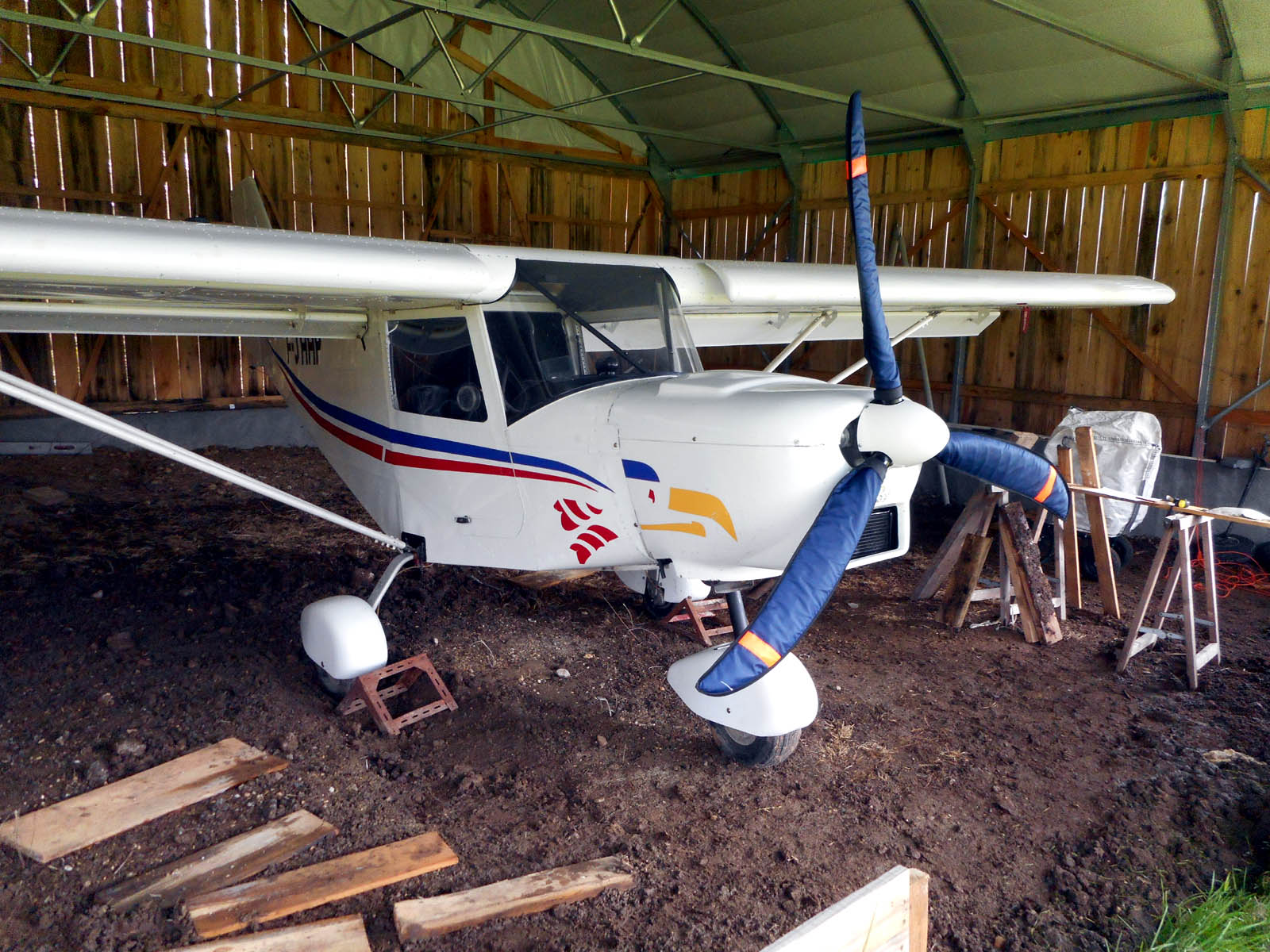
Readers might have surmised by now from my continued silence in respect of my planned UK flight in F-JHHP that all didn’t go as planned. And they’d be right. Not that conditions weren’t perfect for it and the aircraft wasn’t immaculate and perfectly prepared for it, as the following pictures show.

ICP Savannah MXP740, Dordogne, France

ICP Savannah MXP740, Dordogne, France

So everything was perfect and with the glorious weather conditions on the day, Sunday 20 May, I was looking forward to an epic flight. However, an unfortunate sequence of events succeeded in putting paid to it, for now anyway, as I’ll go on to explain.

My good friends, Wim and Victor had turned up to see me off, Wim arriving in his Weedhopper and Victor by car. The first task was to get the Savannah out of the hangar, and while I released the internal retainers, Wim offered to raise the doors from the front. The doors are opened using cords on a pulley system which I’ve found over the months that I’ve been doing it require a bit of a knack rather than just brute strength and as he heaved on the cord of the first door it snapped.

This was a bit of a setback as there’s no simple other way to get the doors raised and propped high enough to extricate the aircraft from the hangar and it took us a good ten minutes or more to do the job with the clock all the while ticking away past my planned departure time. But in the end the Savannah was out on the top of the runway where I had to face it nose uphill to prevent fuel from the topped-up tanks from syphoning out onto a low wing as I’ve had happen on a couple of occasions in the past.

It then took several more minutes for me to load all my baggage and equipment into the aircraft after which I was ready to start the engine, let it run for five or so minutes to warm up and turn it around to face down the runway ready for take off. It was then that I made my fatal mistake.

Wim had left his aircraft to one side in the area where I would be turning and to give me as much room as possible, he moved it back a bit. Then I began to taxy slowly up towards the top of the runway and began my turn to get into position for take off and it became clear almost immediately to both of us as I did so that there was still insufficient space to make the turn.

But by then as the Savannah began to move downhill it was already too late. Even with the engine running at not much more than tickover, the momentum of the aircraft on the downslope was too much for the Savannah’s somewhat puny disc brakes to overcome and as I tried to pull the aircraft round as tightly as possible I was treated to the sickening sight of its right wing tip striking the engine of Wim’s aircraft.

So the flight came to an abrupt end even before it had started. I was furious with myself for not taking more time and trouble to turn the Savannah around in a safer way, but it shows how one’s judgement can be impaired when under pressure. We checked out both aircraft and luckily, apart from knocking Wim’s Weedhopper’s air filter askew, which was replaced back in position merely by loosening and re-tightening a retaining screw, there was no damage to his aircraft.

But the same couldn’t be said for the Savannah. Inspection revealed that luckily the wing itself was not affected and only the end of the wing slat had suffered any damage. I wasn’t keen, but Wim and Victor were quite sure that it could be patched up enough for the aircraft to be safely flown, and after several minutes spent reshaping the end of the slat and making it sufficiently stream-lined with duck tape, they proved their point.

However, I still wasn’t keen and they suggested leaving things until the next day before deciding, which I did. In the meantime, I’d left the Savannah outside because we’d been expecting a German visitor to fly in to whom in my absence we’d promised the hangar. In fact he didn’t arrive due to bad weather in Basel, I think he said, so I went back later to put the Savannah back inside.

Almost unbelievably, in doing so I managed to strike the hangar door with its rudder. It didn’t cause much more than cosmetic damage which was still really annoying even so, but for me this was the last straw and I decided that after so many disasters, it was time to call the flight off, for now anyway.

This was further reinforced by the fact that flying the next day, which was a bank holiday in France, meant that picking up fuel at my chosen airfields would be uncertain at the very least. To be sure of obtaining enough to get me to Calais, I’d need to completely replan my flight to go via Saumur, where fuel is available 24/24 by bank debit card, rather than via Blois, which would more than likely be closed, so that clinched it for me.

So what now? Well, luckily the damage to the Savannah’s wing tip is confined just to the slat so repairing it will be no problem. The reason is that there’s a factory kit to convert the wing design from slatted to vortex generator that involves removing the slats and replacing the leading edges of each wing with new ones with a larger profile and vortex generator tabs.

The upside is that the aircraft retains its trademark STOL characteristics but gains a higher cruise speed together with slightly lower fuel consumption. So gains all round then, for only 20 hours of work. However, the kit’s not that cheap at 2000€ TTC (including VAT) and although I had an idea of doing the job some time in the future, I really wanted to upgrade my radio and buy a transponder first to give myself greater flexibility on longer flights.

But it seems that the choice has now been taken out of my hands and the transponder will have to wait, together with the radio upgrade that won’t be required here in France in any case, until 2021. And looking on the bright side, as with the other work that I’ve had to do on the Savannah as a result of unfortunate mishaps, I’ll end up with a better (and more valuable?) aircraft afterwards. Sighhhh….. 😕

As a footnote, while I was typing this post it was such a glorious evening here that I decided to take a break and go for a short ride, up and down the road, on my electric bike. And it was well worth it, to feel the rush of the evening air on my face in the warmth of the evening sunshine. But it was only as I arrived back home and went to put my bike away that a little something happened that gave me such enormous extra pleasure.

My neighbour has a large ’tilleuil’ (lime tree) on the edge of his grounds that just overlaps the corner of my garden next to the shed in which I keep my bike. As I stood there in the still of the evening I could perceive the sound of what might easily have been the hum of distant traffic. But it was something that could hardly have been more different.

My neighbour’s tree is the twin of the one I had in front of my house that I had to remove in readiness for the extension that I plan to add at some time in the future. Like mine, it stands at something over 20 metres in height and like mine, at this time of the year it is covered in delicate bell-like flowers before the little lime fruits begin to properly form. And the sound was because the tree was alive with thousands and thousands of bees working away to collect the pollen contained in the little flowers.

null

Such an awesome and enthralling sight and sound must surely temper any feeling of disappointment resulting from one’s human activities and mistakes. And it certainly did for me this evening.

Thoughts and memories on this, her birthday, of my Mum who passed away in 2015. You are still greatly loved and missed.

UK flight – here we go again

Doesn’t time fly. Last year when I’d not long started on my course of chemotherapy and really had no idea of how things were going to turn out, I agreed with a good friend of mine that when it was all over I’d fly back to the UK again, as I did in 2016, but this time I’d land in a field he owns adjacent to his house in Kent.

Now here we are almost a year on. I’ve been thinking about and making preparations for the flight for several weeks now and suddenly it’s almost time, with my scheduled departure date just a week away.

I pencilled in a 3-day window of 19-21 May on my calendar because with 21 May being a ‘jour férié’ (bank holiday) in France, that would give me three days of not having to bother about things like French ‘armée de l’air’ low level training corridors and the like. Not that you can’t plan around such things but it’s easier if you can just ignore then completely.

So with take-off being just a week away, what are the problems? Well none, really, except the old one of the weather. There’s still a week to go and forecasts are therefore unreliable, but at this stage, things don’t look too encouraging as it appears that there is likely to be a fairly strong northerly airstream in place (ie strong nose winds) with all that that entails. Like a low temperature and risks of low(ish) cloud and showers, but for now we just have to wait and see closer to the day.

So what’s involved in planning for a flight like this that crosses an international boundary? As readers might be interested, I’ll go through the steps involved and the formalities that need to be dealt with.

First, you need to find your route. Let’s start by making one thing crystal clear. There are a lot of pilots around who enjoy navigating just using charts, dead-reckoning and eye, the way it was done 50 or so years ago. Nothing wrong with that, but do not kid yourself that you can do likewise with a flight like this.

Firstly, there is just too much controlled airspace around these days and innocently blundering into it does neither yourself nor other pilots any good at all. Better is expected of pilots nowadays. And secondly, trying to navigate by dead-reckoning and eye over terrain that you are not familiar with is just much too tiring to keep up for 5 or 6 hours at a time and is a recipe for disaster of some kind or another.

You definitely therefore need some kind of GPS-based navaid. There are many available but the best-known one is probably the UK’s Sky Demon, which fits everything that you need into a tablet or smartphone, including route finding, NOTAMs, en route airfield data and radio frequencies, flightplan filing, in-air route plotting etc. But occasional users, even ones like me who only make infrequent international flights don’t need it.

When I originally flew my old AX3 from the UK to the Dordogne back in 2012 I didn’t use Sky Demon. Instead I just used charts that I’d scanned off the internet and loaded into MemoryMap on my PC and a cheap Chinese satnav and did everything else myself and in principle I still do the same. When I purchase the new Cartabossy French aviation charts each year, I also get a link to download them as geotiffs. This for me is the real value because from then on I confess that although I carry the paper charts with me, they remain unopened.

This is because the geotiffs can be directly loaded into MemoryMap that I purchased years ago and still have, but now on an Asus 7″ tablet as well as my PC and it’s this that I use to create routes on my PC and fly with in my aircraft. And it’s from images of my route grabbed off my PC that the following shots were taken.

All that follows from here on is based on my flight from France to the UK and back. However, everything still applies for a flight in the opposite direction except that it would all be done in reverse.

OK, so back to finding the route. My aircraft is not fitted with a transponder as there’s little need for it in France and staying out of Class D and above airspace is relatively simple. However, it’s a slight hindrance when planning a long flight like this one because the route not only has to remain clear of danger and other restricted areas but also has to divert around controlled airspace when having a transponder on board would allow you to fly straight through.

The next consideration is endurance and refuelling. Unlike driving a car, you can’t just fly an aircraft and when the tanks start to get a bit low, land at the next airport and top up. For a start, fuel isn’t that readily available and certainly not at all airfields. Also, it’s often only available during certain hours and even then may not be on an automatic pump with payment by, for example, a bank debit card. Often only cash will be accepted or else if the pump is automatic, only a Total or BP card, so if you don’t already have one, you can’t buy any fuel.

So refuelling en-route is a major consideration. And one more thing – you mustn’t forget to take the wind into consideration. You should never, ever plan in any case to arrive at an airfield for refuelling with ’empty’ tanks, but if your calculations fail to take into account a strong nose wind, you might find that your landing takes place somewhat earlier than expected and some way away from the nearest fuel pump.

The last time I flew to the UK I went both ways via Abbeville, which was cheap and convenient as it was more or less dead on my chosen route. However, it’s not possible to do the same this time because Abbeville has been closed as a customs airfield as a cost-saving measure, and now you have to go via Calais. So the starting point was just to join up Malbec, my starting airfield, with Calais by a straight line on the chart on my PC.

This immediately revealed where diversions would need to be made around controlled airspace etc and the next consideration was where to land to refuel. My initial calculations revealed two prime possibilities – Blois and Chartres – both more or less dead on my intended route. So the next thing was to look at the official airfield charts for each airfield to see what the positions are regarding fuel availabilty.

Both are shown has having Avgas 100LL available, at slightly different times of day but during hours which I could live with. However, only Blois is shown as having an automatic pump that accepts debit cards, and although I’ve contacted Chartres by email and have been told that debit cards are accepted, I still haven’t received confirmation that supply is by automatic pump and think that it has to be arranged via the aero club.

So I’ve decided to fly to the UK and back via Blois and have ended up with a very simple initial sector of just two legs around Limoges Class D airspace, as shown below.

null

Getting from Blois to Calais using the same principles is only slightly more complicated as the next image shows. A diversion around Chateaudun Class D airspace needs to be made and consideration must also be given to height restrictions that apply. For that reason I’ve chosen also to make a small diversion around Class D airspace to the north of Evreux even though it’s not strictly necessary.

null

Once a final route has been decided upon, then it’s time to start crunching the numbers. I do this even though I’ll be using my GPS-based navaid while flying, mainly because I want to be absolutely sure about leg timings and my refuelling arrangements. I use my own excel spreadsheet for this and the image below shows the plan for the selected route. Some entries at the UK end have been deleted for reasons of privacy as I’ll ultimately be landing at my friend’s private field in Kent, but these do not detract from the sheet’s usefulness.

null

So with the final numbers including wind info ready to go onto my kneeboard, that’s the aviation basics dealt with. Now what about the flight formalities and paperwork? Now’s a good time to mention that you MUST carry your aircraft’s registration and insurance documents with you. The likelihood is that you’ll not be asked to produce them but if you can’t then you can expect problems. But what about the flight formalities themselves?

The first thing that you’ll need to arrange is a Schengen exit form covering the leg from Calais to the UK. It’s available on the airfield web site and is easy enough to complete on your PC and email in 24 hours in advance, as shown below.

null

So that’s one half of the international leg covered – what about the second? For that you’ll need to complete and submit a GAR form for entry into the UK. Once again, it’s easy enough to fill in directly on your PC and email in to the link shown on its second page, again 24 hours ahead of planned arrival time.

null

So that’s it then, you think as you breathe a sigh of relief. Well, no actually. There’s just one more step to take, one that many pilots find a little bit tricky, and that’s creating and filing a flight plan. Users of Sky Demon have this sorted out for them and it’s just a matter of clicking a link (and paying a fee). However, there are other ways of doing it, a NATS based UK system, a French system called Olivia and a web site called EuroFPL to name just three. I like to use EuroFPL because (a) it’s free to GA pilots and (b) it validates your plan at the time of creation so when you file it you know that it’ll be accepted.

Here’s a shot of the (very simple) single leg flightplan for the proposed leg from Calais direct (DCT) to Headcorn.

null

Since I first posted the above image I’ve amended it on the advice of my friend Rick in the UK. I quote:

“Where a VFR flight crosses an FIR boundary the flight plan needs to show the crossing point (co-ords or a radial, for Cap GN to Dover I usually show DVR160 from memory) and the EET to that point. A flight plan generated by SkyDemon does this automatically by the way.”

Rick then found the following in the VFR Flight Planning Guide, which he kindly brought to my attention.

7.3.1 Additionally, for flights to/from France, the French Authorities require the frontier crossing point (the UK/France FIR boundary position) to be included in Item 15 (Route) of the FPL. To assist pilots, the UK now includes the ATS route reporting points on the Southern England and Wales 1:500 000 chart. These can be used as a frontier crossing point. A position may also be shown as LAT/LONG, or as a bearing and distance from a route reporting point or navigation aid. Example: Cap Gris Nez – RINTI Cap Gris Nez – 51N00130E Cap Gris Nez – RINTI23005 Cap Gris Nez – DVR16010
7.3.2 The EET for this position should be shown in Item 18 of the FPL (Other information) in the format EET/LFFF(elapsed time) or EET/EGTT (elapsed time), depending on flight direction. Example: EET/LFFF0145 (UK/France) or EET/EGTT0020 (France/UK).

So now the IFR boundary crossing point is shown in the ‘Route’ box (rather than just DCT for Direct) and the EET (elapsed time) to reach it in box 18.

The plan needs to be filed 24 hours (or less if you want) ahead of time just by clicking on the EuroFPL link, as simple as that.

I think that the section of the form that pilots find the most tricky and that causes the most rejections is the ‘Route’ box. There’s really no need to fear it if you keep it simple and stick to points defined by latitude and longitude pairs.

You can use decimal degrees or degrees and minutes. I find the latter simpler because you can then use ‘N’ to designate our northern latitudes and ‘E’ and ‘W’ for longitudes. All you need to remember is to insert 4 figures describing latitude in degrees and tens and units of minutes followed by ‘N’ (North) followed by 5 figures describing longitude in degrees and tens and units of minutes, followed by ‘E’ (East) or ‘W’ (West) and to make up the correct number of figures, where necessary, by insertion of zeros. Also, not to include spaces. However, if you need to describe a route by defining several lat/long points you just add each one in the same format in the ‘Route’ box with a space between them eg 5101N00132E 5101N00027W (the latter is the Billingshurst VRP to the SW of the Gatwick Class D). Then apart from only ticking boxes on the flight plan form that are relevant (ie no ‘X’s or ‘0’s for items that do not apply) you should never have another flightplan rejected and have to start pulling your hair out wondering why.

And that really is that. With all of the above tasks completed, all that’s left is to fly safely and enjoy the flight 😉

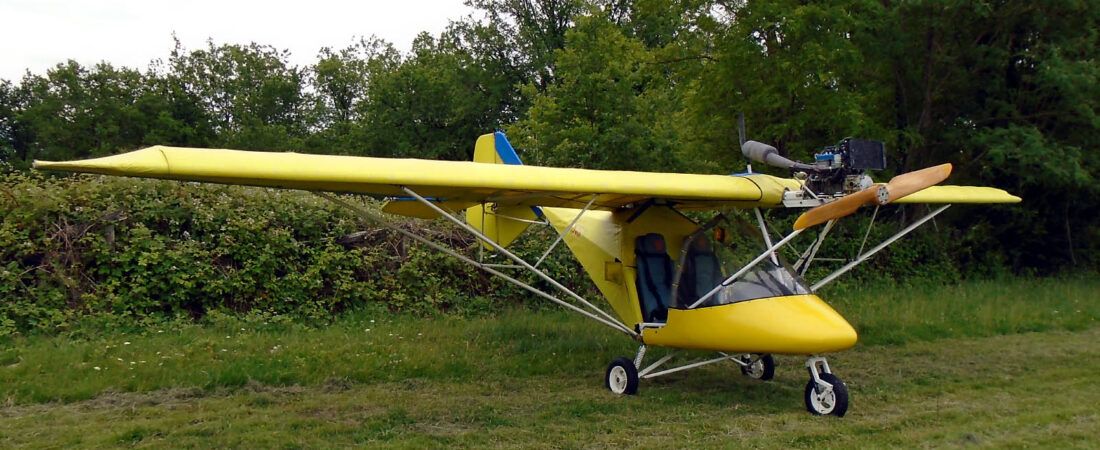
X-Air’s turn now

We had a mixed bag of weather over the past week or so – more rain, over several days in fact, but some good days thrown in too. The highlight was spending an afternoon taking Wim’s son and his children for local pleasure flights. In the past I’ve used the X-Air, which meant that we couldn’t go very far afield, but this time in the Savannah, we were able to do a route as far as around Montignac and back.

They all enjoyed the experience and whereas the others only had a take off and landing back at Galinat, the last passenger, one of Wim’s grandsons who’d never flown before, got a special treat.

Because I’d left the Savannah at Galinat the night before, my car was with me and Wim was to drive it back to Malbec, which was to be the last landing of the day. But because if we had flown direct, we’d have got there ages before him, I decided to drop into Condat first before heading back to Malbec. My passenger was delighted.

Unfortunately, when they left they took the sunshine with them and it only returned today, too late to take up another eager young member of Wim’s family with aspirations of becoming a pilot who wanted to fly yesterday. But for me today was the start of getting the X-Air ready to advertise and sell.

When I cleaned it the other day, I found that the special ‘vernis’ that the previous owners had applied to the fabric was massively flaking off the yellow upper surfaces, the wings especially. If I leave it, although the fabric itself is in good condition, I’m sure that the selling price of the aircraft will be drastically reduced, so I need to do something to improve its appearance.

null

The flaking is almost certainly due to the effect of UV light and the upside is that the coating has suffered rather than the fabric itself, but that still leaves me with the cosmetic problem. Today I took a stiff brush to the surfaces affected and something like 80% or so of the yellow coating came off leaving a small residue, the edges of which are not that pronounced. The solution will therefore be to clean as much more off as I can with suitable thinners and then apply a new coating.

This should restore a good finish, possibly as good as when I bought the X-Air nearly six years ago. I know what the material was that was used so now I’ve just got to see if I can source some more, mainly the yellow but a small quantity of the blue as well to touch in a few areas where there has been some wear.

I’m not expecting to sell the X-Air for a huge amount so I hope that when I’ve finished, there will be someone whose eye it will catch, just as it did mine.

null

Marvellous!

After the high winds and turbulence of yesterday, today was a gift from the weather gods. A high of 27 degrees C had been forecast which you’d have thought would have meant more of the same, but in fact it started off rather dull and a bit cloudy with no hint of a promise of better things to come.

I did a bit of washing and hung it out as you have to if you don’t want to run out of underpants and socks and then left for Malbec as I’d intended to do, in order to give the runway another good cut at a much lower level. All went well and although it had warmed up a little by the time I’d finished, it still remained dull with a hazy, indistinct horizon and no wind to really speak of.

I’d taken the keys to all of my three aircraft with me but hadn’t really thought about flying when it dawned on me that today was the perfect day for testing out the Weedhopper. So after putting the ride-on mower to bed, I pulled it out of the barn and taxied it across to the top of the runway (the entrance to the field is conveniently just wide enough for it to go through).

I’d already walked the runway and found it to be much firmer than it was even yesterday when I flew the Savannah so while allowing the Weedhopper’s engine to warm up for a few minutes at the top of the runway I sat in the cockpit mulling over what to do. Should I do a few more high speed taxi runs or should I go for a take off, and if so, after another high speed taxy down and back again or not?

There comes a moment when the time for testing is over and you just have decide to go for it, and this was that moment. As I looked down the runway I opened up the Weedhopper’s throttle and decided to do just that.

And what happened? After a take off roll of probably less than 100 metres, it lifted off beautifully and soared into the air without a hint of drama. It was just like old times, like being back in MYRO again, except it seemed to feel a bit more stable and to have a bit more power despite having the same engine.

I adjusted the trim for a bit more nose-up and turned a bit right of runway heading so I could turn back left again 180 degrees for a straight-in approach to Malbec’s runway just as I’d done umpteen times over the past twelve months in the model I’d made of Malbec in X-Plane while I was unwell. But this time it was for real, and so much more exhilarating.

On final I had to pull the power back quite sharply because despite the day still being relatively cool compared to yesterday, there was still plenty of thermal lift trying to force me upwards. So as I was only a short way out with a runway of only 160 metres to land on, I had to keep concentrating on keeping my approach low and my speed within limits to avoid the embarrassment of having to dump the Weedhopper down with too much groundspeed.

But it all turned out nicely. Visibility from the Weedhopper is superb, much better than either the X-Air or the Savannah and despite any trepidation that I might have had, my landing was good if not totally textbook. But this was a relief nevertheless, as a first landing in an unfamiliar aircraft always is, and I taxied up to the top of the runway and shut down. There I did a thorough walk round and visual inspection to ensure that nothing had dropped off or was loose and it was time for another go.

I hadn’t taken any charts or anything else with me to Malbec, just the aircrafts’ keys, so this was not a time to be venturing too far afield much as I would like to have done. So I went for another take off and landing, which this time only took 5 minutes as I didn’t have to spend any time warming up the engine. I continued my landing roll up to the top of the runway and turned round again for another take off.

This time I flew straight out before turning left and flying over Victor and Madeleine’s house. I didn’t think that they’d be there and sure enough I couldn’t see a soul, although Victor has since told me that he was there working on his Mehari and saw me fly over.

Then I turned a bit more to the left to fly over Wim and Sophie’s place. Once again, I couldn’t see anyone on the ground, but thought that this wasn’t surprising as I know some family members have just arrived from Holland for a visit. However, Wim and Sophie were both in a field not far from their house and also saw me fly over.

So then I continued to turn left to avoid over-flying Chateau Fleurac and Fleurac village itself for another full-stop landing back at Malbec. And another respectable one, making three-out-of-three leaving me with a feeling of satisfaction and a smile on my face.

Time to put the Weedhopper back in the barn, but before I did so, a few shots to commemorate the occasion of its first flight after all my renovation efforts.

AX3 Weedhopper 28AAD, Dordogne, France

AX3 Weedhopper 28AAD, Dordogne, France

AX3 Weedhopper 28AAD, Dordogne, France

AX3 Weedhopper 28AAD, Dordogne, France

AX3 Weedhopper 28AAD, Dordogne, France

And that was it. A day that was especially poignant for me and a source of great satisfaction after all the work I’d put into getting 28AAD airworthy after its previous owner’s landing accident. Now I can’t wait to do it all over again, this time going further afield. And there should be time enough for that during the coming week despite there being a forecast of a down-turn in the weather for a day or so.

And the next thing I look forward to after that will be having my Weedhopper flying alongside Wim’s single seat version, something which I think will be good fun for both of us. Bring it on is what I say!

What a day!

Come what may, I intended to do my planned flight today taking in Galinat, Condat and Sarlat Domme. I did all my planning and downloaded my route into my GPS last night and when I checked the weather this morning it was almost identical to last night’s forecast – wall-to-wall blue sky with winds variable from the east to the south-east with gusts up to about 12 kmh. So relatively benign, it seemed, and a good day to do my first flight for over a year.

Here’s a pic of my intended route, dropping into Galinat then Condat, then doubling back again to Galinat and back once again to Condat before flying south to Sarlat Domme and finally back to Malbec.

null

The one thing we have to look out for down here, though, on days like this is thermal induced turbulence and with today’s high being in the region of 28-30 degrees C, there was almost a cast-iron certainty that there would be a big build-up of thermals as the day progressed. So I really wanted to get away pretty smartly from Malbec with the aim of being back shortly after lunch time before the thermals had too much of a chance to build up.

But then the inevitable happens. First you get delayed leaving home and then when you’re preparing the aircraft, unexpected things crop up. Like my landing light, that I found was loose and will require a more secure fixing. For the moment though, as the next shot that I took at Galinat shows, I just duck-taped it in to make sure that it couldn’t fall into the prop.

null

Finally, after fixing one of my little sports cams to the right wing strut, I was ready to take off, but at gone 11.00 am, which was a bit later than I would really have liked. But no worries – as I took off, everything felt immediately familiar as though I’d never been away from the Savannah’s controls, let alone for over a year. The new scimitar prop felt great – I was up and away in well under 100 metres and as I climbed away over Victor and Madeleine’s house, then I spotted it. The ‘Remove Before Flight’ tag hanging out of pitot.

In my haste I’d forgotten to remove it – a lesson learned – but I wasn’t too worried. If I can’t land the Savannah at Galinat by now without a proper airspeed read out then I shouldn’t be flying at all, and so it proved. A perfectly good landing that I was very happy with after such a long lay-off. It was great to be back at Galinat and here are some shots that I took there.

Savannah MXP740 at Galinat

Savannah MXP740 at Galinat

Savannah MXP740 at Galinat

Then on to Condat. Here’s a shot that I took of Montignac as I passed by.

null

After I’d landed at Condat, again not too shabby a landing at all, that’s when my time plan really went by the board. The reason was that Roland, the airfield owner, and his wife were working getting it ready for the season. And it showed – the airfield looked the best that I’ve ever seen it and I told them so. But it’s hard to get away once you’re engaged in a friendly conversation here in France and I stayed for much longer than I’d planned to and already the wind and turbulence were beginning to pick up.

Here are some shots of the Savannah at Condat.

Savannah MXP740 at Condat

Savannah MXP740 at Condat

After I’d signed the visiting aircraft book that Roland has to keep for the benefit of the local police, I was off as planned to drop in again at Galinat before returning to Condat. By then Roland and his wife had left for lunch so after a quick turn-round, I was off south for Sarlat Domme. By now the visibility was reducing a bit but the main thing was that the wind from the east was increasing, as was the turbulence.

The saving factor was that the wind was almost straight down runway 10 so apart from a very bumpy final with a bit of wind shear, the approach was actually quite straightforward. And also, because my groundspeed was so low, I was able to slow the Savannah down in just a few metres and turn right immediately onto the main apron, something which I’ve never been able to do before!

Here are some shots that I took at Sarlat. The last time that I was there was at the beginning of last year and I think that the airfield’s been given a makeover, as today it and its facilities looked superb, as the pictures show.

Savannah MXP740 at Sarlat-Domme

Savannah MXP740 at Sarlat-Domme

Savannah MXP740 at Sarlat-Domme

null

null

null

null

The tower and aero club looked super, but also the public cafe with all of its tables and seats outside. That I’m sure will be a big hit with visiting families during the summer, especially now that the weather seems to have turned the corner. I couldn’t help but think that the overall impression was so positive compared say, to somewhere like Headcorn in the UK which is all a bit ramshackle and amateurish in comparison. Perhaps it’s chicken and egg, and we can see why the general public attitude to general aviation is so much more positve in France compared to the UK.

But already the weather was beginning to fall apart. While I drank a can of Coke and chatted to a mechanic in the aero club club house, I noticed that at times the windsock was horizontal. I’d originally left the Savannah with its flaps down and tail into the wind and because it has no handbrake, we suddenly spotted it starting to move blown by the wind across the apron!

Luckily there were no other aircraft in the way and I just had to turn it out of the wind, but this meant that as well as having to contend with bumps and turbulence on my way back to Malbec, the wind direction meant that I’d also have a pretty strong tailwind component to deal with on landing.

On balance it seemed a good idea to consider what to do under the circumstances, and I gave Victor a ring on my mobile. The wind direction would be almost straight down Galinat’s runway so we agreed that should it be too risky to go for a landing at Malbec, I’d land at Galinat and leave the Savannah there for the night. Victor would then drop over and pick me up so I could retrieve my car from Malbec.

When I checked the weather on my mobile, I saw that gusts of up to 50 kmh were now being forecast, which seemed incredible compared to the situation as it was when I left Malbec only a relatively short time before. So I decided to hang on for a while longer at Sarlat and see how things developed.

After an hour or so, the worst of the gusts seemed to be over so I decided to give it a go. Sure enough, conditions on the flight back up to Malbec were pretty bumpy but things seemed to settle down a bit when I was set up for final. So I decided to continue for a landing, despite having a strong crosswind from the right. And after a landing that was I have to admit, not the tidiest that I’ve ever accomplished, the Savannah and I were down on the ground ready to fight another day with the shot below to prove it.

null

After such a long break from flying, I was very pleased with how the day went. My landings were all OK except for the last one at Malbec, but that was challenging to say the least and I was pleased to have handled it. Not that I’d have tried if I’d thought that I couldn’t do it, but I was, let’s just say, overall very satisfied with how my first flight for over a year panned out 😉

Desperate times

Like I said yesterday, when the going gets tough, you’ve got to start thinking out-of-the-box a little. So when I went over to Malbec this morning and found that the runway was still too soft to use plus the ground in the hangar exit was still bog-like, I decided to implement my plan B.

This is now getting stupid. Other airfields in our area are now perfectly usable but Malbec’s runway is hardly improving at all despite the incredible weather that we’re now getting. Nevertheless, I was determined to start making some moves with the Savannah which has been languishing in the hangar for far too long.

The first thing was to get it out and that presented me with my first problem. I’d got hold of three boards to place on the soft ground outside the hangar for the Savannah’s wheels to run on but before it even got that far, it’s left main wheel got heavily bogged down in the mud that’s inside the hangar. The more I tugged on it the deeper it sank in and I was more or less resigned to having to call for some help.

But at that moment Lila from the chateau turned up to give me a message and when she saw my predicament, offered to give me a hand. I was rather sceptical because she’s only a small, slightly built lady, but believe me, is she some tough cookie! Between us we had it out of the mud in a trice and in a few minutes more, up at the top of the runway where the ground is stony and much harder.

Later on I laid down some old wooden boards inside the hangar for the Savannah to run on when I want to put it back in, as the following picture shows.

null

I don’t intend to do that for now as we’re not expecting any more rain for several more days and in the meantime I intend to keep the Savannah outside and even start flying it again! But today’s main job was to give it a thorough external clean to remove all the grime that has built up on it during the months that it has been confined to the hangar. Here are several shots that I took of it after the completion of several hours of work that I think show that the effort was justified.

Savannah MXP740 at Chateau Malbec

Savannah MXP740 at Chateau Malbec

Savannah MXP740 at Chateau Malbec

Savannah MXP740 at Chateau Malbec

Savannah MXP740 at Chateau Malbec

Savannah MXP740 at Chateau Malbec

Savannah MXP740 at Chateau Malbec

Savannah MXP740 at Chateau Malbec

Savannah MXP740 at Chateau Malbec

After chocking its wheels, I then looked around for some weighty objects to attach to the wing struts to anchor it down just in case we get any unexpected larger wind gusts. I found some old gas cylinders in the barn and those combined with a couple of concrete blocks should do the trick, as shown below.

Savannah MXP740 at Chateau Malbec

So it now looks as thought my first ‘come-back’ flight won’t be in the Weedhopper after all as the runway is just too soft to risk for a first take off. The grass has also shot up again since I last mowed it on Friday and will need to be cut again before I will be able to chance taking off on it in the Weedhopper.

So what now? A flight in the Savannah, that’s what taking in a few local airfields and incorporating a few take offs and landings to get my hand and eye back in again. My plan tomorrow is to fly Malbec – Galinat – Condat – Galinat – Condat – Sarlat – Malbec which will give me a total of six take offs and landings.

The weather is going to be very warm again so I’ll probably have to get off fairly early to avoid too much turbulence, especially for my landing back at Malbec. I think it should be a lot of fun and I’m looking forward to it 😉

Still no flying for me

But not for everyone. Victor received a phone call yesterday from a pilot based in south-east France in the Drôme who wanted to drop into Malbec for a visit and asked my advice on whether our runway was yet dry enough to use.

I had to say that sadly it still wasn’t, so Victor suggested that the visitor should instead go into Philippe’s airfield LF2468 at Mauzens-et-Miremont a few kilometres as the crow (or ULM) flies to the west of Malbec, which is now dry.

In the recent taxy tests that I’ve been making in the Weedhopper at Malbec, I’ve been disappointed that even though I’ve been half-way down the runway by the time I’ve closed the throttle, 28AAD has only ever got up to about 50 kmh. This would be nowhere near fast enough for a take off and I was worried that maybe I’d over-adjusted its brakes which might be binding.

So Victor and I dropped into Malbec this afternoon to check. In fact the wheels were all running freely, so the problem can only be down to the softness of the runway. As I wish to avoid any form of take off incident in 28AAD at all costs, it looks as though I’ll have to wait until the runway is bone dry and hard before making my first attempt.

Then Victor’s phone rang and it was the visiting pilot saying that he’d landed at Mauzens and that he needed some fuel, so off we went in the Mehari to pick some up and take it over to him.

His name was François and he’d arrived in the club Nynja (www.ulmevasion26.com), a very smartly turned out aircraft as the following pictures show.

Nynja

Nynja

Nynja

We had a chinwag at Mauzens for a while and then went off with François uncomfortably loaded(!) into the Mehari’s rear luggage space to look for the chambre d’hôte that he’d booked for the night a few kilometres from the airfield. We found it and were lucky enough to be treated to a beer each by the landlady before Victor and I bade our adieus and departed.

Victor dropped me off at Malbec to pick up my car and while I was there I checked the runway yet again. It was a little bit firmer but still too soft for the narrow wheels of the Weedhopper and X-Air so I’m now beginning to think about a plan B to take advantage of the current good weather. If it’s still soft tomorrow I think that I’ll have to make a bridge arrangement out of three planks to get the Savannah out of its hangar.

I’ll then be able to give it the good clean that it needs from having been left uncovered in the hangar for so many months. Then if the runway is still soft, because the Savannah has relatively wide tyres and would do little if any damage, I’m thinking about doing one take off from Malbec and flying it over to Galinat whose runway is dry and the grass of which Christian, the owner, has just cut.

I’d have to phone him first but I’m thinking about then leaving it there for a few days until normal service has been resumed at Malbec and I can fly it back in again. Desperate times call for desperate measures and as each day passes, I’m becoming more and more desperate about not flying 😐

Corker!

The temperature rose to a spanking 26 degrees Celsius today and we could well see it rising a bit higher again tomorrow. My main aim today was to taxy 28AAD, my Weedhopper, but first I had a couple of other things to attend to.

The first one was to fix my ride-on mower. The last time I used it, a securing pin dropped out of one of the arms that hold the cutting bed in place allowing the arm to twist backwards and under the cutting bed bringing the mower to a dead stop. Luckily this happened as I was approaching the end of the job and I had a spare pin that allowed me to put the arm back in place to finish off.

However, I then found that the bed wasn’t lifting on that side when the height lever was raised, so I needed to look at that before doing anything else today as having a working mower is essential at this time of the year.

As I expected, I found that yet another pin had dropped out allowing the lifting lever on that side to fall off its peg, and yet another pin that I just happened to have solved that problem too.

But what I’m finding rather concerning is why all these pins are dropping off? And the other question I ask myself is why the heck can’t I find any of them while I’m driving around on the mower cutting the grass, as they’re big enough for goodness sake.

Then it was time to get some fuel, 20 litres for the Weedhopper and/or X-Air and 20 litres for my garden tools. And while I was in Intermarché getting 2-stroke oil I also picked up one or two items that I forgot when I was there the other day.

Then it was home for lunch and over to Malbec with high hopes that with today’s high temperature I’d be able to do some decent taxy testing in the Weedhopper on what I thought would be a rapidly drying runway.

Here are a couple of shots of the Weedhopper in its ‘natural environment’ at last, ready and waiting at the top of Malbec’s runway in what I think must be the best weather we’ve had so far this year.

Weedhopper 28AAD

Weedhopper 28AAD

Weedhopper 28AAD

Weedhopper 28AAD

Weedhopper 28AAD

Weedhopper 28AAD

Weedhopper 28AAD

But it wasn’t to be. After doing one high power taxy down the runway and back I got out and checked the runway surface. Sadly, I found that it’s still too soft and I’d left some marks that I then needed to tread down again. So that was it – taxying had to be abandoned yet again for the day, but before calling it a day, I took the opportunity to take a few more shots of 28AAD parked in the sunshine.

Weedhopper 28AAD

Weedhopper 28AAD

Weedhopper 28AAD

Weedhopper 28AAD

Weedhopper 28AAD

It’s taking much longer than I expected for Malbec’s runway to dry out but there’s no point pushing it as that will only cause damage to its surface that will then need to be rectified. I’ll try again tomorrow but I must say that on today’s evidence, I’m not that optimistic that things will be much better.

Fortunately the high temperatures should persist right through until the week-end and, hopefully, beyond, so surely it will become dry enough to use some time in the near future. Why it’s taking so long is a complete mystery 😕

Windsockery

The last job that needed to be done at Malbec while waiting for the runway to dry out was to put up the new windsock. I tried to do it by standing on a ladder on Friday but that was impossible as well as being unsafe and instead we decided to do it today by hoisting me up in the bucket of the chateau’s digger.

That made it much easier but as it was still impossible to detach the old windsock from its mounting ring, we decided to bring the complete rotating top assembly down to ground level to do the change-over from old windsock to new and then raise the top assembly back up again.

And lucky that we did. Even working at ground level using a power tool, it still took well over an hour to do the work as the jubilee clips that Victor had used to attach the old windsock to the mounting ring had weathered somewhat in the three years or so that they had been up there and I hadn’t thought to source replacements. Here’s a shot of the new windsock that I took shortly after being lowered back to ground level.

null

That was all very well, but one of the reasons apart from UV degradation that had brought about the demise of the old windsock was it getting torn by catching on the top attachments of the four cables that support the pole. The cables are attached using shackles which, together with the nuts that hold them, are perfect for catching on the windsock fabric when the wind drops and then putting small tears into it when the wind picks up again, small tears that eventually become large ones.

I had the idea of fabricating a cone to fit over the cable attachments using scrap Lexan from an old ULM windscreen or door panel and after mounting the windsock I went home to see what I could find in my ‘atelier’. I came across one of 28AAD’s old door panels which wasn’t suitable for any other purpose and cut out a piece from it that would roll up roughly into the shape of a cone using dimensions that I took on Friday and could then be pop riveted together.

Here are shots of the finished cone and the windsock billowing in the wind with the cone now attached. I’m pretty confident that it will do the job.

null

null

So that’s it for now and Malbec is ready for use, or at least it will be when its runway is firm enough. We’re expecting little if any rain going into the coming week with a temperature of 17 degrees, less than today tomorrow, but with it rising to the upper mid-20s by the end of the week. I doubt that the runway will be firm enough to use tomorrow, but I’m hoping at least that I’ll get my first flight in for over a year on Tuesday.

Watch this space 😉

More Malbec

I pulled my ladder out of my garden ‘abri’ yesterday and after clearing away all the spiders and blowing away their webs, took it across to Malbec to see if I could use it to put up the new windsock. However, although it reached the necessary height, it was much too precarious to do the job with the wind gusting and blowing the old one around once I’d uncurled the bits of it that remain from around the pole.

So the job has now been put off until Sunday when, at Victor’s suggestion, I’ll get a lift up in the bucket of the chateau’s digger, which will be much safer and probably more effective too.

As conditions were dull but dry, I took the opportunity to once again open up the Savannah’s hangar to get some fresh air into it. I also finalised the measurements for its new towing arm and then decided that as the runway was still a bit soft, I’d give it another mow at a lower height.

On completion, as the following pictures show, Malbec is now beginning to look a treat again with the parking area next to Philippe’s hangar and the turning area at the top of the runway both nicely cut in. I can’t wait to start flying from it again, but sadly it still won’t be for a few days yet while it continues to dry out.

null

null

Afterwards Victor, Wim and I met up for our regularly weekly ‘apero’. I hadn’t realised how much I’m still being affected by the aftermath of my illness because I felt incredibly tired after my afternoon’s exertions, which previously I would have regarded as quite minor. But as if to emphasise that my body is still not back to ‘normal’, this morning I awoke after sleeping for a full 10 hours. That’s not usual for me at all, but it’d be foolish not to take note of it.

Some Savannah stuff

My Savannah has taken a bit of a back seat for the past few weeks what with the work I’ve had to do involving 28AAD, my Weedhopper and the weather, which has made it impossible to even get it out of the hangar. But today I went to Malbec with two jobs in mind – the first was to see about putting Malbec’s new windsock up that arrived today via la Poste and the second was to take some more measurements for my revised-revised design for the Savannah’s new towbar.

null

We haven’t had much more rain in the past 24 hours or so and the afternoon was dullish but warm, so the situation looked good when I arrived and opened up the hangar in an attempt to get some air circulating through it. There wasn’t much chance of that though, even with the main doors wide open because there was practically no wind to speak of.

null

The first thing I found was that the only ladder that I could find at Malbec was too short to get up to the windsock, so I had to abandon the idea of putting the new one up for today. That allowed me therefore to concentrate on just the Savannah.

There was absolutely no chance of getting it out of the hangar, though, because the area in front of the opening through which it would have to be brought was beyond swamp-like with water rising to the surface when even the lightest pressure was applied to it, as the following picture of my boot shows.

null

So then I had to raise the Savannah’s nose wheel up onto blocks to give easy access to the nose wheel for me to take the measurements that I needed.

null

null

At present the crossbar that was intended for my original towbar design is still attached to the nose wheel fork.

null

This was to be a simple ‘T’ design with a pin at each end of the ‘T’ to drop into the two holes at each end of the crossbar. The pins were to have holes drilled in them through which securing pins would have been located to ensure that the towing pins could not come out of the holes, allowing the aircraft to be pulled or pushed in safety.

There was, however, one flaw in the design. If during manoeuvering of the aircraft using the towbar it was necessary to stop and drop the towbar for any reason eg to move an object out of the way, the towbar handle would have immediately fouled the nosewheel mudguard with the potential of causing considerable damage especially if, for example, the towbar was to slip out of one’s hands while in use. There was obviously, therefore, a need to re-think the design before moving forward.

null

The first modification was to turn the ends of the crossbar either up or down so the holes into which the pins will locate are horizontal. This will allow the pins to act as pivots, allowing for the handle to be raised or lowered as desired in use.

But this still wouldn’t solve the mudguard fouling problem, and the only way to do that would be for the end of the towbar that connects to the nose wheel to be in a ‘U’ shape so when the towbar is lowered, the sides of the ‘U’ clear it.

The final requirement will be for the ‘U’ to be rigid enough steer the aircraft while it is being towed or pushed without bending or flexing, and the best way to achieve that would be by fabricating that part of the towbar from steel box section.

The following rather scrappy diagram shows what I’m talking about.

null

So taking measurements for this new, revised towbar design was this afternoon’s task and that only took half an hour or so. And then having the hangar main doors open provided just the opportunity that I needed to give the Savannah’s engine a much needed run.

null

null

null

I ran the engine for 10 minutes or so until its water temperature got to around 75/80 degrees before calling it a day. Now I’ve got to redo my towbar diagram with dimensions to give to my local contact who will be making it up for me. I think he’ll get a bit of a surprise because every time we speak it gets a little bit more complicated. I think that the price he gave me will also be a little bit more too 😉

Is there any hope?

Not from the evidence that I clapped my eyes on when I looked out of the window this morning.

null

null

null

null

null

After the unexpectedly lovely day that we enjoyed yesterday we had overnight rain – and from the look of it, in buckets. This inevitably meant that all of the recent progress made at Malbec in getting a runway dry enough to begin using was not only undone but several steps were also made backwards. I dropped into the airfield in the early evening after the rain had stopped for several hours and not only was there again standing water on the runway, the ground outside the hangar exit had once again been reduced to a swamp.

At this rate I’ll be lucky to get any flying in at all this month, which is incredible. It’s already over a year since I last flew and last year we were enjoying good flying weather even in January. This year is shaping up to be a disaster which makes it doubly so for me having missed out on last year’s gorgeous summer due to my dratted illness. And the medium term weather forecast looks to be offering no respite 🙁

No rain today!

Which was a surprise as continuous light rain had been forecast for most, if not all, of the day. But what do those ‘experts’ know eh? We’ve had a lovely day, at times very warm in the bright sunshine, with just the occasional cloudy spell. But no rain.

So today was a day for busying oneself with little jobs, not trivialities as such, but things one has been, let’s say, putting off doing for a while.

One such thing was my main trailer’s lights connection. Several months ago when I was still unwell, a French friend unfortunately pulled it by the cable, not the plug, to detach it from my car while helping me with work in my garden and pulled off all the connections.

When we reattached them all for some reason we just couldn’t get them in the right order even though we had the wiring diagram, and things like flashers didn’t work when they should have. I’ve been meaning to get around to sorting the problem out for quite a while so today was the ideal day and it was satisfying to get things working properly again after only a few minutes work.

Now I can take my mower to Malbec if necessary safe in the knowledge that all my trailer lights will be working properly.

And the other thing I needed to do was fit the handles on my two recently acquired little oak tables. They arrived from China several days ago and I just needed to motivate myself to fit them, so today I did. And it was well worth the effort.

null

As I type this we’re being treated to a glorious evening with a clear sky and wonderful sunshine. The weather forecast for tomorrow is for more rain and we’re all keeping our fingers crossed that it will be equally as good (or bad) as their forecast for today. Anyway, here’s hoping 😉