
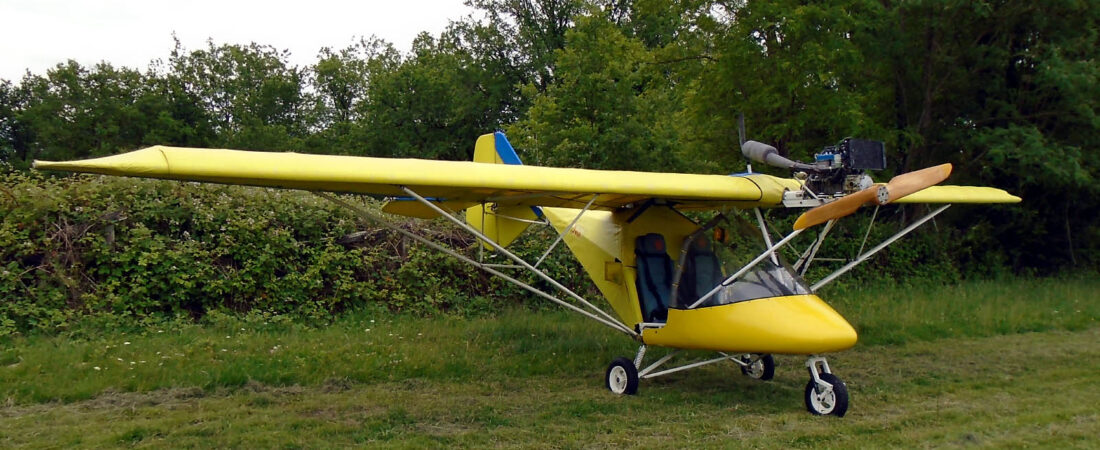


After yesterday’s little mishap I’d taken 56NE’s battery home and put it on my electronically controlled charger overnight. Wim dropped in for a cup of coffee this morning while out with Barbouse and I told him that later on I’d put it back in the aircraft, give the plugs a clean up and try the engine again.
Not surprisingly, when I removed the plugs, I found that they were still very mucky and wet after yesterday, so I cleaned and re-gapped them and gave the engine a try. It started just as usual, so I decided that I’d do the flight that I’d loaded into my new tablet GPS to give it a good test. While I’d been working there was a good layer of mist over Galinat and although it hadn’t completely disappeared and there was a still a bit floating around lower down in the valley, it was burning off pretty quickly.
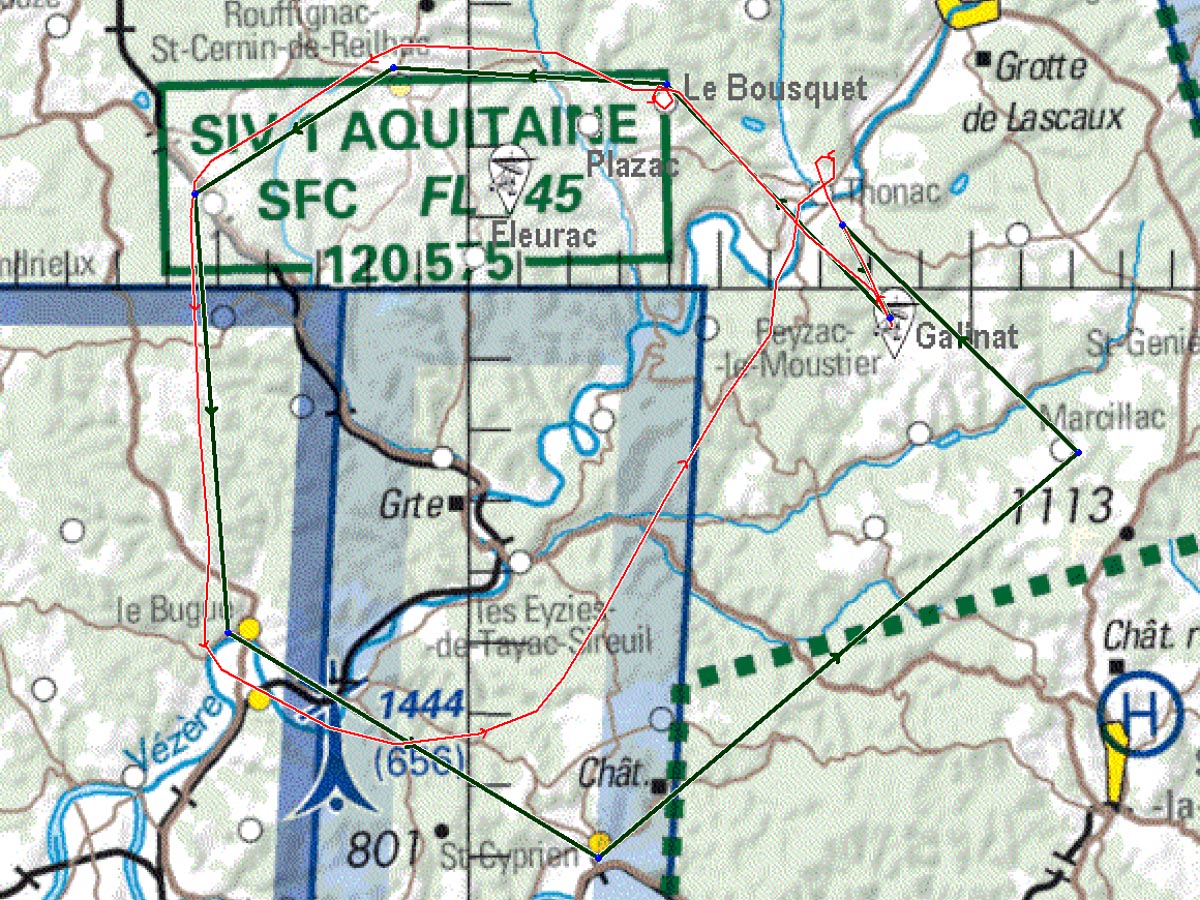
Here’s a shot showing my intended route in green and my actual track in red. As shown, I had to cut the flight short after passing Le Bugue for reasons I’ll come back to in a moment.
I allowed the engine to warm up to 70 degrees Celsius on the water temperature gauge as usual and on these cold Winter days, I think it’s even more important to do so if you want to avoid a cold seize at full revs on climb out. However, as I climbed out it didn’t quite seem to me to be developing the usual maximum revs on the rev counter and I made a mental note to see if I could find out more, if so, after the flight.
I flew across to my house and did a low circuit over it as my neighbour Benjamin was at home with his little boy, Samuel today, but as I’d been unable to tell him what time I’d be flying over I wasn’t too surprised not to see them outdoors as it was still rather cold. Then I flew across to Rouffignac before heading for St Felix and then Le Bugue.
Conditions were fantastic and wrapped up as I was, I wasn’t feeling the cold at all. As I approached Le Bugue I noticed that half of it was still blanketed in thick mist, but even more spectacularly, the valleys of the rivers Vézère, which passes through Le Bugue, and Dordogne, which is further south, were both full to the brim with mist and cloud. The valleys come together where the rivers join at Limeuil to the west of Le Bugue and where they converge can be clearly seen in the following image that I took from a video that I was shooting at the time, where the two cloud banks merge in the right of the picture (I was flying from north to south).

I flew slightly more to the west of Le Bugue than I’d originally planned, over the edge of the cloud bank and as I did so, I immediately sensed that the air above it was much colder than I’d been flying through up to then. I then turned left to head for St Cyprien, my next waypoint, and opened the throttle to climb a bit as I’d descended a few hundred feet to get the best view of the cloud bank that I could.
It was then that I found that with the throttle fully open, the engine wouldn’t manage any more than an indicated 5300 RPM when it should have been giving over 6000. My immediate thought was that I was getting some carburettor icing. When the fuel/air mixture passes through the jet of the carb into the cylinder it expands and this expansion causes it to cool quite significantly. Then, if there’s a lot of moisture in the air, as there was today, this can freeze causing deposits of ice in the carburettor inlet to the extent, if it is really serious, that fuel flow is prevented and the engine stops.
I didn’t think that this was going to happen but I had to assume that the revs I was getting were the maximum that I was going to get, so some decisions were necessary. The first one was easy – to immediately cut short the flight and head straight back to Galinat, so that’s what I did. When I flew with Wim the other day, I was using only about 5200 – 5400 RPM to fly at a similar speed as his Weedhopper so I knew that so long as my engine kept running as it was, there would be no problem getting back to Galinat. But you never know, so as there was an element of doubt and as 56NE could still climb with the revs that I was getting, I decided that although I’d be ascending into colder air, that’s what I would do.
Height gives you more options, so as I continued towards Galinat I slowly climbed until I got to 3000 feet. That was enough because by then I had Thonac in sight and could begin my descent to land at Galinat, knowing that in theory I’d only have one go at it if the engine did actually die on me. But that didn’t happen and pretty soon I was down on the ground after a very presentable landing, actually. Before packing up to go home, I naturally gave the engine another test. However, it was inconclusive because even with chocks and its brakes full on, before the engine was up to full revs, 56NE was already sliding forward in the mud.
So what have I found out since the flight? Well, for one thing, the track altitude and speed profiles from Memory Map provide some very interesting information. The average speed for the flight, including take off and landing, was 99 kmh, which is not bad even for ‘normal’ conditions. Not only that, while I was climbing after Le Bugue at no more than an indicated 5300 RPM, the GPS ground speed never fell below 110 kmh and at times was almost as high as 120 kmh, which seem extraordinarily high for that engine revs figure when there was no discernible tail wind component. So it possibly begs the question whether for some reason today, the rev counter was playing up? I can’t think why it should have been and I don’t think ‘by ear’ that the engine was doing more than the indicated reading, but it’s something that I’ll need to consider when I look into things more closely.
But there’s one thing that I do know that would have had an effect, namely that when I cleaned and re-gapped the sparking plugs, I set a gap from memory of 0.025″. This actually was far too wide – the official Rotax figure is 0.015-0.020″. Also, 56NE’s plugs were still the ones left in by the previous owners. I have done just over 25 hours with them myself and who knows what they did with them, so really they are overdue for a change. I have four new plugs which I’ll set to the correct gap and replace the old ones with and then it’ll be a fair test. I have to visit Intermarché tomorrow morning for a few provisions, so hopefully that’s a job for tomorrow afternoon.
 English
 Nederlands
 Français
 Deutsch
 Italiano
 Latviešu valoda
 Português
 Español