
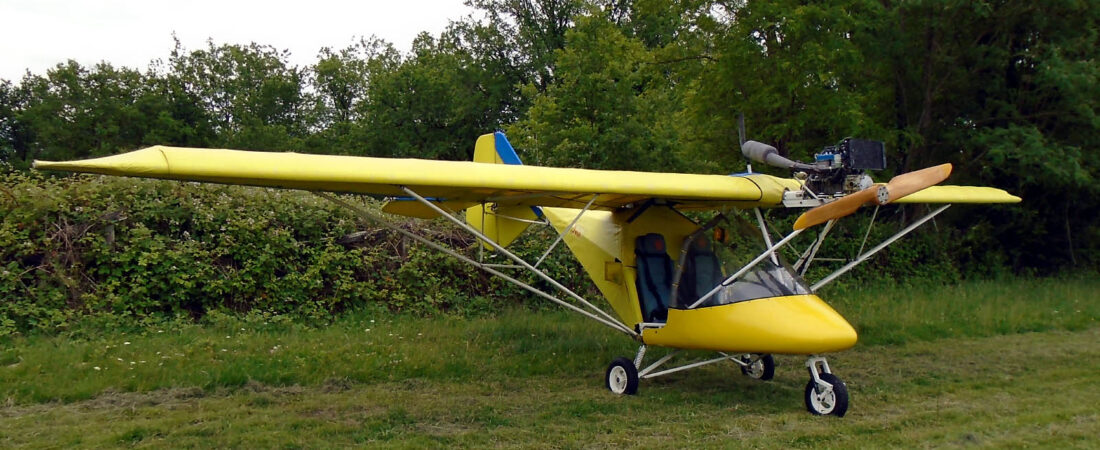


So here I am, the new year just begun and me with the best start to a new year ever. And the reason is that I’ve just bought myself a fabulous new aircraft, a brilliant STOL ICP Savannah ULM.
As I mentioned in my last post, I went off on a two-day road trip on 20th and 21st January to view two Savannahs that I’d found for sale on Le Bon Coin. The first one, the more expensive of the two, was based at l’aerodrome la Ferté Gaucher near Coulommiers to the east of Paris and the second at l’aerodrome Ploermel to the west of Rennes in Bretagne. It meant that I drove over a 1000 miles in the two days and ended up sleeping in the car overnight, but it was well worth it.
The first one was a factory built Classic model whereas the second had been built from a kit. It also turned out that although the latter was advertised as a VG (Vortex Generator) model, it had started out life as a Classic and been subsequently modified. As a factory-supplied kit is used in the conversion, this is not a problem in itself so long as the aircraft is immaculate and the work has been done well. But to my mind it made the former intrinsically more valuable than the latter, and the latter was also not immaculate and nor had the work been done that well.
Here are the details about the Classic model that I viewed first (information for the second Savannah, the VG, shown in brackets for comparison). It was built at the Savannah factory in Italy in 2001 (VG, 2002 kit built) and has a 100 HP Rotax 912 ULS engine (VG, 80 HP 912 UL). It has a Duc 3-blade ground adjustable prop (VG, 2-blade) and will cruise at around 90 kts (100 mph, 160 kmh, VG 85 kts, 95 mph, 150 kmh).
The difference in cruising speed is not that important to me as it will only be significant when I fly back to England in it, which I’ll be able to do in only around 6 hours. It has been impossible to contemplate such a flight in my X-Air, 56NE, although the tour of the west coast that I did last year with Wim demonstrated that long distances are possible in first generation ULMs just so long as you are patient and have the time.
It has only 355 airframe and engine hours on it (VG, 1650) with under 20 of those since 2013, and whereas the differences in the airframe conditions of the two aircraft were quite strikingly obvious, as I’ll go on to explain, it also showed in the relative conditions of the engines. The Classic’s engine appeared well looked after, clean and relatively shiny with more or less everything that could be, wire locked.
The VG, on the other hand, was and looked well used. Its seller said that it had been mechanically overhauled at 1600 hours, but this only included the gearbox and some peripherals and didn’t include any engine internals, which meant that its engine was at the end of its official Rotax life. The Classic has some 1200 hours to go before reaching that limit and should continue to at least double that, so will have plenty more than enough life in it for the rest of the time I’ll be flying, I’d think.
In fact, it’s well know that 912 engines run happily to 3000 hours and beyond, but that depends on how they’ve been used and maintained and the condition of the VG’s engine didn’t promote confidence in that department. What was also nice to find was that the Classic’s engine had water-heated carburettor manifolds, which are extras, to prevent carb icing, whereas the VG’s did not.
So what about the interiors? It’s a fact of life that renovating a tatty or well-used aircraft interior can work out to be pretty expensive, and the Classic scored here again. Both aircraft had the standard Savannah panel, but the Classic’s was the bright, clean, original white whereas the VG’s was a scruffy, hand painted matt black with areas worn away from heavy use. A no-brainer, then. The Classic’s also had all holes filled, whereas the VG’s had a vacant one covered up by a stick-on digital timer, which I couldn’t have lived with.
Again, this in itself wasn’t important as to get the full use out of the aircraft, I’ll need to fit a transponder that will need a hole somewhere on the panel. The obvious place is where the VG’s hole is, which is filled by the usual French Alphatec intercom in the Classic. To my mind this is an anachronism because nowadays an intercom is built into the radio interface or, as in the case of my own, into the headsets themselves if no radio is being used. I took the intercom that was in 56NE when I bought it out and threw it away!
As an added bonus, the Classic was also being sold with a Garmin GPS (that looks as though it needs a new battery), a legal (which my Vertex is not) Icom A3E radio and two brand new-looking headsets.
And finally, for the interiors, we come to the seats and belts, and yet again the Classic scored very heavily over the VG. It has gorgeous black leather upholstery that’s in used but perfect condition and matching black full-harness belts. The VG, on the other hand, had cloth trimmed seats that were not only dirty and stained in places but also somewhat tatty, and to top it all, only had lap belts, which would be illegal in the UK.
Now moving on to the exteriors. There’s not much to say about the Classic other than it appeared to be in almost perfect condition, with no dings or dents, not even any hangar rash that you generally find on aircraft of its age. This was probably because it’s spent most of its life parked in a corner as a hangar queen and hasn’t had to be moved much, either to be flown or to allow access to other aircraft. There may have been some slight hailstone damage on the upper surfaces of the wings, but I couldn’t see clearly as I’m a bit of a short-house, and if there was, I don’t think that it amounted to much.
But the same couldn’t be said of the VG. What was immediately noticeable (to me anyhow) was a large vertical crease near the port wingtip. Although the owner flew the aircraft with some vigour during our test flight, my own judgement is that the damage really needed to be repaired. There was also a dent in the leading edge of the starboard stabiliser and no paintwork under the plastic vortex generator elements where it been ground away for them to be stuck on, so these things coupled with several areas where paintwork had been worn off, ripples in the inner top surface of the port wing and several noticeable cracks in the screen that had, admittedly, been drilled to prevent them running further, meant that the overall impression of the VG was somewhat underwhelming to say the least.
So that’s about it, I think. It explains why I decided to go for the Classic rather than the VG, even though the difference in the asking prices amounted to 5,500€. This is not an insignificant amount and could be greater still as the VG owner was fairly realistic and knew that he’d have to drop his price somewhat. But in my mind, there were too many question marks over his aircraft that represented too high a level of risk (not to mention work) for my stomach, so in the event I still decided to go for the former.
I’ve made a short video about it that can be viewed by clicking on the following image.
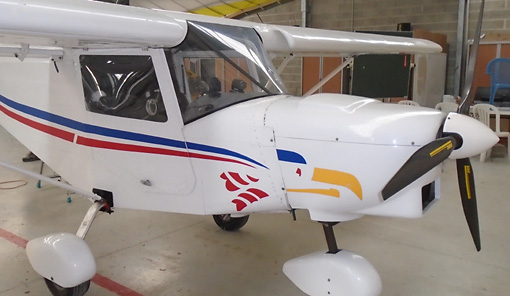
There are still some things to be sorted out, not the least of which will be getting up to la Ferté Gaucher by public transport, spending some time with an instructor that will be laid on for me by the seller, and ultimately flying the aircraft home to Galinat. I’ll also have to find some temporary cover for it at this end as it’s condition is too good for it to be left out in the open. But those things are not for now and I’ll write about them in due course.
 English
 Nederlands
 Français
 Deutsch
 Italiano
 Latviešu valoda
 Português
 Español