
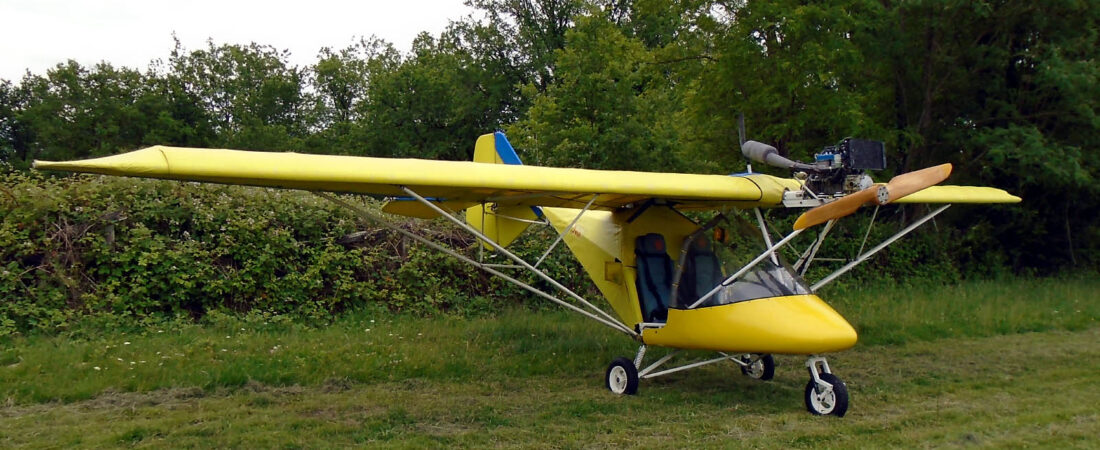


I bought 24ZN, my ‘ex-pat X-air’, off my friend who I’ll call ‘K’ in England in order to bring it to France and save it from being broken up for spare parts. ‘K’ had owned it since 2007 but shortly after acquiring it and having its engine overhauled, badly injured his arm and never got around to flying it. His brother ‘P’ did put a few hours on it but by the time I became involved, in 2019, its total hours were still very low and it had spent several years parked in a hangar under full covers without being flown at all.
British microlight aircraft are subject to an annual inspection and permit regime under the auspices of the British Microlight Aircraft Association (BMAA) which in my opinion is bureaucratic, expensive and unnecessary *. No such system exists in France and the levels of accidents and incidents are no higher here than in Britain and there are no ULMs (French microlights) falling out of the air as a result and killing children, puppies and little kittens.
Because it had been un-flown for so long, ‘K’ had been informed by an ‘inspector’ appointed by the BMAA that it would be uneconomic to get it inspected and re-permitted to fly again so ‘K’ was in a bit of a quandary. I suspect that if ‘K’ had shown a sign of going along with this assessment that the ‘inspector’ would either have made an offer for the aircraft himself or would, very conveniently, have known a third-party who would be interested in acquiring it, but at ‘scrap value’, of course, as it wasn’t airworthy and would only be fit to be broken up for parts.
And that’s when I heard about it, on one of my return visits to Britain in my Savannah. I was involved in the original purchase of the aircraft by ‘K’ back in 2007 and was impressed at the time by the condition it was in and when I rolled back the covers in 2019 my impression was that it had hardly changed. And unsurprisingly so in view of the small number of hours it had flown in the meantime and the fact that it had been stored at all times since then indoors under full covers. So I thought that the idea of breaking it for spare parts was a travesty and that’s when I offered to buy it to rescue it and bring it back to its homeland, France, where the decision as to whether it could or could not be flown again would be down to its owner and not a faceless bureaucrat or an opportunistic ‘inspector’.
And my decision was not made lightly. By doing so I would be putting myself and my life even, on the line because shortly after taking off from where the aircraft was located in Kent I would be undertaking a crossing of the English Channel. This is something not to be undertaken on a whim and without having confidence in the aircraft you’re flying in, but such was my confidence in what was to become 24ZN and in my own competence to get it into a fit state not only to do the crossing but also to complete an arduous, long day’s flight from south-east England to south-west France.
I began the restoration work in the late summer of 2019 and wanted to get 24ZN re-registered, ‘exported’ to France and actually on the other side of the Channel by the end of the autumn. But it was not to be. There were bureaucratic delays in obtaining a French registration (24ZN) due to needing to ‘prove’ the identity of the aircraft ie that it actually was the one specified on the paperwork when the kit was exported from France to be assembled in the UK back in 2002.
This I was eventually able to do, by which time the favourable UK summer weather had dissipated and the autumn was turning out to be very unsettled, both in the UK and France. In the end I had to leave the aircraft in the UK and pay for months of expensive hangarage and almost unbelievably the absence of suitable weather windows meant that it remained there until the first week of July 2020. Only then was I at last able to make the crossing to France and the flight down to the Dordogne.
There’s an amusing story that arose because this was in the middle of the Covid debacle. I found out that certain categories of traveller were exempt from movement controls and permitted to enter into the UK, one of which was ‘aircrew’. So I crossed into the UK at Dover in my car, informed Border Force that I was aircrew and was there to reposition an aircraft and had my licence at the ready. I was told that I was the first person to come up with this explanation as to why I was exempt and they very considerately motioned me out of the long queue of travellers waiting to enter the UK and opened a side gate to get me on my way, for which I was very grateful.
But now it’s time for these stories and my relationship with 24ZN to come to an end. I still have my Savannah, which is my principal aircraft, and have hardly flow 24ZN in the years that I’ve owned it. I don’t now have anything like the time to fly and maintain two aircraft and 24ZN deserves so much more than to be left in the back of a hangar. Aircraft need to be flown and if they’re not they slowly deteriorate and become like museum pieces. And they need owners who understand that and are prepared to not only fly them but to also give them the care that they deserve.
So I put 24ZN up for sale in the autumn of last year in the hope of finding such a new owner for it. It took a while and although I had several replies to the ad, it was clear that quite a few were just ‘tyre kickers’ and most of the others would not come up to the mark. Until the right one turned up and decided to buy it and a deal was signed at Christmas time. Since then 24ZN has been a ‘lady in waiting’, waiting in its hangar until it could take to air and depart for its new home in Central France.
The new owner asked if I could deliver it and naturally I agreed to. The destination is Morand (LF3759) which is a flight of between 3 and 4 hours north from Malbec. Both locations have grass runways and up to now both have been too wet to take off and land at, as is fairly normal for this time of year. But the weather is changing, both are drying out and firming up and weather windows are beginning to appear (it would have been possible to do the flight this afternoon, for example, but not without the essential planning and preparations). The new owner and I have been exchanging messages and it now looks as though it might be possible to do the flight on 5th March.
But it’s not that simple, as planning such a flight never is. Even with a slight tail-wind, the duration of the flight means that for safety reasons, just over full tanks fuel will be required, meaning that there’ll have to be a landing en-route to add fuel that I’ll need to carry with me in a jerry-can. A prime stopping point would be Le Blanc, an airfield that I landed at when bringing 24ZN down back in 2020.
The trouble is that the airfield only accepts radio-equipped aircraft and since then the old-specification radio which is still fitted in 24ZN is not now officially approved. So I’ve whizzed off a request to land at an alternative airfield, Bellac, which also has a ‘new’ frequency but does not insist that aircraft using the airfield are radio-equipped. I’ll have to see what the response is, but there are one or two other small, privately owned airfields (similar to Malbec) to turn to as possible alternatives. Otherwise it’s just a matter of waiting now for the weather window and for 24ZN’s new owner to obtain written permission for me to land at Morand.
Parting with 24ZN will be a bit ‘bitter sweet’ in view of the long relationship I’ve had with it. It’s a lovely old aircraft with a great character and although I’ll be sorry in some ways to see it go, I know that Marc, its new owner, will be the right person to take it over. Until the day to hand it over finally arrives, here are a few photographs of the old girl that I took back in the autumn of last year when I put 24ZN up for sale.


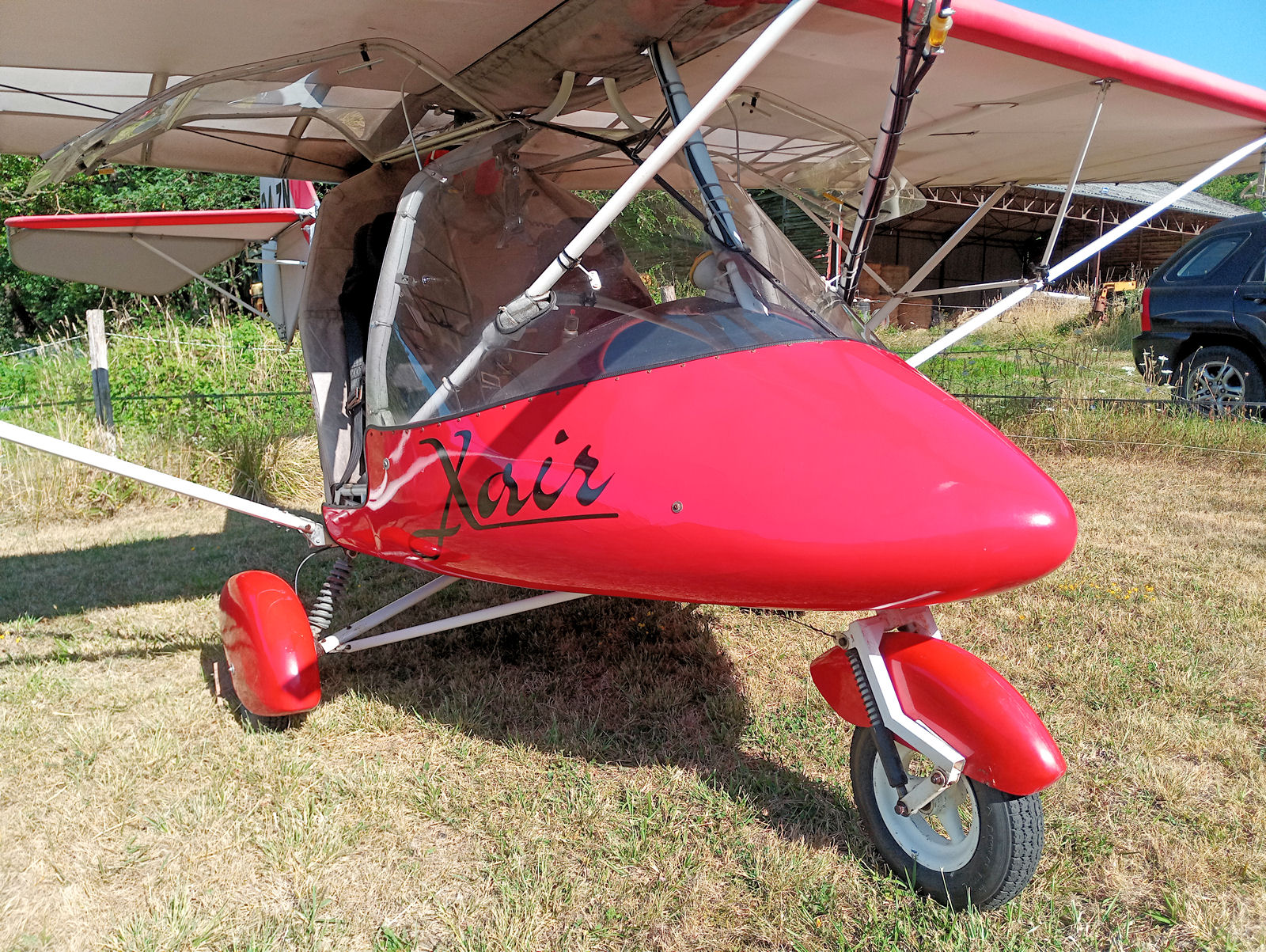
The old girl still looks as good as ever – if not in her prime, not much past it, surely 😉
* I believe that a case can be made for mandatory inspections of microlights that are used in a Public category – eg at schools and for ‘pleasure’ and ‘trial’ flights for members of the public. I also think that provision should be made available for private microlight pilots who do not have either the experience or confidence to carry out their own safety inspections of their aircraft and wish to pay for another ‘qualified’ person to do so on their behalf. However, I believe that private microlight pilots who do wish to carry out their own safety inspections should be permitted to do so subject to certain safety requirements eg placarding on their aircraft, even if they wish to carry consenting passengers as they, the pilot, will still be subject to any claim made by their passenger or their estate in the event of an accident or incident whether the BMAA has been involved or not in ‘approving’ the airworthiness of their aircraft. Having a costly BMAA inspection sticker on their aircraft will not save them from this.
 English
 Nederlands
 Français
 Deutsch
 Italiano
 Latviešu valoda
 Português
 Español