


Well, almost. This post may be of interest to other British ex-pats who do ‘D-I-Y’ things and even to anyone in the UK who is also experiencing satellite TV problems.
When I came to France over eight years ago I brought a Sky satellite kit with me that I’d never got around to installing while I was still in the UK. Even though I’ve never been a ‘TV person’, after arriving here I quickly fitted it and bought myself a new wide-screen TV so I could still watch UK TV on Freesat if I wanted to plus a collection of DVDs that I’d brought with me and also listen to UK radio (I’m a great Classic FM fan).
And it worked pretty well up until a few months ago when I noticed that my ‘HD’ channels began telling me that they had no signal and picture quality in general began playing up. Things finally came to a head a week or so ago when, after a fairly hefty storm, signal disappeared across the board. I checked everything inside and concluded that my Humax box was still working OK so then turned my attention to the satellite installation outdoors, thinking that maybe something had come loose and it had become misaligned in some way.
That wasn’t it though, and when I went up a ladder to take a look I soon found the source of the problem, as shown by the following image.
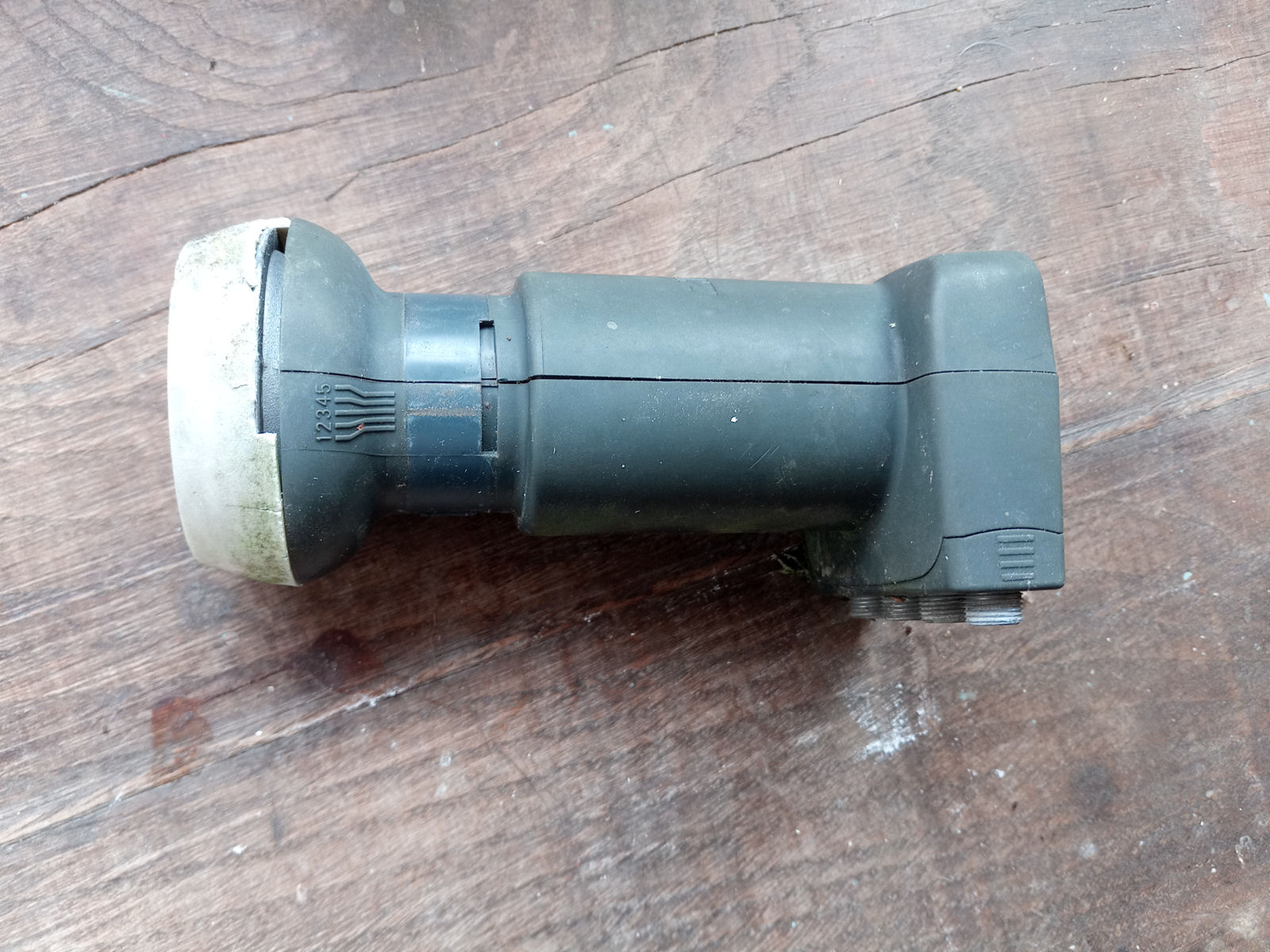
The dish receives the signal from the Astra satellite hurtling around above the earth and focuses it so it can be picked up by the receiver mounted in its centre which is called the LNB. The latter is absolutely critical as the signal received from the satellite is incredibly weak and the LNB’s role is to collect it and pass it on so it can be amplified and sent to the satellite box in the house.
It was clear that after more than eight years on a south-facing wall, not only had my dish been focusing the satellite signal onto the LNB, it had also been focusing the rays of the sun with the result that the concentrated UV had caused massive damage to the LNB itself. The main problem was that the LNB’s end cover had completely disintegrated and disappeared as shown below.

This is what an LNB should look like.

The final result was that rainwater had been allowed to enter the LNB causing shorting of its internal components, so it was no surprise that it had stopped working. The solution, therefore, was simple. Just order a new LNB, snap it into the exisiting mounting bracket, reconnect the cable and the system should be back up and running.
Whoah! Just a minute, because this is where the catch comes in that this post is all about. You find when you go to purchase the replacement LNB that all of the ‘universal’ ones have a 40 mm diameter body, so that’s what you order. Then you climb up your ladder to fit it and find that it’s a bit snug in the old mounting bracket, to say the least. However, you persist in your efforts and within a couple of seconds, the old mounting bracket that has also been affected by the UV, snaps.

And believe me, this isn’t much fun when you’re up a ladder several metres off the ground and are then faced with the job of removing the old bracket from the arm on which it’s mounted, which can only then be done with great care and brute force.
So what’s the reason for this? Well, it seems that the LNB that comes with UK Sky satellite kits IS NOT 40 mm diameter – it’s 37 mm, so a new replacement universal LNB will NEVER fit onto your Sky satellite dish. But no worries, a new universal mounting bracket will, so the lesson is this. Don’t do as I did and just order a new LNB. Order one together with a new mounting bracket because firstly the job will end up being more expensive (something like 50-60% more compared to if you order the two items rogether) but your system will be out of commission for longer and you’ll be up and down the ladder a lot more times than you’d otherwise have had to. And why do that (remember poor Rod Hull?) if you don’t need to.
 English
 Nederlands
 Français
 Deutsch
 Italiano
 Latviešu valoda
 Português
 Español